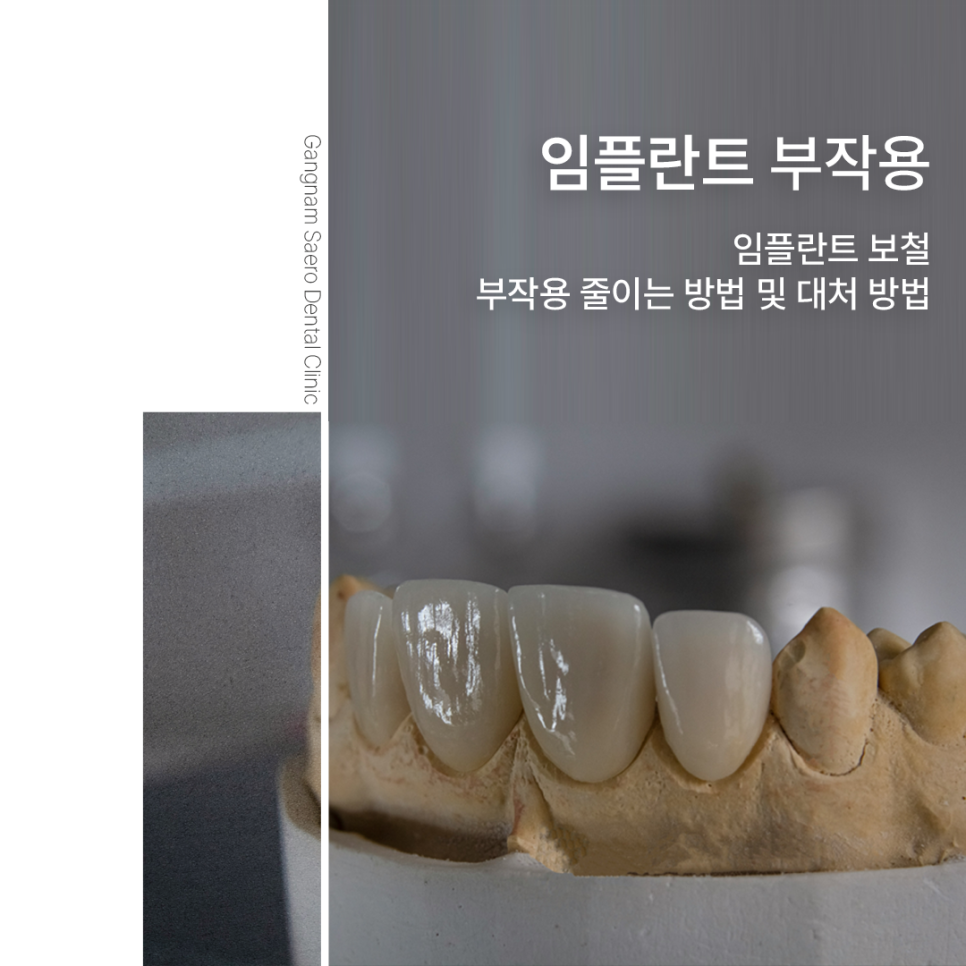
Implant Complications After Implant Surgery
Implant Prosthetics
How to Reduce and Manage Complications
These days, tooth loss is not uncommon even among younger people in their 20s and 30s. As a result, people consider not only function but also aesthetics, and naturally think of implants first. Many people find them appealing because they look similar to natural teeth and can be used relatively comfortably in daily life.
However, an implant is still a surgical procedure. It is not a light treatment that ends like a simple procedure; it involves working with the gums and bone and precisely connecting the prosthetic components to complete the treatment. Therefore, it is natural to be concerned about possible complications.
Although implants were developed to address some of the shortcomings of conventional dentures and bridge treatments, the procedure involves opening the gums and placing an artificial tooth root in the jawbone. For this reason, it is very important to carefully choose the dental clinic and medical staff from the beginning.
In my previous post, I provided an overview of implant complications by dividing them into prosthetic complications, surgical complications, and periodontal tissue damage. This time, I will take a closer look at prosthetic complications in particular.
I will explain step by step why implant prosthetic complications occur, how they can be reduced, and how to respond if a problem has already developed.
Implant Prosthetics
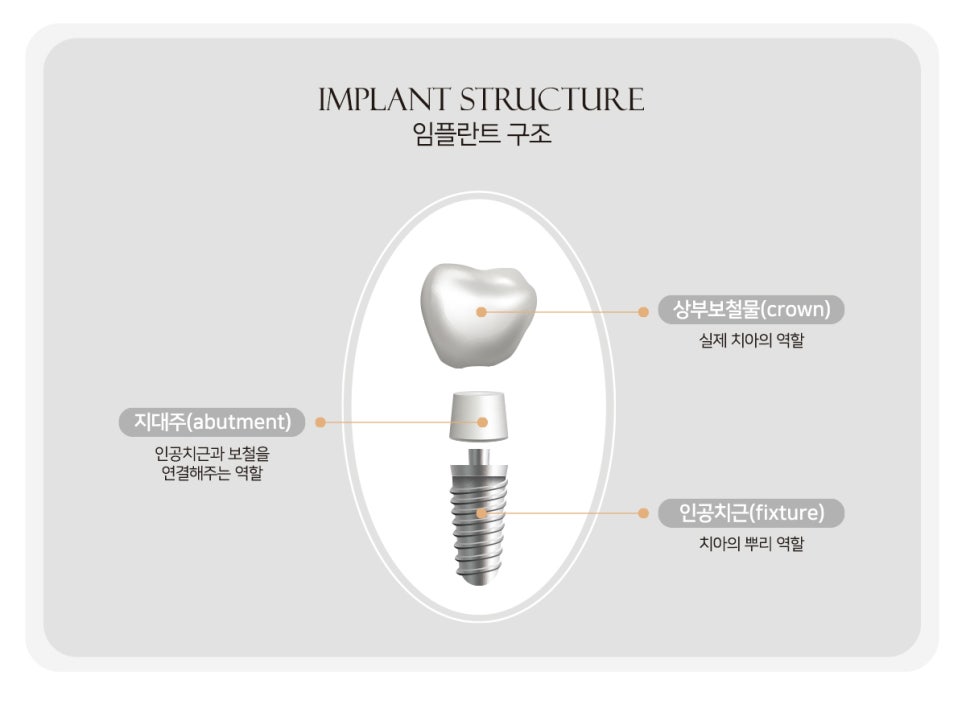
An implant is not a treatment in which just one artificial tooth is placed. Several components must be precisely connected for it to function like a single tooth.
In general, an implant consists of an artificial tooth root (fixture), which is placed in the jawbone and alveolar bone and serves as the tooth root; an upper prosthesis (crown), which serves as the visible tooth crown; and an abutment, which connects the two. A screw that firmly secures the fixture and abutment is also included.
Broadly speaking, the entire set of structures used in dental treatment can be considered part of the prosthetic system. In other words, prosthetics in implant treatment does not refer only to the visible artificial tooth; it includes all the structures connected to ensure that the tooth functions stably.
Types of Implant Prosthetics
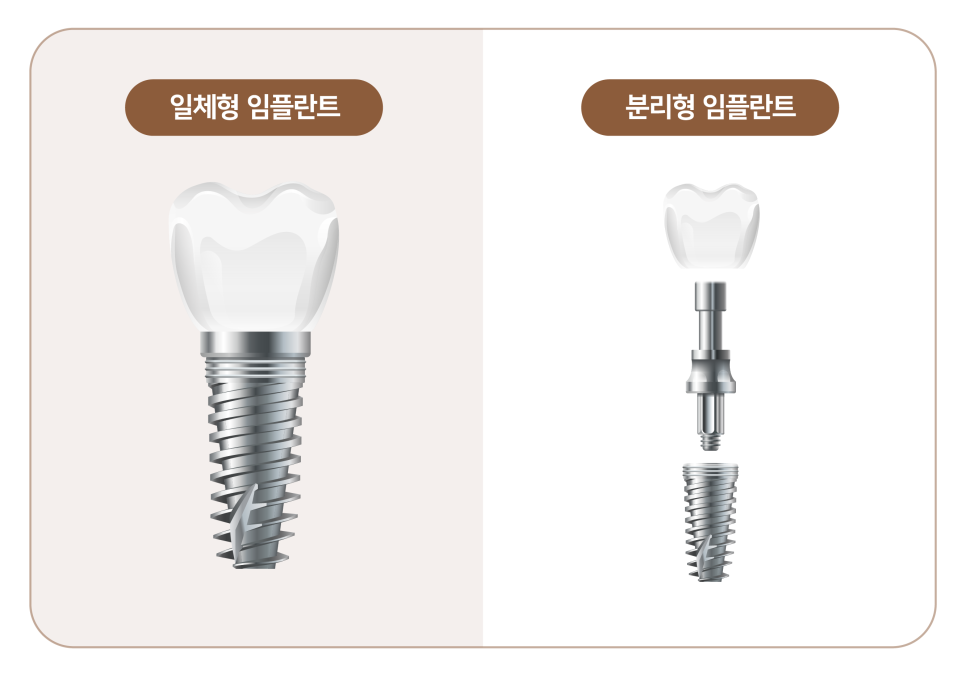
- One-Piece Implants
The type of implant we commonly think of is a two-piece implant in which the fixture, abutment, and crown are separate. In contrast, there are also one-piece implants in which the abutment and fixture are connected as a single unit.
Because there is no gap between the abutment and fixture in this design, it can reduce the space through which bacteria may enter and lower the possibility of screw loosening.
The treatment process may also be simpler, and in some cases the overall treatment period may be shorter.
However, this type is not suitable for every patient, and it may be difficult to use depending on the condition and density of the alveolar bone and the placement location.
- Abutments
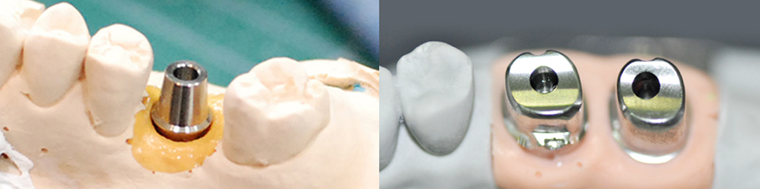
Abutments can generally be divided into prefabricated abutments and customized abutments. Prefabricated abutments are manufactured in standardized sizes, so they can be used quickly and have the advantage of relatively lower cost.
Customized abutments, on the other hand, are made to fit the patient’s oral condition. Their advantage is that they can conform more naturally to the shape of the gums and the crown.
Although the difference may seem small on the surface, the shape and fit of the abutment can affect crown stability, food impaction, and gum irritation.
- Crowns
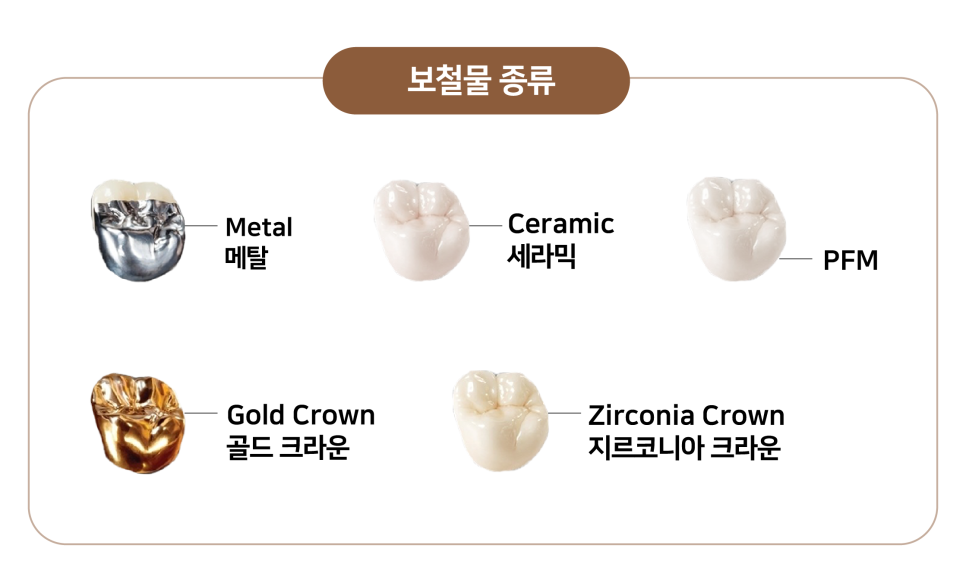
The strength, color, and recommended location of an upper prosthetic crown vary depending on the material.
Metal crowns: Resistant to breaking, but dark in color, so they are mainly used for molars
Ceramic crowns: Aesthetic, but may be vulnerable to strong impact, so they are mainly suitable for front teeth
PFM crowns: Ceramic on the outside and metal on the inside, taking both strength and aesthetics into consideration
Gold crowns: Resistant to breaking and durable, but mainly used for molars because the gold color is visible
Zirconia crowns: A material that combines strength and aesthetics and can be used in a wide range of locations
In other words, crowns should not be selected based solely on appearance. The location, chewing forces, and aesthetics must all be considered.
- Prosthetic Brands
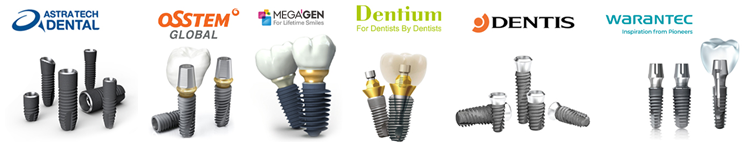
Fixtures differ in structure and design depending on the brand. Abutments are also often manufactured to match the corresponding brand. Although it is not always necessary to use the same brand, it is important to choose a structurally compatible combination when considering the fit and stability of the prosthetic components.
Complications of Implant Abutments
Choosing a prefabricated abutment has the advantages of being quick and relatively affordable. However, because it is difficult to reflect each patient’s different tooth position, gum line, and prosthetic shape, it may increase the possibility of various complications in some cases.
- Crown Dislodgement and Fracture
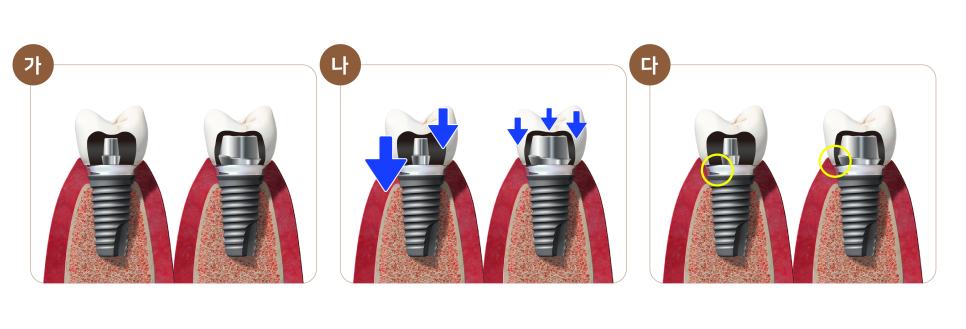
Molars and front teeth require different crown shapes, and the direction and intensity of the forces they receive also differ. If an abutment that does not sufficiently reflect these differences is used, chewing forces may not be distributed evenly, increasing the possibility that the crown will become loose or break.
In particular, areas such as molars require a thick and wide crown, as well as a stable supporting structure. If this support is insufficient, dislodgement or fracture may occur more easily.
- Inflammation
The height and contour of the gums differ from patient to patient. If an abutment that does not fit precisely is used, a tiny gap may form between the gums and the crown. This gap can become a space where food debris and bacteria easily remain, potentially leading over time to peri-implantitis or gum inflammation.
In addition, if occlusal forces are not distributed evenly, repeated stimulation may accumulate in a specific area of the gums, increasing the possibility of inflammation.
- Screw Loosening
During chewing, the jaw does not move only up and down. Slight rotation and lateral forces also act on it. When this stimulation is repeated, the screw connecting the abutment and fixture may gradually loosen.
In some respects, screw loosening can be a sign that helps prevent more serious damage. However, if the loosened condition goes unnoticed and the implant continues to be used, not only the crown but also the internal structure may be damaged.
Preventing and Managing Abutment Complications
To reduce abutment complications, it is advantageous, whenever possible, to choose a customized abutment rather than a prefabricated product. Since a customized abutment can be adjusted in width, height, and thickness to match the patient’s gum shape and prosthetic area, it can help distribute chewing forces more stably and reduce food impaction, bacterial penetration, and gum irritation.
If problems such as screw loosening, inflammation, or a loose prosthesis occur, do not put off visiting the dental clinic again. In particular, when a screw has loosened, internal damage may progress even if the outside appears normal, so prompt examination and action are necessary.
Complications of Implant Crowns
Crown complications can be broadly divided into dislodgement and fracture. They may appear simply as a tooth coming out or breaking, but caution is necessary because the causes can vary and leaving the problem untreated may affect other components as well.
- Abutment Problems
As mentioned above, if the abutment was made without properly matching the shape of the gums and crown, or if the screw has loosened and structural stability has decreased, the effects may appear first in the crown.
- Inadequate Fabrication Fit
If the inside of the crown is loose or the contact with the abutment is insufficient, the crown is more likely to become loose or come off over time.
- Reduced Retention
Implant crowns often use a dedicated retention method that differs from that used for natural-tooth crowns to facilitate maintenance. For this reason, the retention may weaken over time or when excessive force is applied, causing the crown to come off.
Preventing and Managing Implant Crown Complications
To reduce crown complications, it is most important to avoid applying excessive force. Be as careful as possible with hard or chewy foods, and if you grind your teeth, consider an auxiliary device such as a mouthguard.
The choice of material is also important. If a material that is too weak for the location and your usage habits is selected, the possibility of fracture may increase, so the decision should take into account the balance between strength and aesthetics.
If the crown comes off or breaks, do not continue using it for a long time in that condition; visit the dental clinic promptly. This is because if the abutment and fixture are also subjected to stress, the problem may go beyond the crown and lead to more extensive repair or repeat surgery.
Complications of Implant Fixtures
The fixture is a structure placed directly in the jawbone and alveolar bone. Because it is the core component that supports the implant from the deepest location, any problem should not be taken lightly.
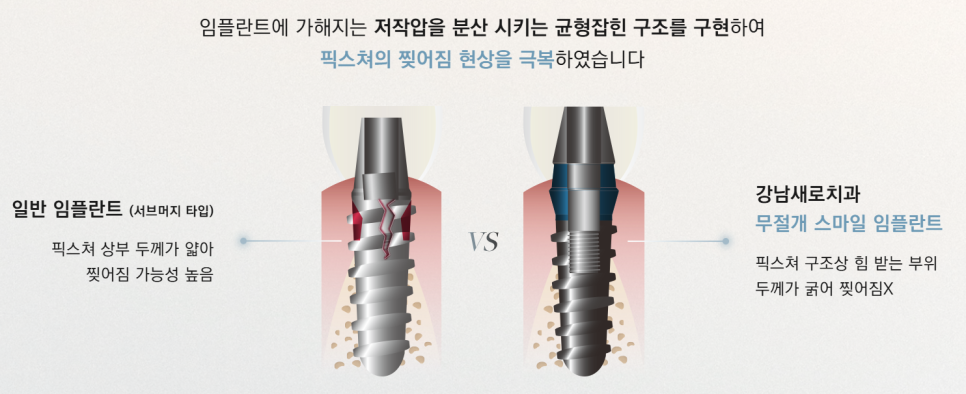
- Fixture Damage
If problems repeatedly occur in the abutment and crown areas and the resulting stress accumulates over a long period, the fixture at the bottom may eventually also be overloaded. In such cases, the fixture itself may become damaged.
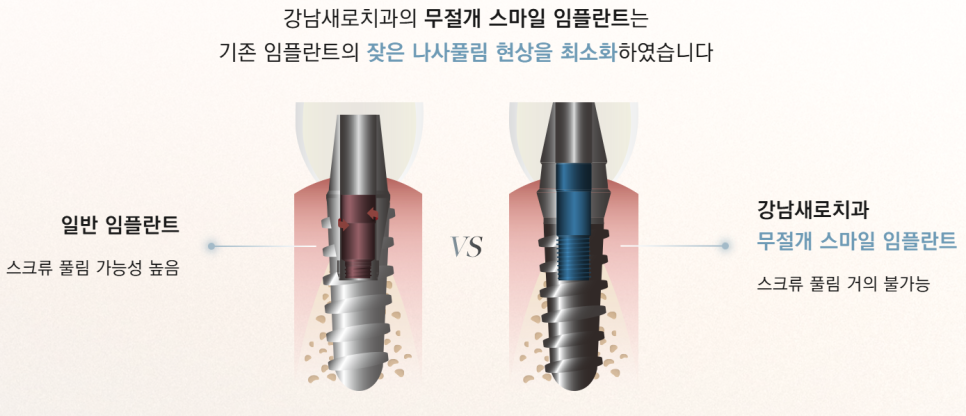
- Failure of Fixation
After the fixture is placed in the bone, it must become firmly secured through osseointegration. However, if the condition of the bone was not sufficiently assessed before placement or the surgery was performed under excessive strain, osseointegration may not occur properly, resulting in fixation failure.
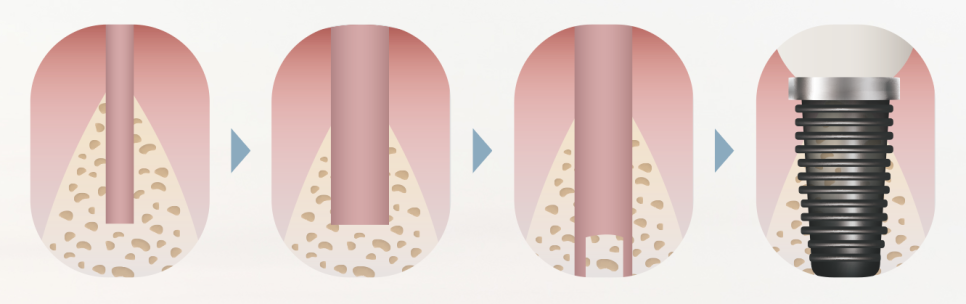
- Problems with Length and Direction
If the fixture length does not match the patient’s bone condition or the placement direction is tilted, it may not receive chewing forces vertically. Abnormal forces may then be transferred to the surrounding bone, eventually leading to problems such as alveolar bone resorption.
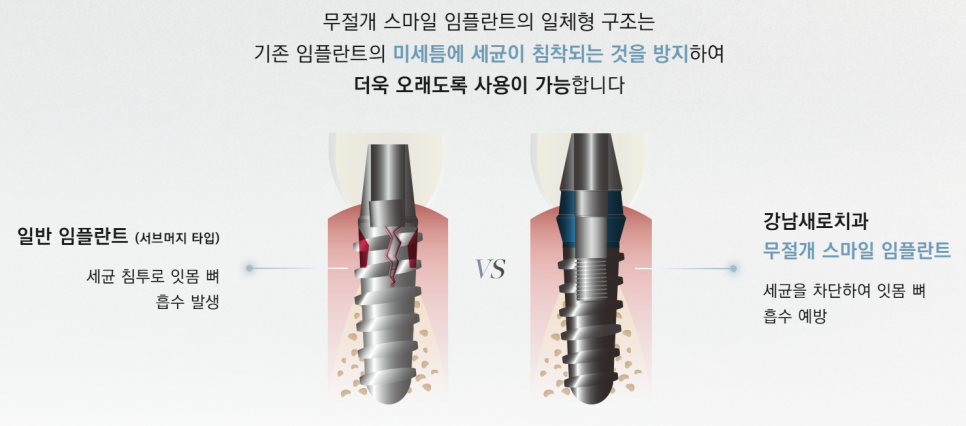
- Compatibility Problems
Fixtures have different design structures depending on the brand. Even if they look similar, forcibly connecting an abutment from another company may create a gap inside because of slight discrepancies. If blood, saliva, or bacteria enter through this gap, the risk of inflammation and repeat surgery may increase.
- Nerve Damage
Although rare, nerve damage may occur if the fixture is placed excessively deep or if the location of the nerve was not sufficiently identified before surgery.
Preventing and Managing Fixture Complications
To reduce fixture-related problems, it is very important to use genuine products and select structurally compatible components. It is best to avoid forcibly using third-party products or unverified compatible components whenever possible.
It is also important to visit the dental clinic as soon as you notice an abnormality in the abutment or crown. Resolving a problem in the upper structure early can prevent stress from being transferred to the fixture below.
If a problem has already developed with the fixture, do not delay any further; the exact cause must be identified. The most important thing is to receive a thorough diagnosis to determine whether the problem can be resolved through simple adjustment, whether replacement placement is necessary, or whether another technical issue was involved.
Preventing and Managing Implant Prosthetic Complications

Ultimately, the most reliable way to prevent implant complications is to choose a good dental clinic from the outset. It is a serious mistake to assume that all clinics are the same simply because their surgical methods are similar.
The medical team’s experience, diagnostic ability to assess the patient’s condition, precision in using advanced equipment,
The quality of prosthetic fabrication and the aftercare system can all change the outcome.
What You Can Experience at Gangnam Saero Dental Clinic
- Extensive Surgical and Repeat-Surgery Experience of a Prosthodontic Specialist
Based on experience with numerous cases, the clinic has the technical expertise to reduce the possibility of prosthetic complications.
- Advanced Digital Diagnostic System
The patient’s oral condition is examined in greater detail using three-dimensional precision analysis equipment, 3D-CT, and an intraoral scanner.
- Precision Prosthetic Fabrication Using the Latest Robotic Manufacturing System
Customized prosthetics tailored to the patient’s condition are manufactured precisely to help reduce the possibility of loosening, breakage, and inflammation.
Gangnam Saero Dental Clinic
does not simply end treatment by placing an implant;
it carefully plans and provides treatment from the beginning
so that the implant can be maintained comfortably afterward as well.
A new smile, a new beginning, a fresh start.
If you want to ease your concerns about implant complications,
consider starting at Gangnam Saero Dental Clinic.
- This post was presented by a medical institution under a third-party contractual relationship and partially utilized AI.