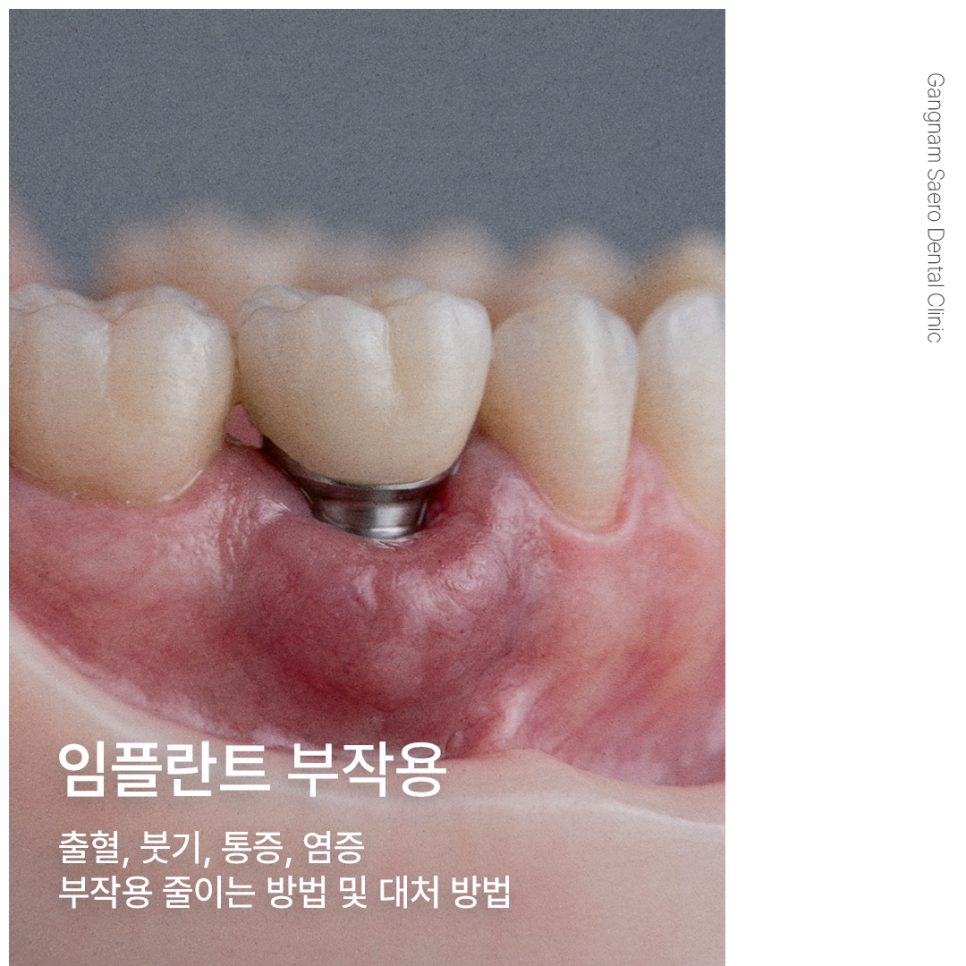
Implant Side Effects After Implant Surgery
Surgical Bleeding, Swelling, Pain, and Inflammation
How to Reduce and Manage Side Effects
As standards of beauty become increasingly refined, even when deciding to undergo surgery for treatment, people now consider not only function but also aesthetics. This trend applies not only to general surgery but also to dental treatment. Representative treatment options after losing a tooth include dentures, bridges, and implants.
Among these, when it comes to the treatment that offers the most natural appearance and the highest aesthetic satisfaction, many people think of implants first.
Dentures have the advantage of being quick to make and removable, but over time they can place stress on the jawbone and even lead to changes in the contours of the face. With bridges, the need to remove the surrounding natural teeth is always a drawback. For this reason, many people ultimately choose implant surgery.
In its previous post, Gangnam Saero Dental Clinic provided an overall summary of implant side effects and first examined prosthetic complications in detail. This time, we will take a closer look at the next topic: side effects of implant surgery.
We will carefully go through, one by one, what problems may occur after implant surgery, how to reduce the possibility of these problems, and what to do if discomfort has already developed.
Implant Surgery
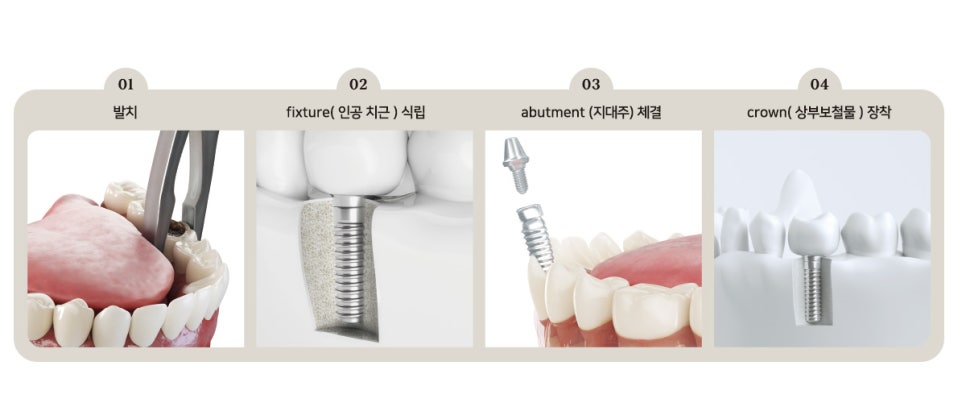
To properly understand the side effects of implant surgery, it is helpful to first review what implant treatment involves.
Implant surgery is a treatment in which an artificial tooth root is placed and firmly secured in the gum and jawbone where a tooth has been lost, after which an abutment and an upper prosthesis are connected to replace the natural tooth.
Unlike dentures, implants are not removed and inserted. Unlike bridges, they do not involve shaving down the teeth on both sides to connect them. The procedure involves opening the gums and working with the bone, and because placement itself has a surgical nature, it is an area of dental treatment that requires a more cautious approach.
Therefore, just as with other surgeries, postoperative reactions or side effects such as bleeding, swelling, pain, and inflammation may occur, and there are also precautions that must be followed during recovery.
Bleeding After Implant Surgery
One of the first reactions that comes to mind after implant surgery is bleeding.
A small amount of blood mixed with saliva immediately after surgery can generally be considered a relatively natural part of the process. This may occur during the first 12 to 24 hours, which is why patients are instructed to bite down on gauze immediately after surgery.
The reason for keeping the gauze in place for a certain period is to apply pressure to the wound and help stop the bleeding. Bleeding during this period is not necessarily a sign that the surgery went wrong; it can be viewed as part of the body’s process of beginning to heal itself.
However, if the bleeding does not stop and continues heavily, or if it does not decrease over time, you should not dismiss it as a simple reaction. It is advisable to contact the clinic immediately.
Swelling After Implant Surgery
The second most common reaction is swelling.
Because the gums are incised and the tissue is stimulated, swelling can be considered a natural recovery response. To repair tissue damaged by surgery, the body increases blood flow and initiates various healing responses. During this process, the blood vessels expand and fluid gathers in the surrounding tissue, causing swelling. If you have experienced facial swelling after having a wisdom tooth removed, it may be easy to understand as a similar process.
Swelling is usually most noticeable within one or two days after surgery and may continue for approximately 48 to 72 hours, depending on the patient’s condition.
There is generally no need for significant concern if it gradually subsides over time. However, if the swelling continues to worsen or is accompanied by a feeling of heat and severe pain, the possibility of inflammation should also be checked.
Pain After Implant Surgery
Pain after surgery is also a concern for many people.
Since implants involve working with the gums and bone, it is not unusual for some pain to occur once the anesthesia wears off. Although you may not feel much discomfort during surgery because of the anesthesia, pain may increase as time passes after the procedure. For this reason, taking the prescribed pain medication before the anesthesia has completely worn off is usually helpful. In many cases, the pain gradually decreases over time and remains within a range that can be adequately controlled with medication.
However, if the pain continues to worsen after several days or is severe enough to make it difficult to sleep, there may be another underlying cause rather than ordinary postoperative pain.
Inflammation After Implant Surgery
Inflammation is the side effect of implant surgery that requires the closest attention.
A representative example is peri-implantitis. Inflammation that develops around a natural tooth is called periodontitis, while inflammation around an implant can be considered peri-implantitis. This problem generally begins when plaque and tartar are not properly removed and bacteria multiply. When peri-implantitis develops,
there may be bleeding from the gums or visible pus, an unpleasant odor, increased swelling and pain, and in some cases even a sensation that the implant is loose.
If these symptoms are left untreated for a long time, it may eventually become difficult to maintain the placed implant, increasing the possibility that revision surgery will be necessary.
Therefore, it is especially important to detect inflammation early and respond promptly.
Precautions After Implant Surgery
To reduce implant side effects, postoperative care is as important as the surgery itself. Even when surgery has gone well, problems can worsen if the recovery period is neglected.
- What to do immediately after surgery
On the first day after surgery, it is advisable to eat soft foods. Avoid hot foods and drinks, as they may cause irritation, and when chewing, try to use the opposite side rather than the surgical area whenever possible. It is safer to avoid hard or chewy foods for the time being. Take the prescribed medication as instructed, and avoid hot environments such as saunas and Korean-style heated rooms for approximately two to three days after surgery. It is also helpful for recovery to take a break from strenuous exercise for about a week.
2, When can you smoke after an implant?
Smoking can negatively affect recovery after surgery. Smoking creates suction in the mouth, and this force can place stress on the incision, worsening bleeding or pain. In addition, the substances in cigarettes can reduce blood flow and interfere with the bonding of the jawbone and implant, which may slow recovery. For this reason, many clinics recommend abstaining from smoking for at least one week, or for about a month if possible. If the surgery becomes an opportunity to quit smoking altogether, that would be an even better direction.
- When can you drink alcohol after an implant?
Alcohol can also interfere with recovery. It can dilate blood vessels, make bleeding and swelling worse, and may contribute to a worsening inflammatory response. Therefore, it is advisable to avoid alcohol for at least one week after surgery, and preferably even longer.
- Oral hygiene after surgery
On the day of surgery, it is advisable to care for your mouth using the prescribed mouthwash or the method you were instructed to follow, rather than brushing vigorously. From the following day onward, continue caring for your mouth gently without causing excessive irritation, while taking care around the surgical site. Avoid using an electric toothbrush for the time being and brush carefully with a soft toothbrush. Once the implant has settled, more thorough hygiene is needed to prevent plaque and tartar from accumulating. Dental floss and interdental brushes may also be helpful.
- Postoperative care habits
Because care at home alone has limitations, regular checkups and professional cleanings are also essential. It is generally advisable to have a checkup every six months to one year to assess the condition of the gums and the area around the implant together.
Prevention and Management of Implant Surgery Side Effects
The most reliable way to minimize the possibility of side effects from implant surgery and respond quickly if discomfort develops is ultimately to choose the clinic carefully from the beginning. A clinic that communicates sufficiently with patients and carefully assesses their usual habits, systemic diseases, and the condition of the jawbone and gums before selecting a suitable surgical method can greatly reduce the risks of bleeding, swelling, pain, and inflammation. Implant treatment does not produce the same result simply because the surgery follows the same sequence. The diagnosis made, the surgical method used, and the way postoperative care is provided determine actual satisfaction.
Systems Available at Gangnam Saero Dental Clinic
- If you are afraid of the surgical process, IV sedation is available
Conscious sedation is used to help patients undergo surgery more comfortably.
- If you are concerned about pain after surgery, a three-day continuous pain-relief infusion is available
This option is considered to help reduce discomfort from immediately after surgery through the recovery process.
- If you are concerned about the injection itself, topical anesthesia is available
The clinic takes a careful approach from the stage before the injection to help reduce the patient’s tension and discomfort.
Gangnam Saero Dental Clinic carefully designs its treatment process so that patients can undergo surgery more comfortably and recover more steadily, rather than simply completing the procedure as quickly as possible. If you have any questions, please consult the clinic at any time.
A new smile, a new beginning, a new start.
We will help ease your concerns
about implant side effects
at Gangnam Saero Dental Clinic.
- This post is a medical-information article presented by a medical institution under a third-party contractual relationship and was partially created using AI.