Orthodontics and Pronunciation
If You Are Preparing to Become a Celebrity or News Anchor
Recommended Orthodontic Methods
When your teeth are crooked,
your eyes keep being drawn to them
both when you smile and when you speak.
For aspiring celebrities or news anchors,
who need to speak and smile more than others,
this concern can inevitably feel much greater.
Even so, it is not easy to start orthodontic treatment right away.
That is because pronunciation is one of the biggest concerns.
You may have heard at least once that someone's pronunciation became awkward after orthodontic treatment.
Even when looking around at people I know,
it can seem that quite a few of those whose pronunciation is particularly slow to improve
have undergone orthodontic treatment.
So it can leave you feeling conflicted.
You do not want to leave your crooked teeth as they are,
but you hesitate because you are worried that orthodontic treatment might make speaking uncomfortable as well.
So what should you do?
From now on, we will organize the relationship between orthodontic treatment and pronunciation,
as well as ways to improve your appearance while minimizing orthodontic pronunciation problems as much as possible!!!
✿Checklist✿ Why Can Orthodontic Treatment Worsen Pronunciation?
First, we need to consider why pronunciation becomes uncomfortable after orthodontic treatment,
don't we?!
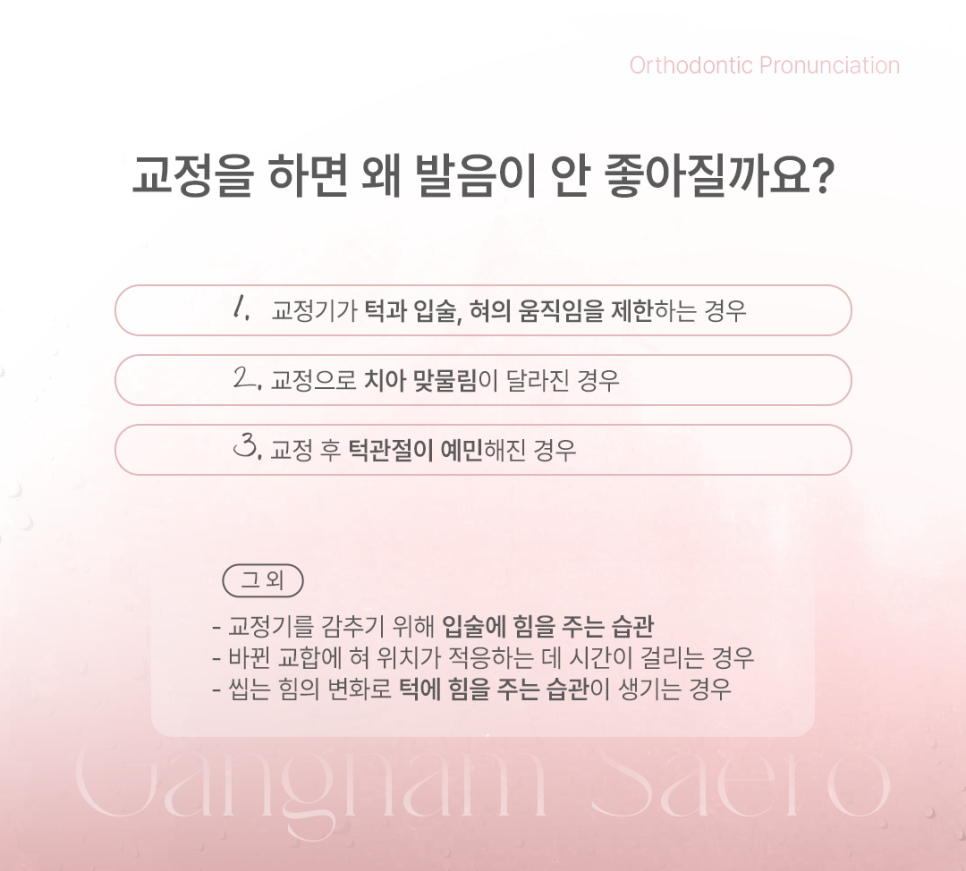
First. When orthodontic appliances restrict the movement of the jaw, lips, and tongue
When practicing pronunciation,
people often say that you should move your jaw, lips, and tongue widely.
In fact, for clear pronunciation,
it is important to use the structures inside the mouth naturally and freely.
But what happens when you move your jaw and lips widely while wearing wire braces?
The inside of the lips can be rubbed by the wires and become injured,
and with lingual braces, discomfort can occur whenever the tongue touches them.
When this irritation is repeated,
you may unknowingly open your mouth less,
move your tongue less,
and develop habits intended to get through pronunciation without discomfort.
The problem is that this may not end as temporary discomfort
but can gradually become ingrained as a speaking habit.
Second. When the way the teeth meet changes due to orthodontic treatment
Orthodontic treatment moves the teeth.
As the alignment changes and the bite adjusts,
the path through which air escapes inside the mouth
or the position where the tongue touches may differ from before.
Especially when tiny gaps form between the teeth
or while you are still adjusting to changes in the bite,
your pronunciation may feel breathy or blurred.
These changes can temporarily appear during the intermediate stages while the teeth are moving.
Third. When the temporomandibular joint becomes sensitive after orthodontic treatment
The temporomandibular joint
is continually used
when opening and closing the mouth,
chewing,
and speaking.
If the joint becomes sensitive during orthodontic treatment
or an existing temporomandibular joint problem becomes apparent,
the range of mouth opening may decrease
and jaw movement may become unnatural while speaking.
As a result, pronunciation may sound unclear or constricted.
There are other factors as well
The habit of tensing the lips to hide the orthodontic appliance
Cases where the tongue takes time to adapt to its position with the changed bite
The development of a habit of tensing the jaw due to changes in chewing force
As you can see, pronunciation problems cannot be explained simply
by one reason: that the appliance makes it difficult to speak.
Several factors may overlap and work together!!!
✿Checklist✿ Can Orthodontic Treatment Actually Improve Pronunciation?
That said,
not all orthodontic treatment worsens pronunciation.
In fact, there are cases where pronunciation becomes
clearer through orthodontic treatment.
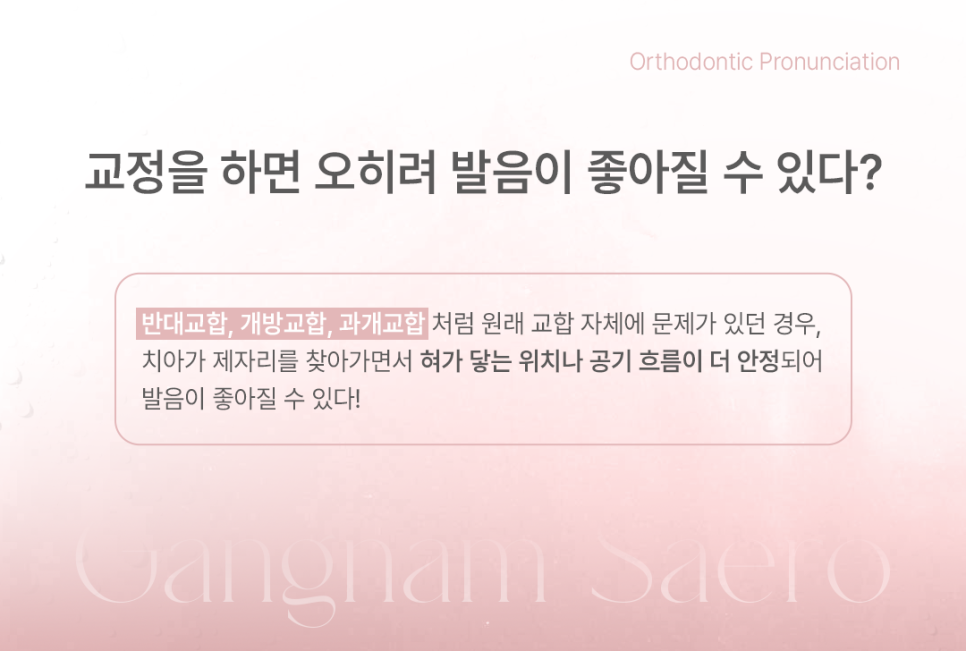
Typically,
when there was already a problem with the bite itself,
such as an underbite, open bite, or deep bite,
pronunciation may improve as the teeth move into their proper positions
and the tongue's contact position and airflow become more stable.
In other words, it cannot be concluded that orthodontic pronunciation problems will inevitably occur.
For some people,
orthodontic treatment may instead help reduce pronunciation problems!
What matters is the condition of your bite and tooth alignment,
as well as how the orthodontic treatment is carried out.
✿Checklist✿ Recommended Methods for Orthodontics and Pronunciation
Then,
what kind of orthodontic treatment should people who are worried about pronunciation consider starting?
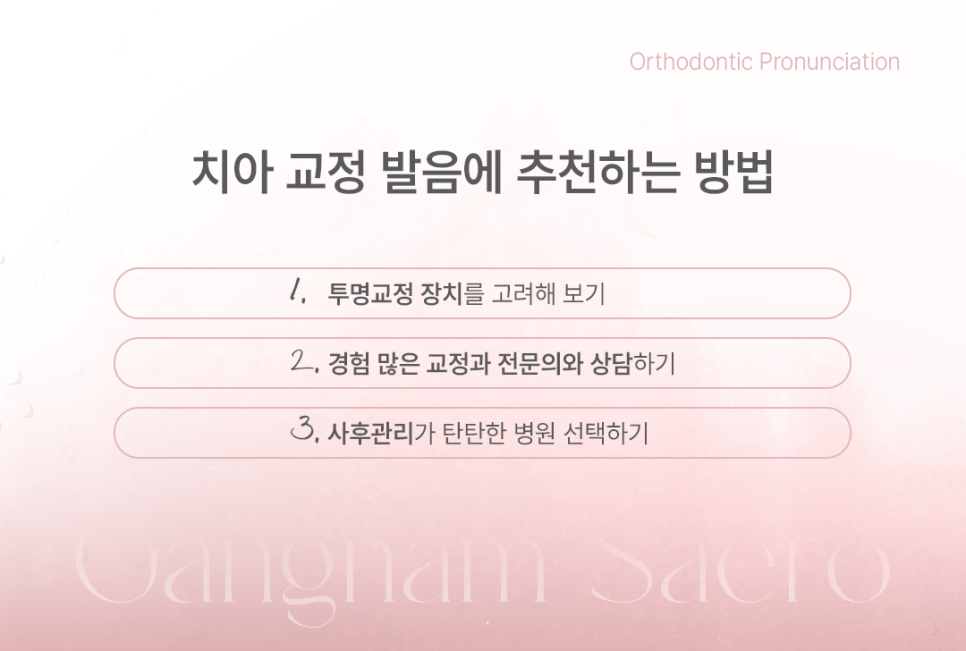
First. Consider clear aligners
If one of the main reasons pronunciation becomes unclear is
irritation that causes injuries to the lips and tongue
and the resulting restriction of movement,
clear aligners may be much more comfortable than wire braces.
Because clear aligners do not have protruding structures like wires or brackets,
the inside of the lips is less likely to be rubbed
and there is relatively less irritation when the tongue touches them.
This can also reduce the burden when moving your mouth,
and may somewhat lessen the feeling of having a foreign object while speaking.
You may be concerned that clear aligners might not provide sufficient orthodontic results,
but these days their range of use has expanded enough to treat various types of malocclusion.
Second. Consult an experienced orthodontic specialist
Not all dental professionals provide the same type of care.
Even within dentistry, fields are divided into areas such as conservative dentistry, prosthodontics, oral and maxillofacial surgery, and orthodontics.
If you are considering orthodontic treatment, it would naturally be a good idea to look for a specialist in orthodontics.
(Of course, even a non-specialist may achieve sufficiently good results depending on their level of experience!!!)
However, there is one more thing to consider.
Even among orthodontic specialists,
results can differ depending on how many and what types of cases they have handled.
Especially for people in professions where pronunciation is important
or for those who speak frequently,
experience in taking a meticulous approach that considers not only straightening the teeth
but also the bite, tongue position, and pronunciation habits is important.
Third. Choose a clinic with thorough aftercare
Orthodontic treatment does not end simply by wearing an appliance.
In fact, after the appliance-wearing period ends,
how stably the alignment and bite are finalized may be even more important.
The problem is that some clinics sometimes explain treatment as if it ends
the moment the orthodontic appliance is removed.
In reality,
the finishing stage may require adjustments to a slightly misaligned bite
or areas of discomfort.
Therefore, before starting orthodontic treatment,
it is a good idea to be sure to check
whether treatment ends when the appliance is removed,
how insufficient aspects will be adjusted after treatment,
and whether there is a plan for additional adjustments or maintenance!
✿Checklist✿ A Dental Clinic Recommended for Orthodontics and Pronunciation
That is why there is one point we can discuss with greater confidence.
Gangnam Saero Dental Clinic
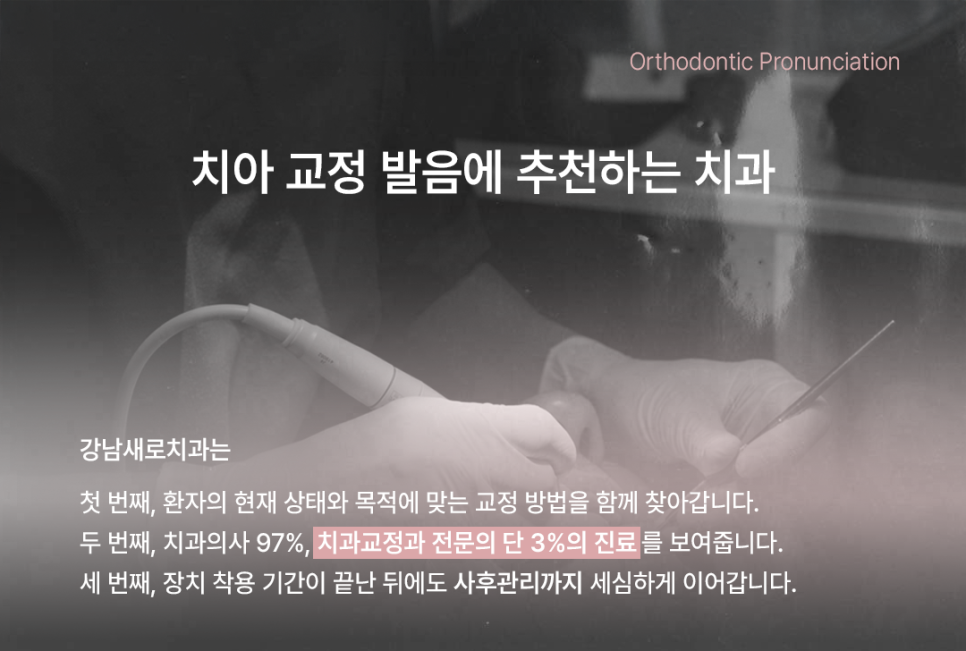
places importance on communication with patients,
so rather than recommending only one type of appliance,
it works with patients to find an orthodontic method suited to their current condition and goals.
In particular, among dental clinics near Gangnam Station,
it offers a wide range of clear aligner systems,
allowing it to suggest options more flexibly according to each person's dental condition.
In addition, while 97% of dentists are dentists and only 3% are orthodontic specialists,
Gangnam Saero Dental Clinic
has an orthodontic specialist personally provide treatment,
making customized care possible that considers not only alignment and the bite
but also pronunciation and aesthetics.
For those preparing for professions that involve speaking or being seen,
this difference in experience is by no means insignificant.
In addition,
even after the appliance-wearing period ends,
it continues to provide attentive aftercare,
including making additional adjustments to areas where the bite is insufficient.
Starting orthodontic treatment is important,
but how solidly it is completed is truly important as well.
✿Checklist✿ What Types of Clear Aligners Are Available?
For aspiring celebrities and news anchors,
who speak frequently and often appear in front of people,
clear aligners are certainly an appealing option.
The biggest reason is
that the fact you are undergoing orthodontic treatment is barely visible from the outside.
Clear aligner systems also have somewhat different features depending on the brand:
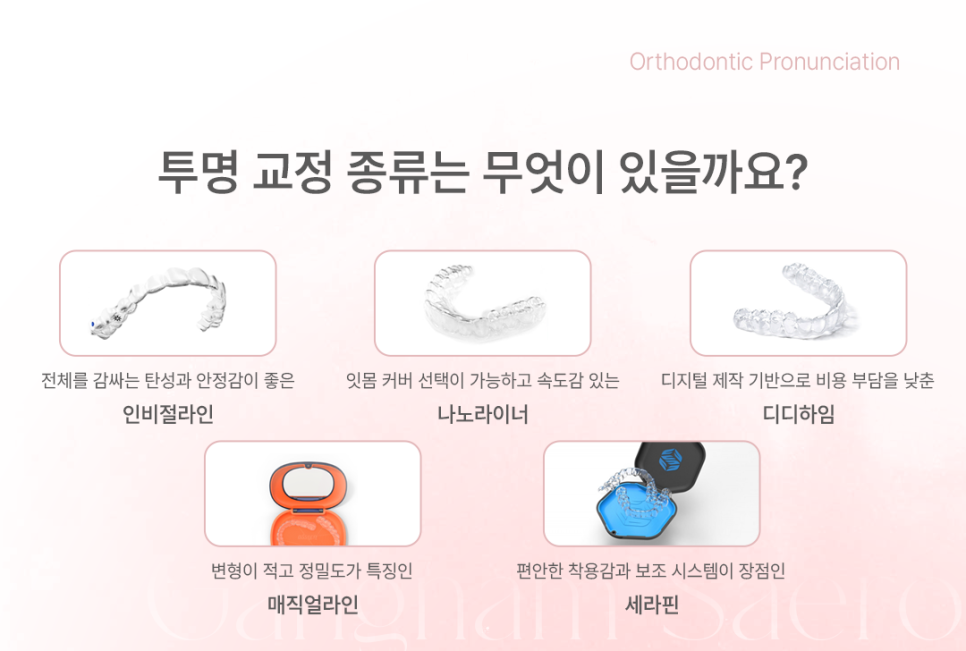
Invisalign, with good elasticity and stability while covering the entire area
Nanoliner, which allows a gum-covering option and offers a faster treatment pace
Didiheim, which reduces the financial burden through digital manufacturing
Magic Align, known for minimal deformation and precision
Serafin, whose advantages include comfortable wear and an auxiliary system
Because each appliance has different characteristics,
it is important to choose the one that suits you according to your tooth alignment, lifestyle, and desired direction!
And being able to compare these various appliances in one place
and receive a consultation tailored to your condition can make a bigger difference than you might expect!!!
✿Checklist✿ Orthodontic Treatment Without Giving Up Pronunciation or Your Smile
The reason you are considering orthodontic treatment
is probably not simply that you want to straighten your teeth.
You may also want to smile more naturally,
feel confident when speaking,
and use your face and voice a little more comfortably.
Just because you are worried about pronunciation
does not mean you need to continue living with crooked teeth.
What matters is
which appliance you choose,
who provides your care,
and how attentively you are managed even after treatment!
A new smile, a new departure, a new beginning
Gangnam Saero Dental Clinic is here with you.
Orthodontic treatment chosen even by famous celebrities,
with pronunciation problems reduced as much as possible—
start here now!
- This post was presented by a medical institution under a third-party contractual relationship and contains medical information; AI was used in part.