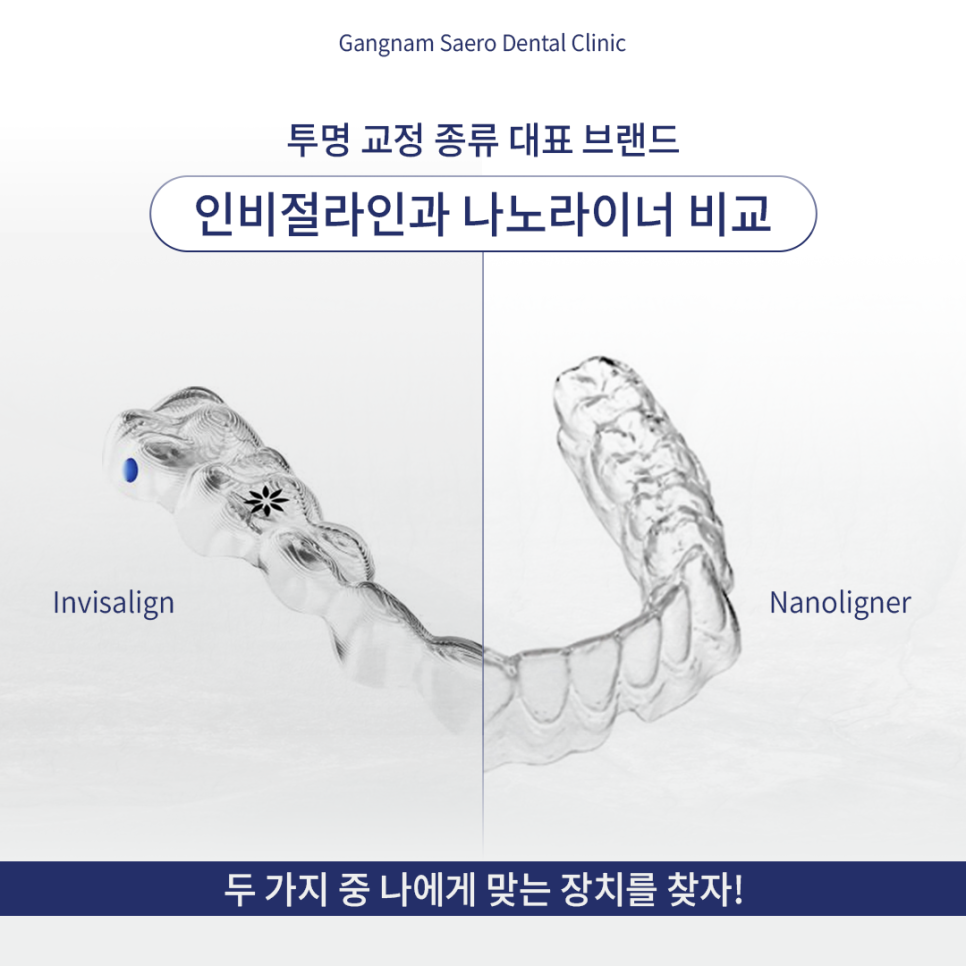
Leading Brands in Clear Aligners
Comparison of Invisalign and Nanoliner
Find the appliance that suits you best!
Deciding to undergo orthodontic treatment as an adult is likely a choice made after a longer period of consideration than you might expect. You have to think about the time involved, the cost, and above all, how noticeable the treatment will be in your daily life.
That is why many people first look to clear aligners, which offer better aesthetics than conventional wire braces. This is also why clear aligners are particularly recommended for office workers, people who frequently meet others, and those with interviews or filming schedules.
When researching clear aligners, the names you will come across most often are Invisalign and Nanoliner. Invisalign is a leading overseas brand that has been widely known for a long time, while Nanoliner is an appliance developed in Korea that is regarded as having strengths in precise setups and rapid response.
Gangnam Saero Dental Clinic offers both appliances, and Dr. Jeon Jae-min is introduced as an Invisalign-certified doctor and a Nanoliner consultant.
Rather than asking which of the two is better, what matters is which one suits you better. From now on, we will compare Invisalign and Nanoliner, two leading brands in clear aligners, step by step.
Overall Comparison of Invisalign and Nanoliner
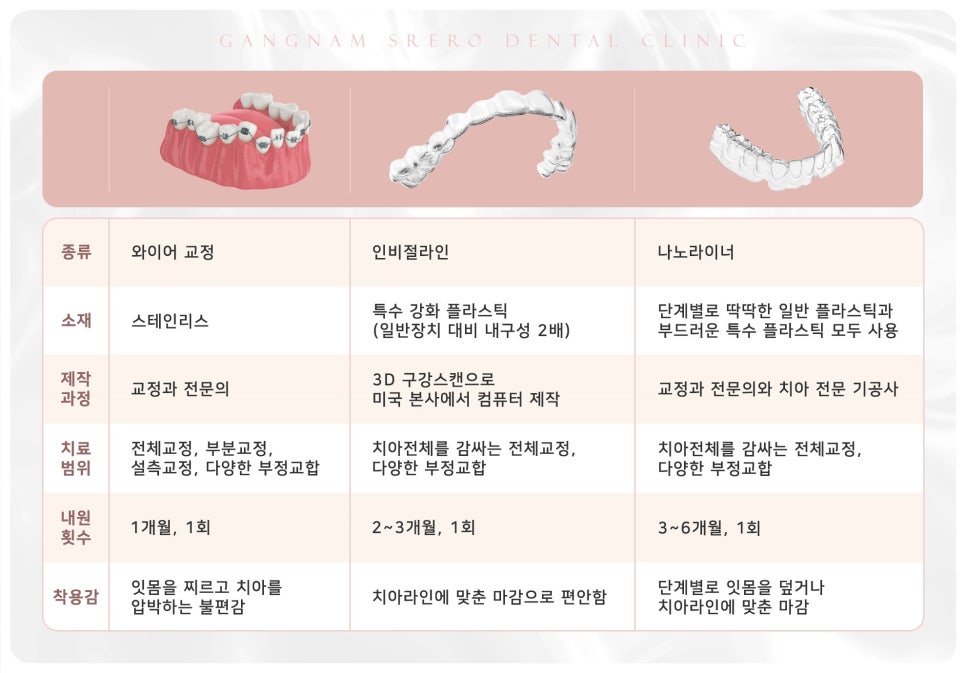
If you place greater importance on extensive clinical experience, high recognition, and a broad range of applications
Invisalign
If you want more detailed involvement in the setup, rapid production and feedback, and the flexibility of a domestic system
Nanoliner
Both are highly aesthetic clear-aligner appliances, and both can be used to correct malocclusion.
However, they have somewhat different characteristics.
If Invisalign is closer to a leading appliance with a well-established track record, Nanoliner can be viewed as an appliance that feels stronger in terms of precise customization and rapid response.
Both types of clear aligners offer good aesthetics, are removable, and place less burden on daily life. They are much less noticeable than conventional wire braces, and brushing and eating are more convenient, which in itself is a significant advantage.
However, even among clear aligners, there are differences in the materials, production process, appliance replacement method, and approach to adjustments during treatment. Therefore, it would be insufficient to say that they are the same simply because both are transparent.
Comparison of Invisalign and Nanoliner Materials
Invisalign
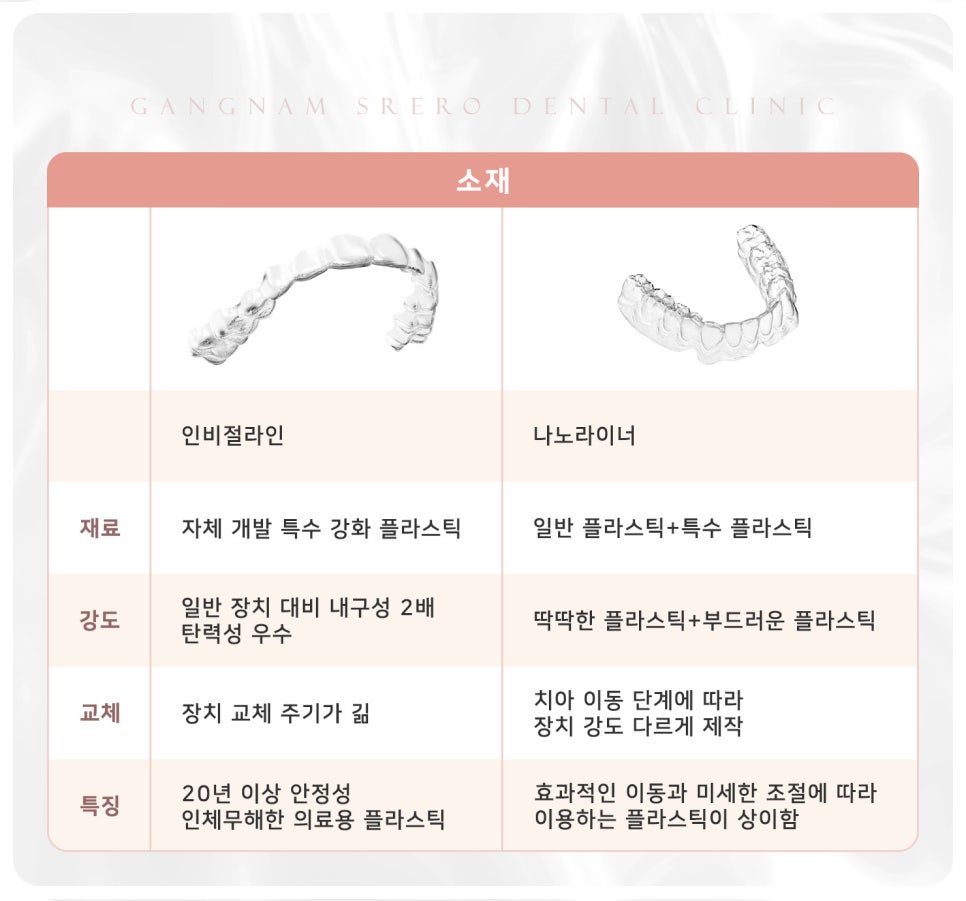
Invisalign uses its proprietary SmartTrack material. This material was designed to promote more predictable tooth movement and comfortable wear. The edges of the appliance are also precisely trimmed along the gum line, creating a structure that takes both aesthetics and comfort into account.
Simply put, Invisalign can be regarded as an appliance with strengths in elasticity, resilience, and overall quality. For this reason, it is often chosen by people who value the stability of the appliance itself and a familiar system.
Nanoliner
Nanoliner is characterized by using different appliance strengths according to the stages of tooth movement. Its official information emphasizes a standard stage-by-stage wear structure, dedicated software, real-time clinical consultation, and a production system involving dental technicians. It also demonstrates a process that allows more detailed adjustment in terms of appliance shape and strength management.
In other words, rather than continuing with one type of appliance throughout treatment, Nanoliner has a stronger impression of responding more precisely to each stage as the teeth move.
Comparison of Invisalign and Nanoliner Production Processes
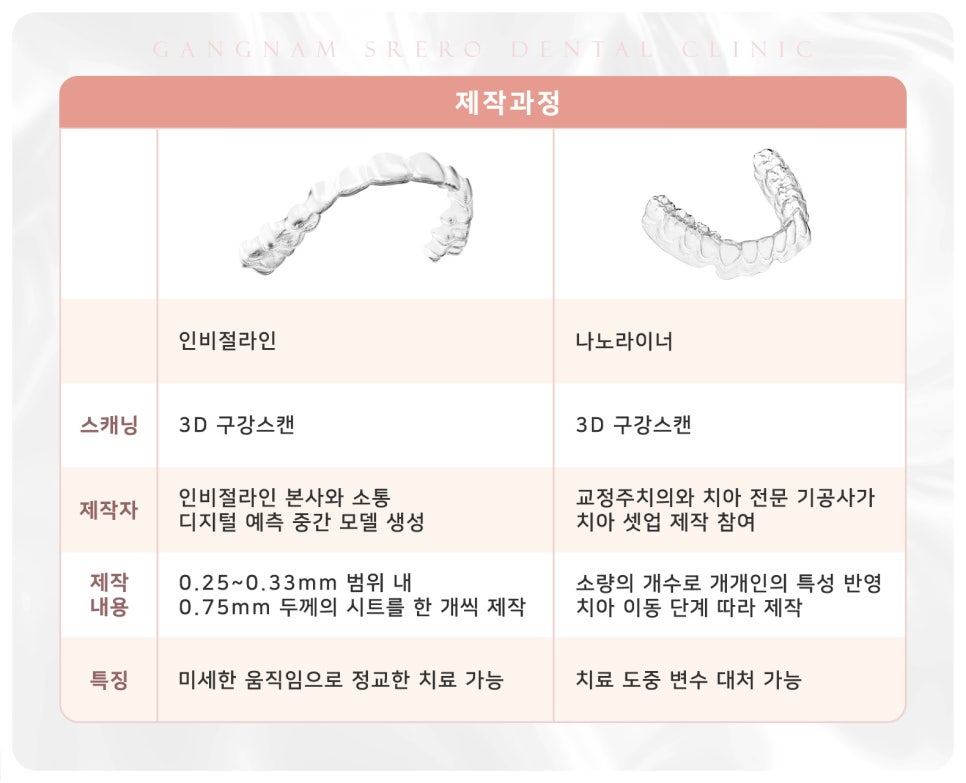
Invisalign
Invisalign’s strengths include digital scanning using the iTero scanner and a 3D simulation system. Before treatment, the tooth structure can be examined precisely in digital form, and the treatment approach can be planned by predicting how the teeth will look after orthodontic treatment is complete. The appliances are then produced through the Invisalign system and provided sequentially.
An advantage of this approach is that the entire system is highly standardized and operates within a process that is widely used around the world.
Nanoliner
Nanoliner is characterized by a process in which the orthodontist in charge and a dental technician specializing in teeth participate more deeply after the 3D scan. More detailed involvement is possible starting from the setup stage, while real-time clinical consultation and rapid remanufacturing are also frequently mentioned as advantages.
Simply put, while Invisalign has the strengths of a well-established global system, Nanoliner stands out more for the rapid feedback and precise manual involvement enabled by domestic production.
Comparison of the Treatment Scope of Invisalign and Nanoliner


Both appliances are quite capable in this area. Both are used to treat the entire dentition and can address not only crooked teeth but also crowded teeth, gaps between teeth, and various forms of malocclusion. Nanoliner also mentions extraction and crowded-tooth cases, while Invisalign is likewise known as an appliance used for various complex bite problems.
In other words, it would be difficult to say that only Invisalign can be used for comprehensive orthodontic treatment while Nanoliner is limited to mild cases. Both have a relatively broad treatment scope.
Comparison of Invisalign and Nanoliner Treatment Duration and Appointment Timing
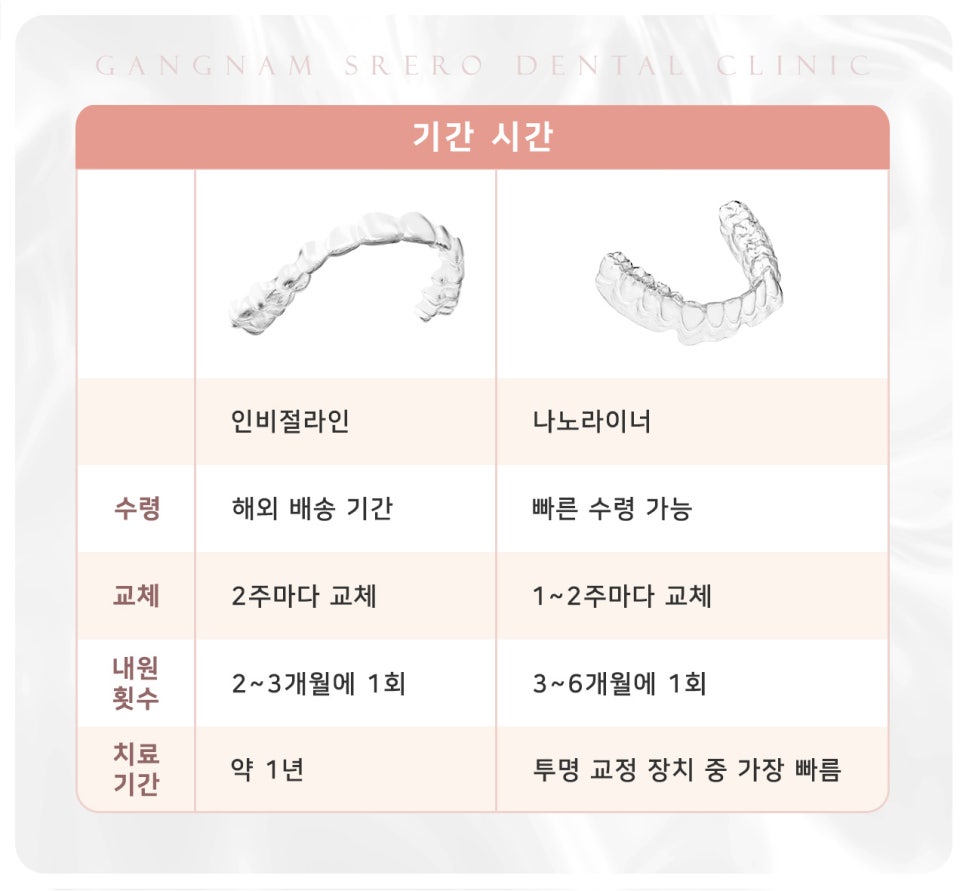
Invisalign
Invisalign generally follows a process in which the appliance is replaced with a new one every one to two weeks. The overall treatment period varies from person to person, but explanations commonly indicate approximately 12 to 18 months. The more consistently the appliances are worn, the more steadily treatment tends to proceed according to plan.
Nanoliner
According to its official information, Nanoliner presents a replacement schedule such as one week for odd-numbered appliances and two weeks for even-numbered appliances. It also emphasizes the advantages of a domestic system, including rapid remanufacturing and the possibility of same-day remanufacturing. It also tends to highlight strengths in terms of treatment speed.
In other words, when the speed of receiving appliances and responding during treatment is also taken into account, Nanoliner may feel somewhat more agile.
Comparison of Invisalign and Nanoliner Costs

Generally, Invisalign is often considered to be more expensive, while Nanoliner tends to feel somewhat more affordable. Of course, the actual cost varies depending on the complexity of the case, whether extractions are required, the number of appliances, and whether additional adjustments are needed.
Even so, based on prices in the Seoul area, Invisalign is often priced at approximately KRW 5–7 million or more, while Nanoliner is frequently discussed in the lower range of approximately KRW 3–5 million.
In other words, when cost is also considered, Nanoliner may be a somewhat more realistic choice, while those who place greater importance on brand recognition and accumulated clinical data may lean toward Invisalign.
Comparison of Candidates Who May Be Better Suited to Invisalign or Nanoliner
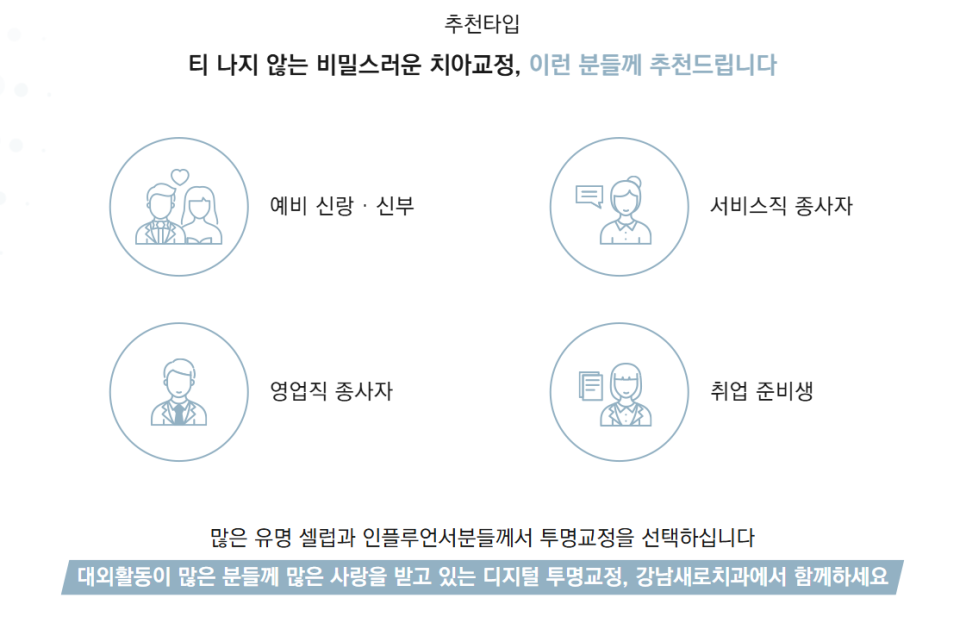
Cases in Which Invisalign May Be a Better Fit
-
When you prefer a leading brand that has already been widely validated
-
When you place importance on the stability of the appliance material and the completeness of the overall system
-
When you prioritize diverse clinical experience and high recognition
-
When you want treatment within a process close to global standards
Cases in Which Nanoliner May Be a Better Fit
-
When you want rapid feedback and flexible responses based on domestic production
-
When you consider active involvement by the orthodontist in charge during the setup stage important
-
When you expect more precise fine adjustments
-
When you prefer an appliance that can respond quickly to variables that arise during treatment
Invisalign and Nanoliner at Gangnam Saero Dental Clinic
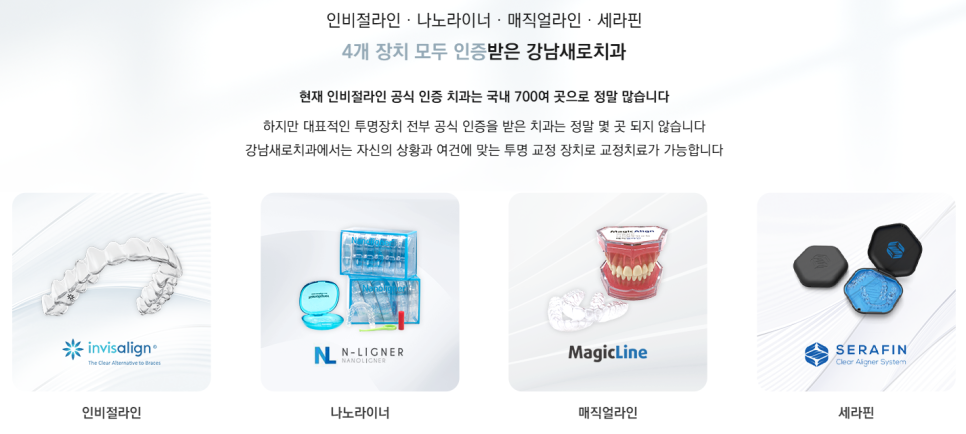
If you now have a better sense of which direction may suit you after comparing clear-aligner appliances, the next question is ultimately which dental clinic to choose.
Gangnam Saero Dental Clinic is certified to provide and operates leading clear-aligner appliances, including Invisalign, Nanoliner, Magic Align, and Serafin. It has a system that allows it to offer a broad range of options according to each patient’s circumstances and situation.
In particular, if you choose Invisalign, it is important to check whether the clinic is officially certified. If you are considering Nanoliner, it is important to know how much experience and setup expertise the orthodontist in charge has.
Dr. Jeon Jae-min of Gangnam Saero Dental Clinic is introduced as an Invisalign-certified doctor, a Nanoliner consultant, and a specialist consultant for the East Asia region. The clinic can therefore be regarded as having a treatment environment that handles both types of clear-aligner appliances extensively.
Ultimately, what matters is
not the more famous appliance,
but the appliance that suits you better.
Both Invisalign and Nanoliner are sufficiently good clear-aligner appliances. The issue is not which one is superior, but which one better suits your current dental condition, lifestyle, desired pace, and budget.
If you value long-term validation and brand trust, choose Invisalign; if you want rapid response, a precise setup, and the flexibility of a domestic system, consider Nanoliner. Organizing the options this way makes the choice much easier.
Orthodontic treatment is a treatment process that continues for quite a long time once it begins. That is why finding the appliance that suits you better is important, and meeting a medical professional who can handle that appliance properly is even more important.
- This post is medical information presented by a medical institution under a third-party contractual relationship.