If you want to correct a protruding lower jaw without surgery
Double-Jaw Orthodontic Treatment
If you are wondering whether double-jaw orthodontic treatment is possible instead of double-jaw surgery
As standards of beauty become increasingly individualized,
Class III malocclusion, commonly called a protruding lower jaw—in other words, an underbite—is
often a reason people consider orthodontic treatment for aesthetic purposes.
However, this issue does not end with concerns about appearance alone.
Because a protruding lower jaw involves misaligned tooth contact,
chewing function may be reduced,
leaving it untreated for a long time can lead to gum recession or loss of alveolar bone,
and the roots of the front teeth may also be placed under excessive strain.
In other words, apart from cosmetic concerns,
this is an occlusal problem that should not be taken lightly from a functional perspective either.
That is why treatment for a protruding lower jaw
may be a choice made to improve appearance,
but more importantly, it is also treatment intended to restore a healthy bite.
Then,
if you have a protruding lower jaw,
is double-jaw surgery always necessary?
Or are there cases that can be resolved with orthodontic treatment alone, without surgery?
In this post,
we will look at nonsurgical double-jaw orthodontic treatment—
that is, methods of correcting a protruding lower jaw without surgery—
and carefully organize the situations in which orthodontic treatment alone may be possible!
Causes of an Underbite and Protruding Lower Jaw
Class III malocclusion, commonly called a protruding lower jaw or underbite,
simply refers to a condition in which the lower teeth cover the upper teeth.
At first glance, it may seem like a simple problem in which
the lower jaw appears to stick out,
but in reality, there are several possible causes.
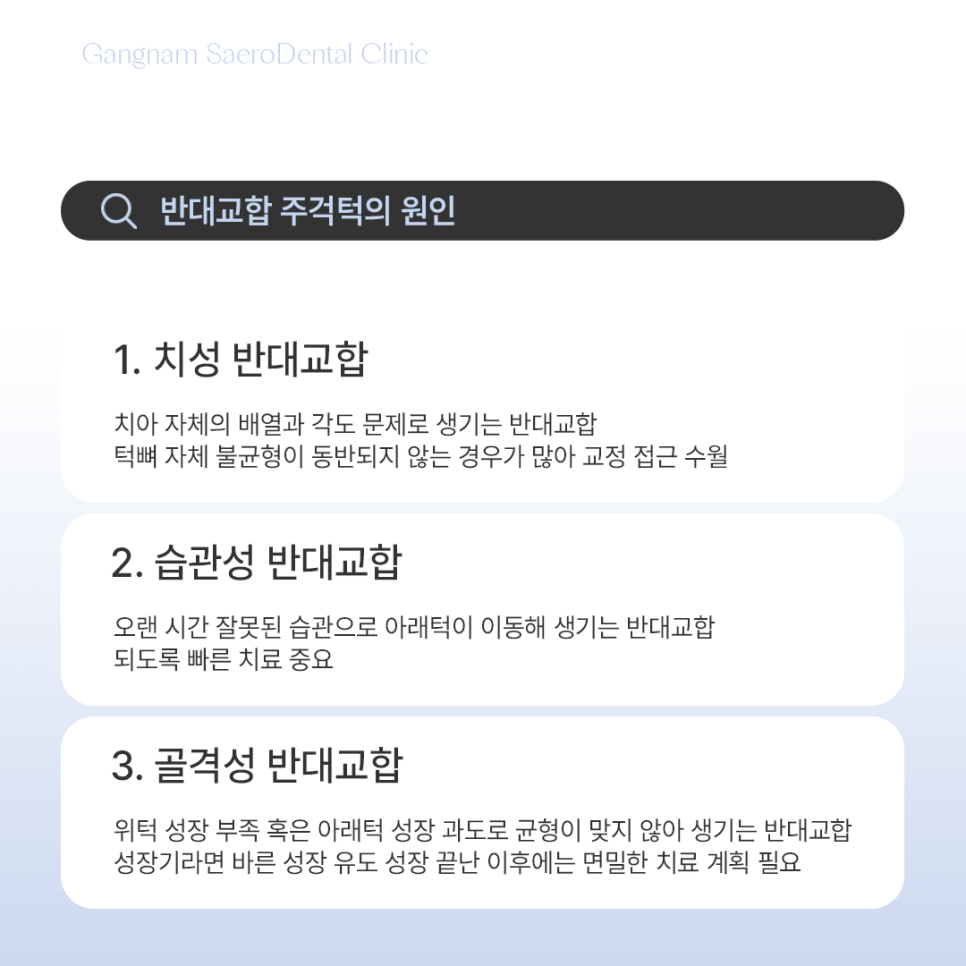
- Dental Underbite
This type of underbite is caused by problems with the alignment and angulation of the teeth themselves.
If the direction or position in which the teeth erupt is misaligned,
some teeth may bite in the opposite direction.
In these cases,
there is often no major imbalance in the jawbones themselves,
so orthodontic treatment tends to be relatively straightforward.
- Habitual Underbite
This can develop when the lower jaw settles into a forward position
due to repeatedly maintained habits over a long period, such as
frequently pushing the jaw forward,
resting the chin on the hand,
sleeping face down,
thrusting the tongue forward,
or mouth breathing.
Although this may appear to be merely a habit,
it can affect the direction of skeletal growth during the growth period,
so early treatment is important whenever possible.
- Skeletal Underbite
This occurs when the upper and lower jaws are out of balance
because growth of the upper jaw is insufficient
or growth of the lower jaw progresses excessively.
Genetic influences are also fairly common,
and changes in facial shape are often visible as well.
In these cases,
treatment can guide growth in a more favorable direction during the growth period,
but after growth is complete, the treatment plan becomes much more important.
Cases of an Underbite Eligible for Nonsurgical Double-Jaw Orthodontic Treatment
So, among these cases,
when can the problem be resolved with orthodontic treatment alone, without double-jaw surgery?
In general,
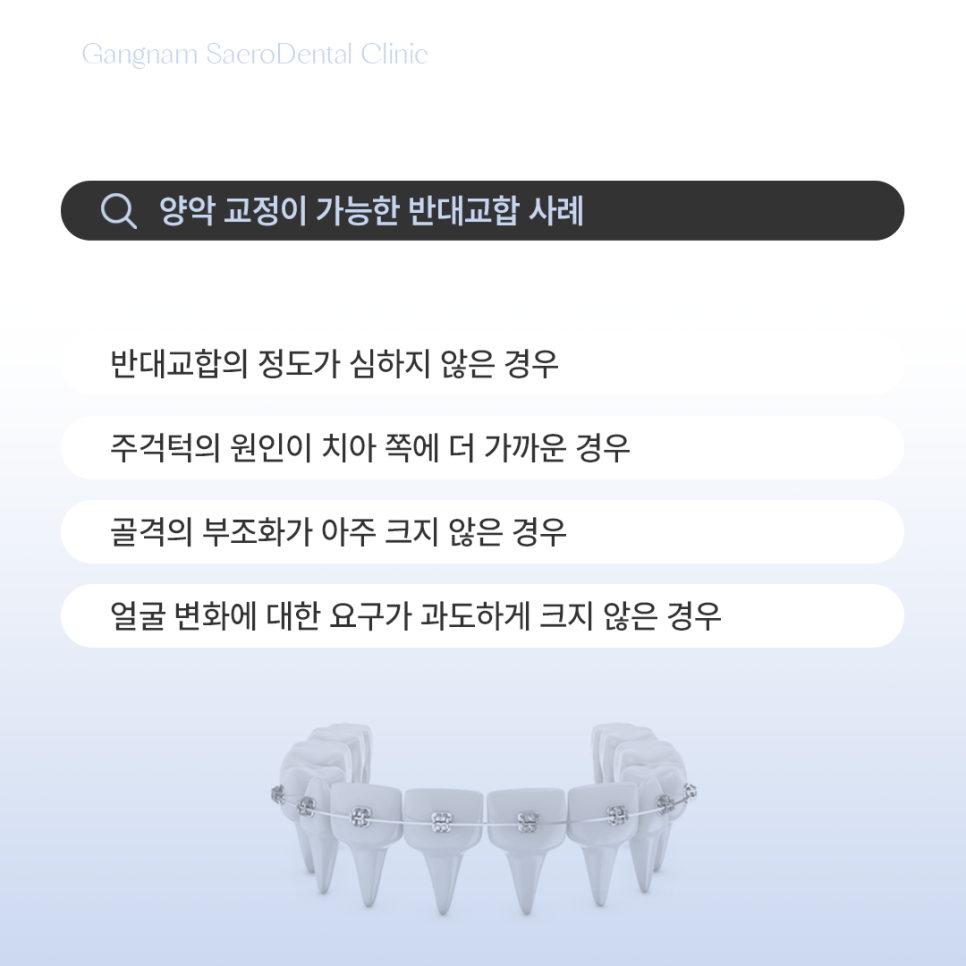
nonsurgical double-jaw orthodontic treatment may be considered when:
-
the underbite is not severe;
-
the cause of the protruding lower jaw is more closely related to the teeth;
-
the skeletal discrepancy is not particularly large; and
-
expectations for facial changes are not excessively high.
In other words, just because the lower jaw appears to protrude slightly,
surgery is not always necessary.
Even when someone appears to have a protruding lower jaw,
detailed examination may show that the main issue is the alignment of the teeth or the bite,
and there are certainly adult cases that can be addressed sufficiently with orthodontic treatment alone.
Conversely,
when the skeletal discrepancy is large
and substantial changes to the position of the jaws are needed,
a surgical approach may be more appropriate.
Therefore, this cannot be determined by appearance alone,
and a detailed diagnosis is essential!
Conditions for Nonsurgical Double-Jaw Orthodontic Treatment in Underbite Cases
Many people think,
“Once an adult has finished growing, doesn’t that ultimately mean surgery?”
However, that is not necessarily the case.
Of course, it is true that there are fewer options than during the growth period.
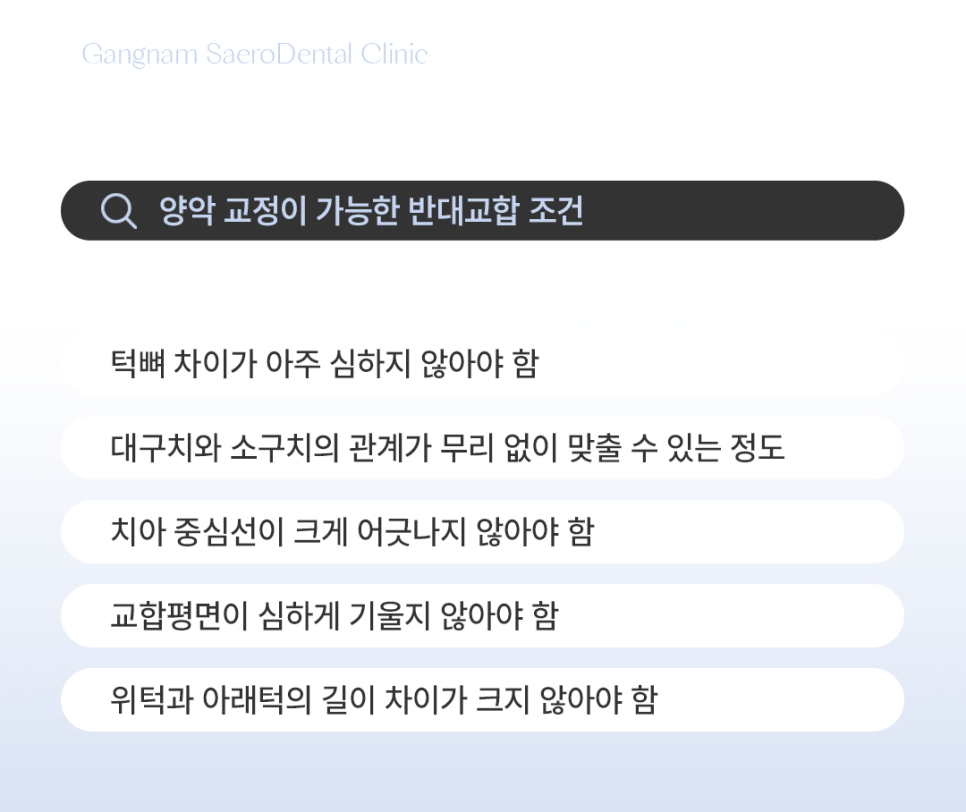
But even for adults,
if the difference between the jawbones is not very severe,
and the relationship between the molars and premolars,
the dental midline,
the occlusal plane,
and the difference in length between the upper and lower jaws
are considered together and fall within a range that can be sufficiently improved with double-jaw orthodontic treatment alone,
nonsurgical double-jaw orthodontic treatment may be possible.
In other words,
there is no need to conclude from the outset that surgery is required
simply because someone is an adult.
Through an accurate diagnosis,
it is important to first determine whether orthodontic treatment alone is possible
or whether surgery would be more appropriate.
Diagnosis to Determine Whether a Protruding Lower Jaw Can Be Treated with Double-Jaw Orthodontic Treatment Without Surgery
To find out whether this underbite and protruding lower jaw
can be treated with orthodontic treatment alone
or whether surgery is truly necessary,
ultimately, the only way is to undergo a detailed examination, right?
Even when they look similar,
some cases can be sufficiently treated with orthodontic treatment alone,
while others require surgery;
the reason for this difference becomes clear through a detailed diagnosis.
Gangnam Saero Dental Clinic
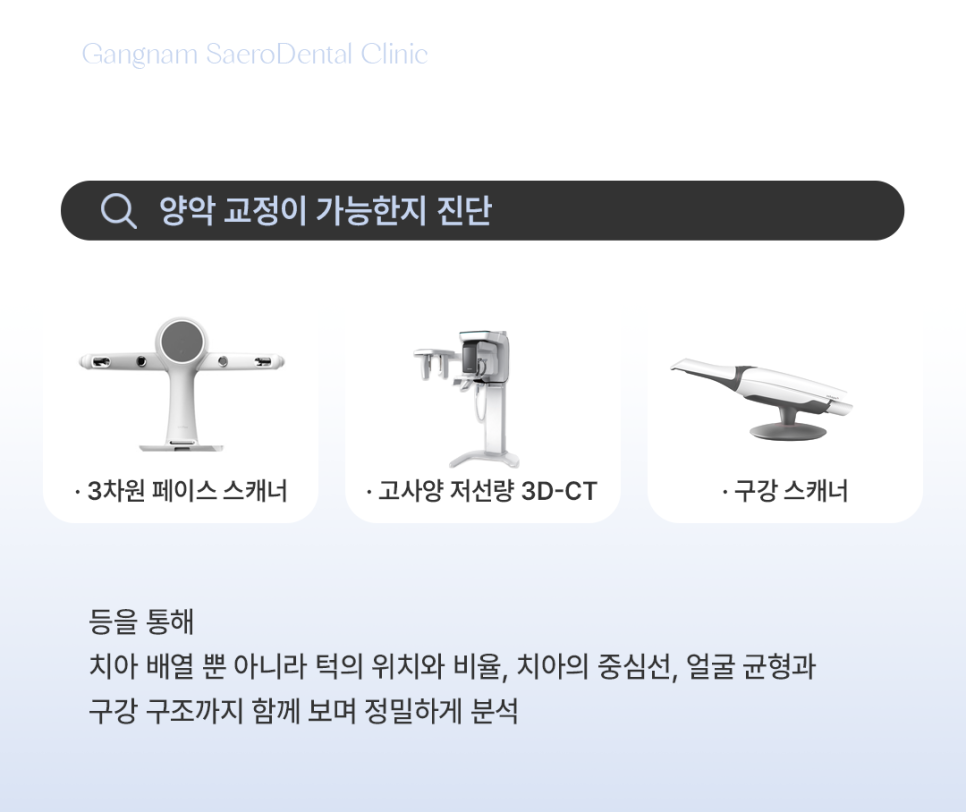
is equipped with an advanced diagnostic system, including
3D face scanners,
high-specification, low-dose 3D CT,
and intraoral scanners,
to assess each patient’s condition more comfortably and accurately!
In other words, rather than simply examining tooth alignment,
the clinic focuses on conducting a more precise analysis of the range that can be treated without surgery
by examining the position and proportions of the jaws,
the dental midline,
facial balance,
and oral structures together!
The Most Important Factor Is Ultimately Choosing the Medical Team
In underbite and protruding-lower-jaw orthodontic treatment,
the most important factor is undoubtedly the choice of medical team.
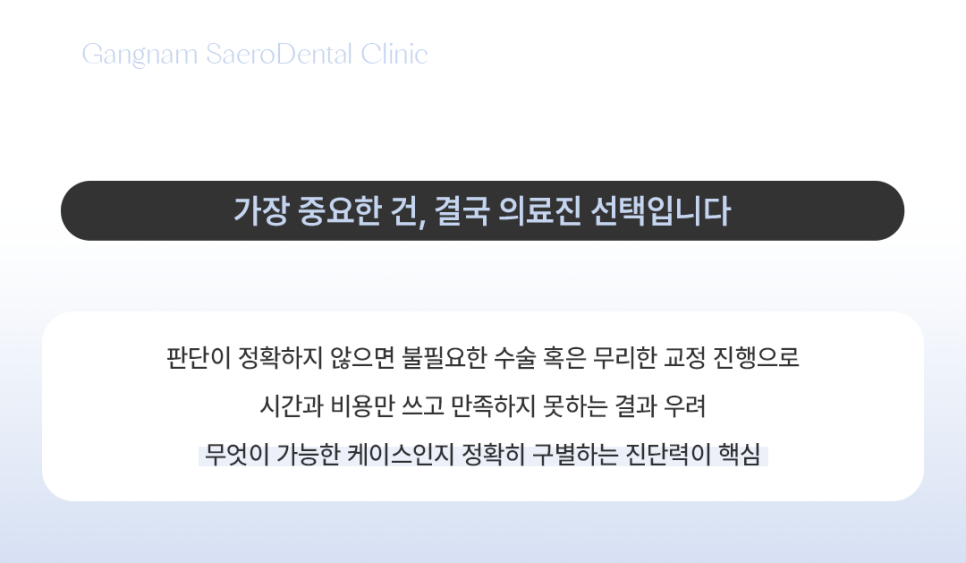
If the assessment is not accurate,
you may be advised to undergo surgery even when orthodontic treatment is possible.
Conversely, even when surgery would be more appropriate,
proceeding with orthodontic treatment alone despite this
may result in spending only time and money without achieving a satisfactory outcome.
In other words,
orthodontic treatment for a protruding lower jaw is not simply a matter of attaching an appliance;
the key is the diagnostic ability to accurately distinguish which cases are treatable by which method.
At Gangnam Saero Dental Clinic,
care is provided by an orthodontic specialist—one of the 3% of dentists who are orthodontic specialists—with extensive experience in double-jaw orthodontic treatment
and experience serving as the orthodontic primary dentist for entertainers and public figures.
A major advantage is that, based on data from experiencing a wide range of cases,
more realistic and precise treatment plans can be established.
Whether double-jaw surgery is necessary
or nonsurgical orthodontic treatment is possible,
these differences in experience can have a significant effect on the outcome,
particularly in borderline cases.
Orthodontic Treatment for an Underbite and Protruding Lower Jaw Should Not Be Delayed

If a protruding lower jaw and underbite are a source of concern,
it is advisable not to put off treatment for too long,
not only for aesthetic reasons but also for functional ones.
As mentioned earlier,
leaving this problem untreated
can lead to issues such as gum recession, alveolar bone loss, and root resorption,
and the difficulty of orthodontic treatment may also increase over time.
Although it may currently feel like nothing more than slight discomfort,
function and health may also be affected later,
so it is advisable to receive an accurate diagnosis as soon as possible.
Gangnam Saero Dental Clinic
will accompany you toward a new smile and a new beginning,
with a little less burden and a little more precision!
- This post presents medical information and other content provided by a medical institution pursuant to a third-party contractual relationship.