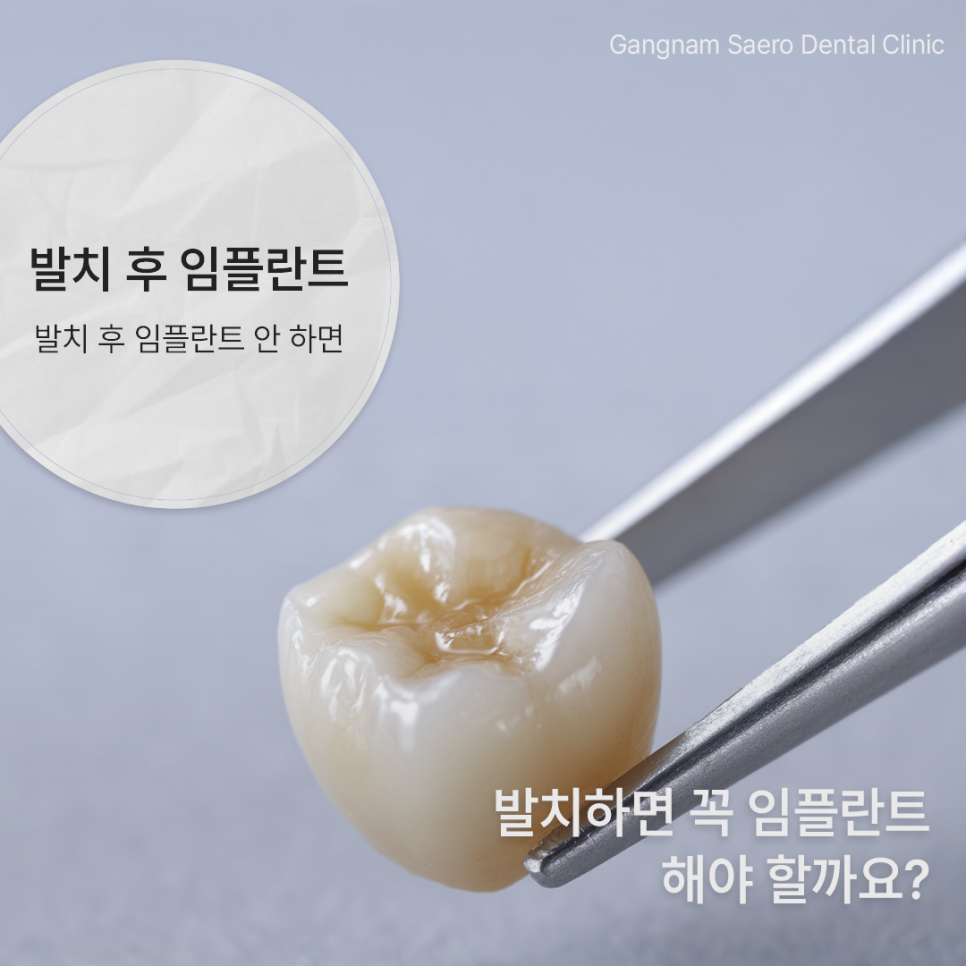
Do you always need to get an implant after a tooth extraction?
Implants After Tooth Extraction
If You Do Not Get an Implant After Tooth Extraction
As we go through life,
we may face situations in which a tooth must be extracted for various reasons.
If you have had a wisdom tooth removed,
some people occasionally assume that extracting a permanent tooth is similar.
Especially when a tooth toward the back, where it is not easily visible, is lost,
many people leave it as it is
because it is not immediately noticeable.
However, extracting a permanent tooth
should not be taken as lightly as extracting a wisdom tooth.
Wisdom teeth often do not play a significant functional role,
whereas permanent teeth are responsible for chewing function, the balance of the alignment,
and the maintenance of the gums and jawbone.
If the space left by a missing tooth remains empty for a long time,
nearby teeth may move into the open space,
and the gum and bone in that area may gradually sink or shrink.
So today,
we will explain step by step
why the space should not be left untreated after an extraction,
what problems may occur,
and whether an implant is truly the only solution.
Do You Have to Get an Implant After Tooth Extraction?
To give the conclusion first,
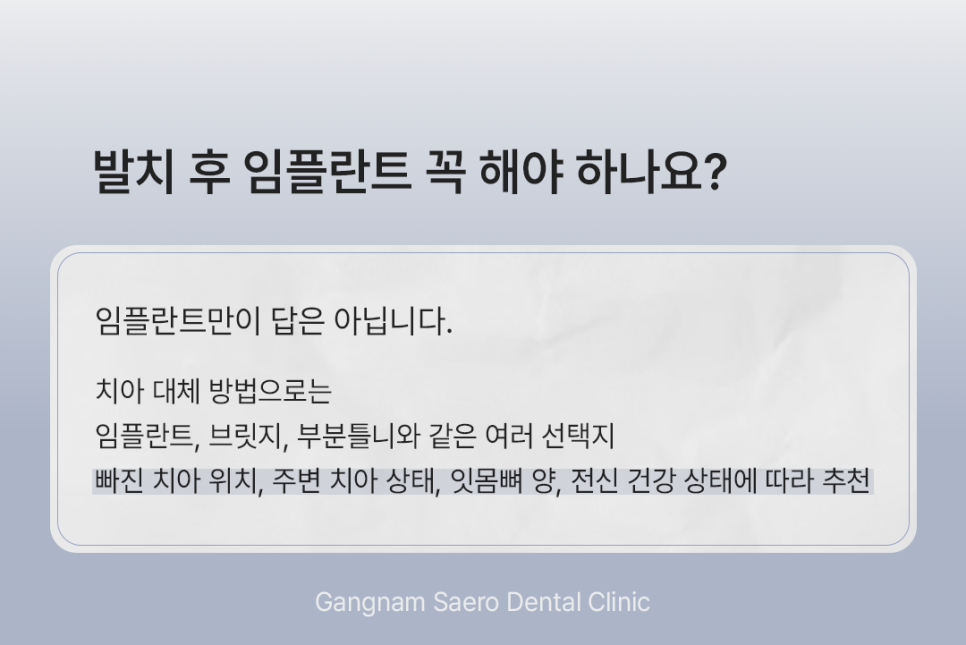
an implant is not the only treatment you must have after a tooth extraction.
There may be several options for replacing a tooth,
such as an implant, bridge, or partial denture.
However, the appropriate method depends on
the location of the missing tooth, the condition of the surrounding teeth, the amount of jawbone, and your overall health.
An implant is one very good replacement treatment,
but sufficient bone and gum conditions are needed,
and bone grafting may be necessary in some cases.
What is important
is not whether you get an implant,
but that you do not leave the missing tooth untreated for a long time.
The key is to restore the space appropriately in some suitable way.
If You Do Not Get an Implant After Tooth Extraction 1. Jawbone Resorption
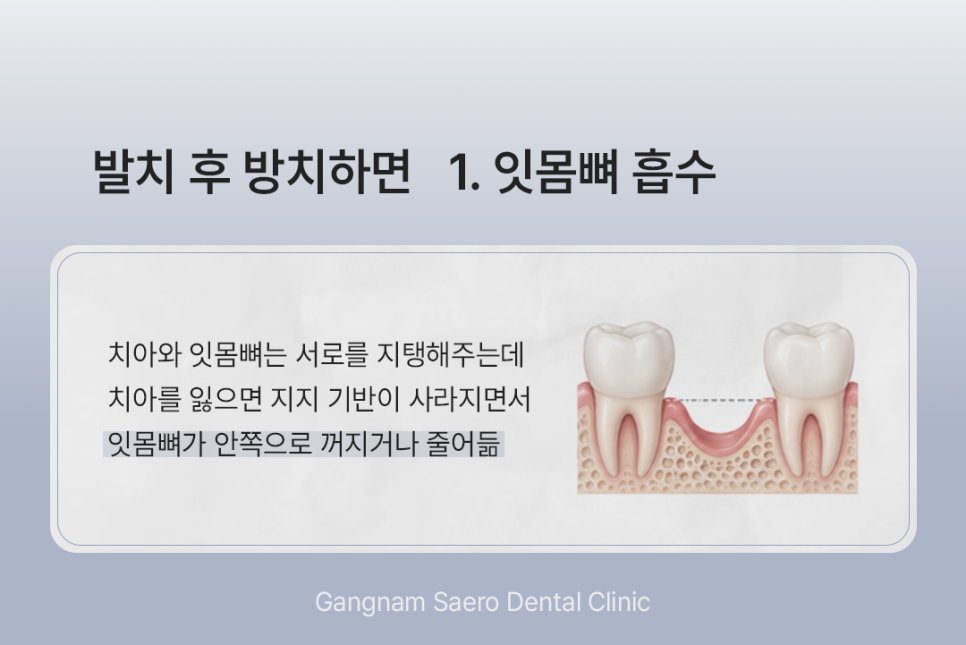
After a tooth is extracted,
if the area is left as it is without any treatment,
the jawbone in that area may gradually shrink.
In particular, changes in which the outer bone and gums appear sunken
may appear first.
While a tooth is present, the bone and gums
maintain their shape around that tooth,
but when the tooth is lost, that supporting foundation disappears,
and over time the gums and bone
may sink inward or shrink.
If you later consider an implant,
and there is not enough jawbone,
additional bone grafting may be necessary,
and the treatment plan may become more complex in some cases.
Implants are more favorable when sufficient bone is present,
but bone grafting may also be used to supplement it when necessary.
If You Do Not Get an Implant After Tooth Extraction 2. Tooth Repositioning
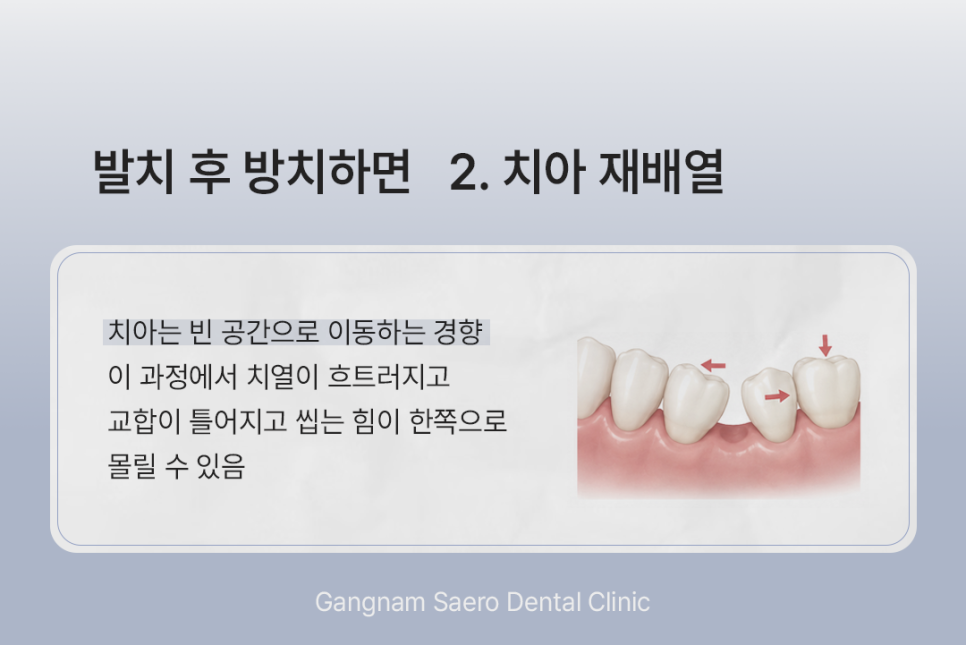
If the space left by a missing tooth remains empty for a long time,
nearby teeth may tend to
move little by little toward the open space.
During this process,
the previously stable alignment may become disrupted,
the bite may become misaligned,
and chewing forces may become concentrated on one side.
In other words, what began as simply having one missing tooth
may eventually affect the surrounding teeth as time passes.
If You Do Not Get an Implant After Tooth Extraction 3. Various Conditions
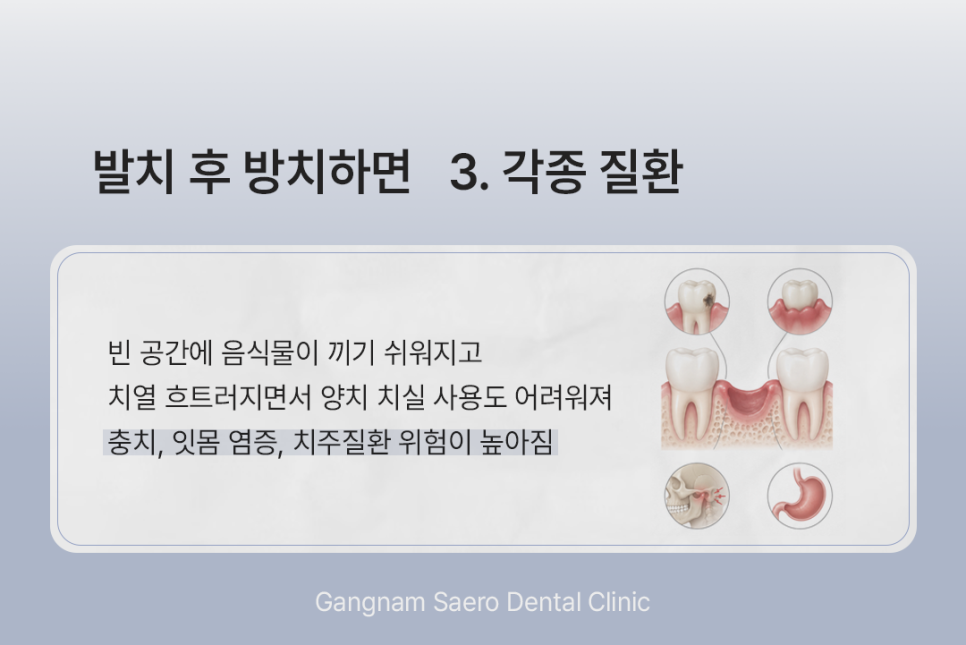
When a gap develops,
food can become trapped more easily around it,
and as the alignment becomes disrupted,
brushing and flossing may also become more difficult.
As a result, the risk of cavities, gum inflammation, and periodontal disease
may increase.
Periodontal disease can lead to bone loss and tooth loss,
and as a cavity progresses, it may also affect the surrounding bone.
This means that as the oral environment worsens,
the surrounding teeth may also be adversely affected.
In other words, even though only one missing tooth was left untreated,
over time
the health of the surrounding teeth and gums may also be compromised.
If You Do Not Get an Implant After Tooth Extraction 4. Changes in Facial Appearance
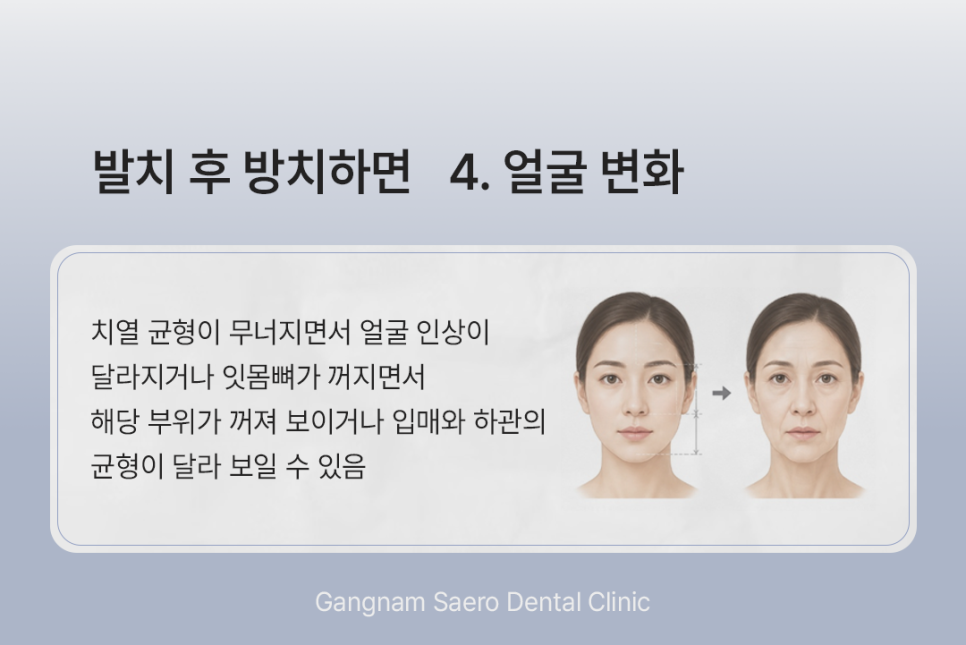
If the space is left empty for a long time after losing a tooth,
as the jawbone shrinks and the balance of the alignment is disrupted,
it may also affect the overall impression of the face.
In particular, as the bone and gums sink,
the area may appear hollow,
or the balance of the lips and lower face may look different.
As mentioned earlier, the fact that the bone and gums in the area of the missing tooth may appear to sink inward
is an observable change.
In other words, the problem of losing a tooth
is not limited to difficulty chewing;
over time, it may also lead to changes in outward appearance.
If You Do Not Get an Implant After Tooth Extraction 5. Future Implant Treatment May Become Difficult
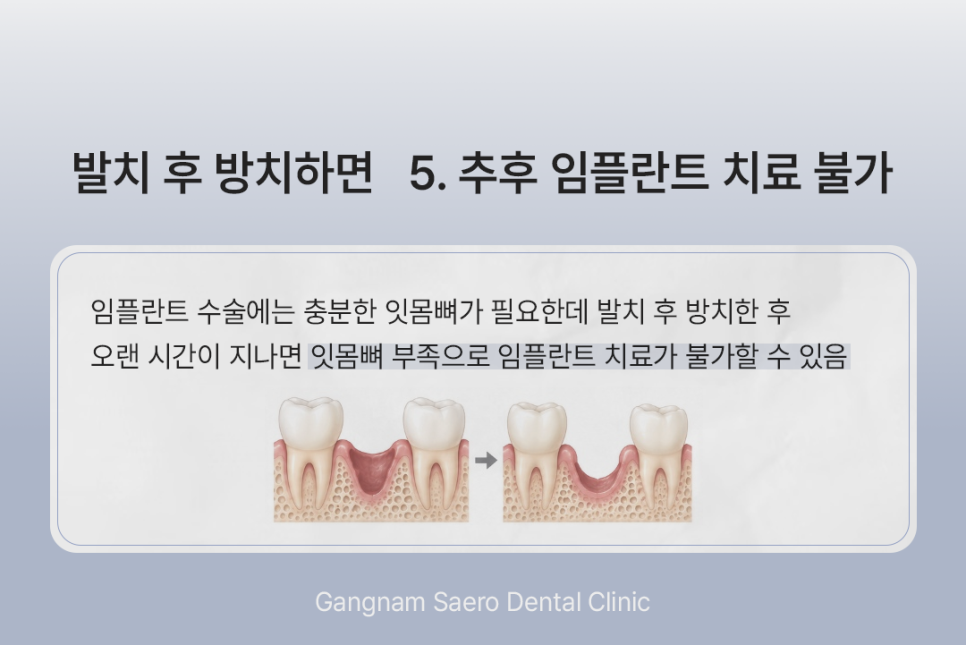
When a long time passes after an extraction,
the treatment plan is often more complicated than it was initially.
If the jawbone shrinks and the surrounding teeth move,
treatment that could originally have been completed relatively simply
may require consideration of additional procedures as well.
Therefore, what is important
is not to make an absolute statement that an implant is always required immediately after an extraction,
but to avoid leaving the extraction site empty for a long time
and receive a diagnosis at an appropriate time.
Whether it is an implant, bridge, or another replacement treatment,
the priority is to determine the most appropriate method based on your current condition.
Why Should You Seek Advice Quickly About Replacement Treatment After an Extraction?
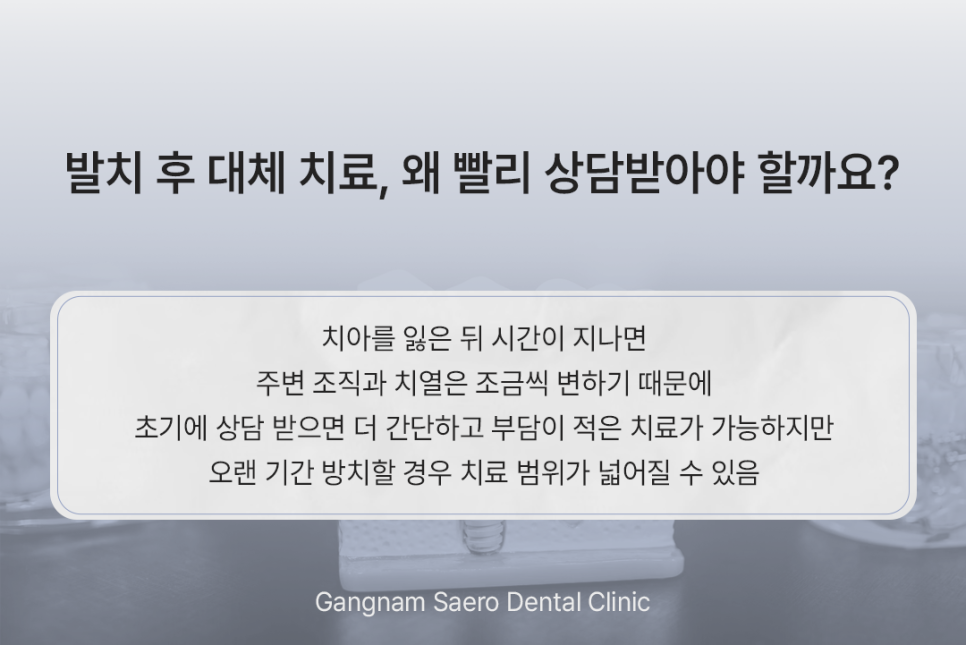
After losing a tooth, as time passes,
the surrounding tissues and tooth alignment do not remain unchanged.
They gradually change.
Therefore, if you seek advice early,
simpler and more conservative options may still be available,
whereas if too much time passes,
the scope of treatment may become broader.
Implants are more favorable when sufficient bone is present,
and bone grafting may be necessary in some cases.
Other methods, such as bridges or dentures,
also require consideration of the condition of the surrounding teeth and gums.
Ultimately, the best approach
is not to decide on a treatment method in advance,
but to accurately determine your current condition.
Gangnam Saero Dental Clinic for Implants After Tooth Extraction
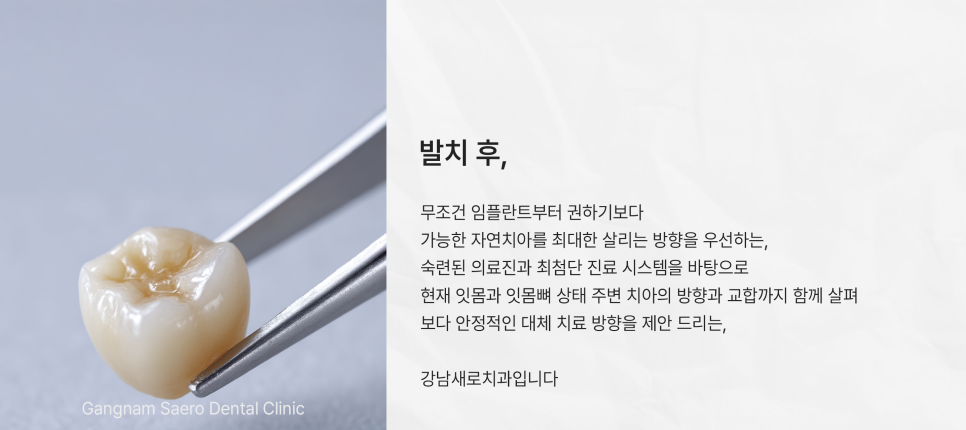
Gangnam Saero Dental Clinic
prioritizes preserving natural teeth as much as possible
rather than recommending implants unconditionally.
Only when necessary,
we develop a treatment plan to restore both function and appearance
with the minimum number of implants.
Based on experienced medical professionals and an advanced treatment system,
we assess the current condition of the gums and jawbone after extraction,
as well as the direction and bite of the surrounding teeth,
and suggest a more stable direction for replacement treatment.
If you have had a tooth extracted
and have left the space empty for a long time,
it is not too late even now.
Rather than taking it lightly,
we recommend that you first receive an accurate diagnosis.
- This post was presented by a medical institution as medical information under a third-party contractual relationship and partially utilized AI.