
How much do you know about dental caries treatment?
Types of Cavity Treatment
A Guide to Treatment Types and Materials by Stage of Dental Caries
When do you usually brush your teeth?
Once after getting up in the morning,
once after lunch,
and once before going to bed.
Many people brush their teeth about three times a day in this way.
However, when it comes to preventing cavities,
it is difficult to feel reassured simply because you brush three times a day.
This is because dental health can vary depending on how the environment inside your mouth changes after eating
and when you brush your teeth for greater effectiveness.
That is why cavities are sometimes discovered during a dental visit
even when you thought you were brushing your teeth regularly.
At times like this, what is important is
to understand step by step what dental caries is,
what treatment is needed,
and how the treatment materials differ,
rather than becoming alarmed.
Today,
we will organize everything at a glance—from the concept of dental caries and ways to prevent it
to composite resin, inlays, onlays, and crowns!
What Is Dental Caries?
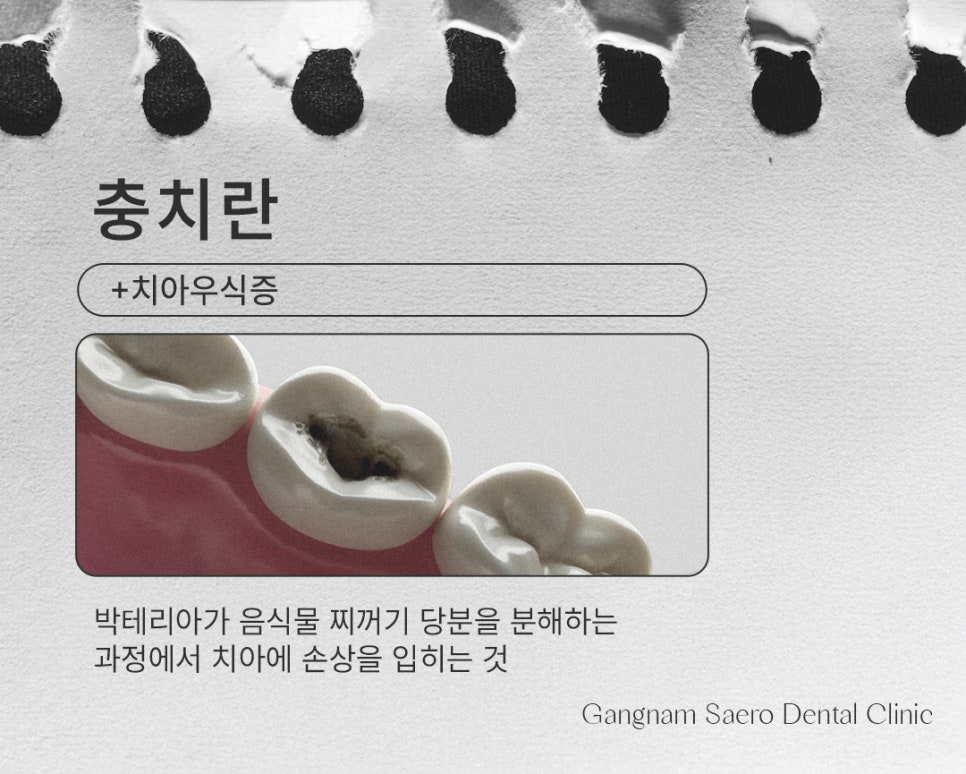
If several cavities are discovered
during a dental examination,
it is a good idea to first understand exactly what condition the cavities are in.
Dental caries, also called tooth decay, is an oral disease in which the tooth surface is damaged by bacteria and food debris,
particularly sugars.
Bacteria in the mouth break down sugars and produce acids,
and these acids weaken the tooth surface,
eventually causing holes to form in the teeth or allowing the damage to spread inward.
It begins as a small change,
but if left untreated, it can progress deep into the tooth
and lead to sensitivity, throbbing, pain, and infection.
Because it is a disease that ultimately damages the shape and function of the tooth,
even a small cavity should not be taken lightly.
How to Prevent Cavities
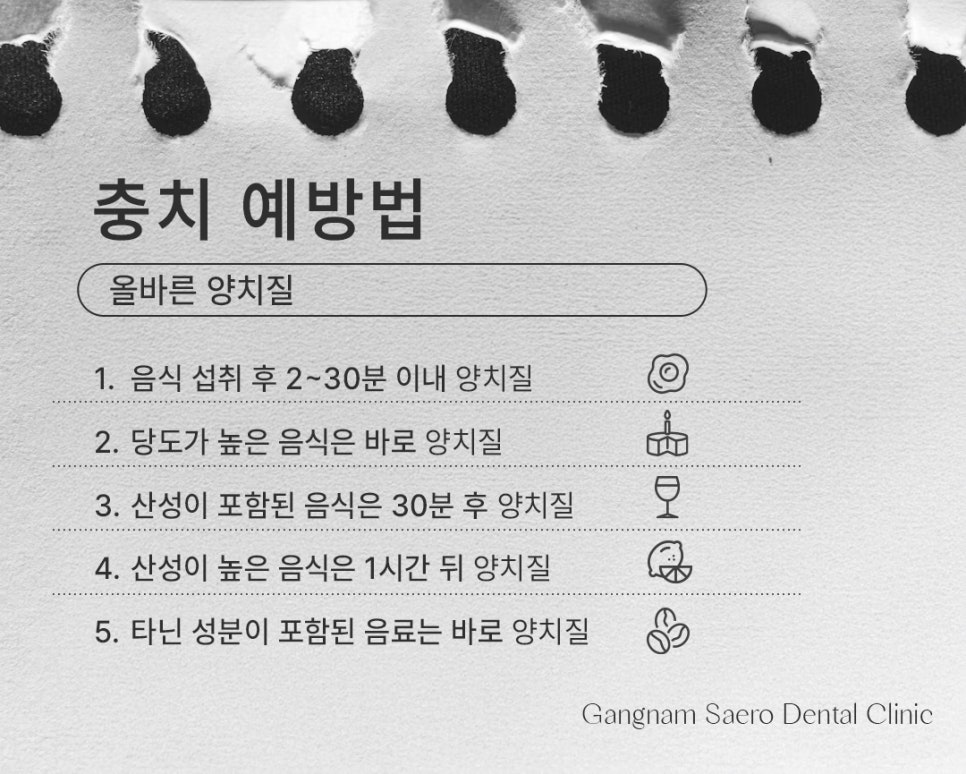
The basic way to prevent cavities
is, as everyone knows, brushing your teeth.
It may sound obvious,
but the preventive effect can vary depending on when and how you brush.
After eating,
bacterial activity may become more active, usually between 20 minutes and one hour later,
so it is important to brush at an appropriate time for the situation.
However, the timing of brushing may vary depending on the type of food.
Foods high in sugar
If you have eaten sweet snacks such as chocolate, candy, or cake,
it is best to brush your teeth as soon as possible.
Acidic foods
If you have eaten acidic foods such as carbonated drinks, beer, or foods containing vinegar,
the tooth surface may be temporarily weakened,
so it is best to brush after waiting about 30 minutes.
Highly acidic foods
For foods with higher acidity, such as yogurt or some sports drinks,
it may be helpful to wait about one hour before brushing.
Drinks containing tannins
When you drink coffee or black tea,
prompt care is helpful for reducing tooth staining,
but if the drink is highly acidic, it is better to wait a little while.
Fruit and juice
Brushing promptly can be helpful after eating sweet fruit that is high in sugar,
but for highly acidic fruit or juice with a strong sour taste,
it may be safer to brush after about 30 minutes.
In other words,
brushing as soon as possible is not always the right answer,
and the timing may vary somewhat depending on the type of food.
Even so, if a cavity has already developed,
it is time to consider treatment.
Cavity Treatment Methods
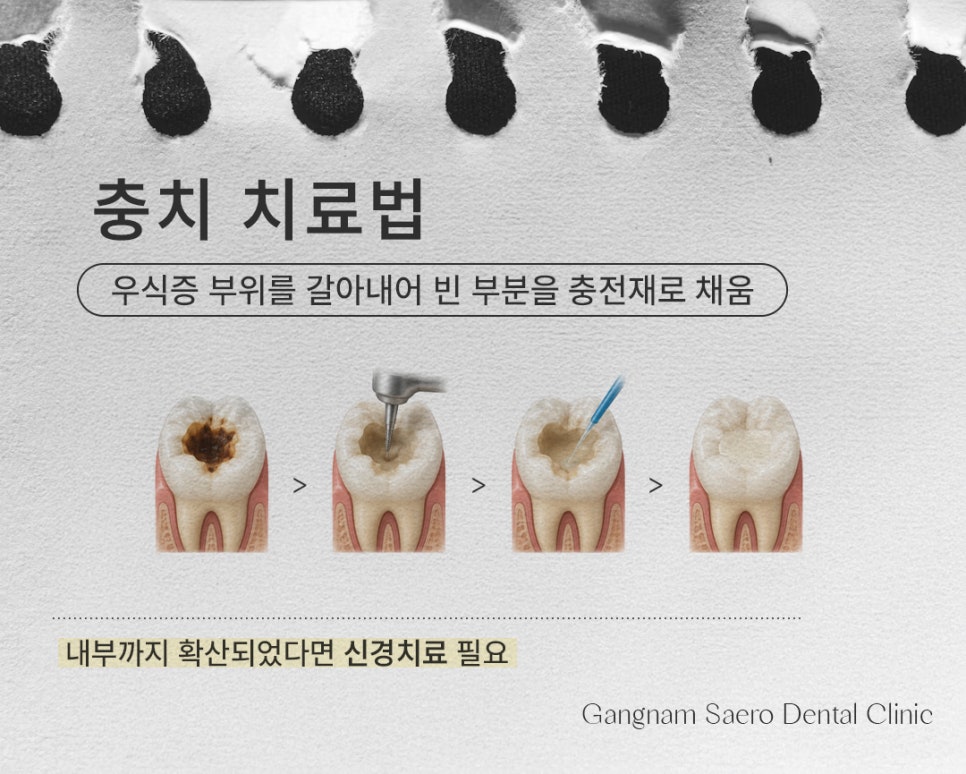
In general, cavity treatment
involves removing the damaged decayed area
and filling the empty space with a suitable material.
The shallower the cavity, the smaller the area that needs to be removed,
while a deeper cavity requires removal of a larger area.
If the cavity has progressed deep inside the tooth
and affected the nerve,
root canal treatment and restorative treatment may be needed in addition to simple filling.
In other words, the types of cavity treatment
may appear to involve several different methods,
but ultimately, the treatment is determined by how far the cavity has progressed.
Types of Cavity Treatment
When you receive an explanation of cavity treatment at a dental clinic,
terms such as composite resin, inlay, onlay, crown, “filling,” and “covering” may all be mentioned at once,
which can make things feel even more confusing.
So, let us organize each one by stage.
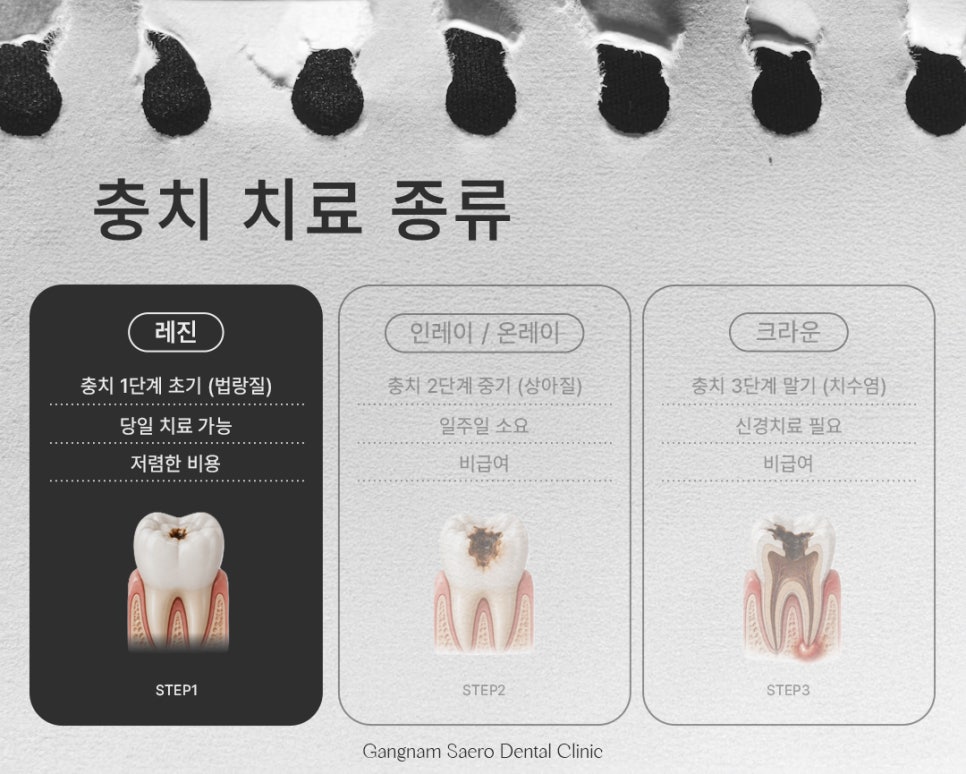
Composite Resin
Composite resin is a material in the reinforced-plastic family
that is mainly used when the cavity is not extensive
and the amount of tooth removal is limited.
It is often used for relatively early-stage cavities,
and when the damage is limited to approximately the enamel,
treatment can often be completed in a single visit.
Cavities at this stage
cause little to no pain or sensitivity,
so they can be difficult to detect on your own.
Therefore, if they are discovered early through regular checkups,
treatment can often be completed relatively simply and with less burden.
Inlay / Onlay
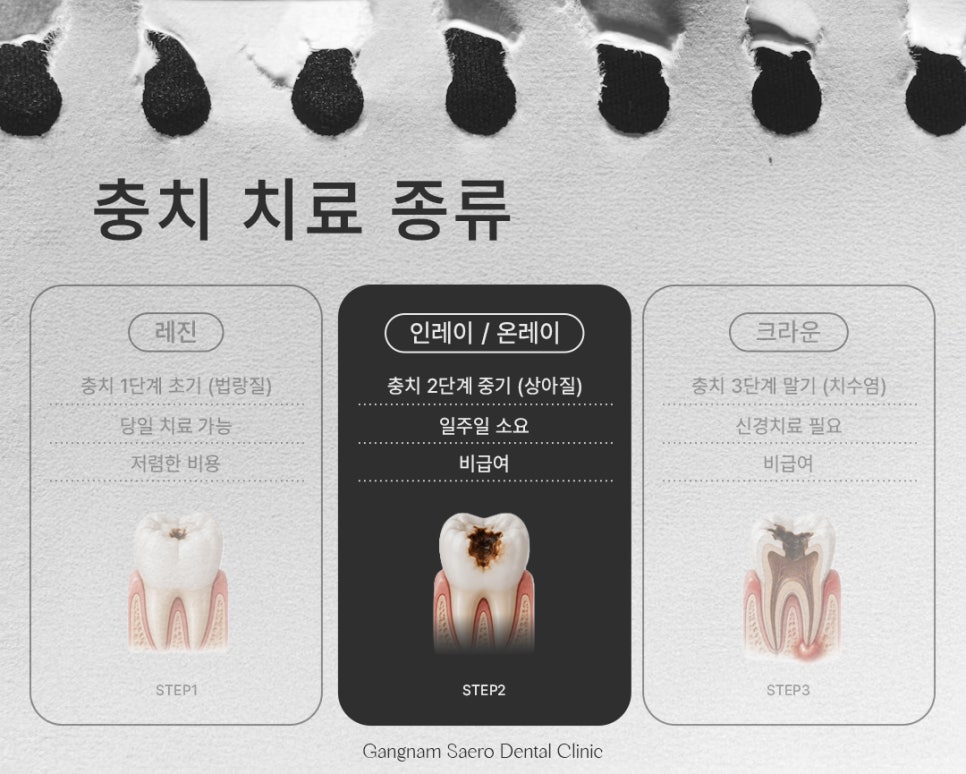
Inlays and onlays
are treatments used when a cavity has progressed more extensively than one suitable for composite resin.
Ceramic or gold materials are generally used,
with an inlay referring to a somewhat smaller area of damage
and an onlay to a somewhat larger area.
At this stage,
the cavity has often progressed beyond the enamel into the dentin,
which may cause sensitivity to cold or sweet foods
or occasional throbbing discomfort.
Unlike composite resin treatment,
an impression must be taken and the restoration must be fabricated,
so the process usually takes around one week,
and one or more additional visits may be required.
Crown
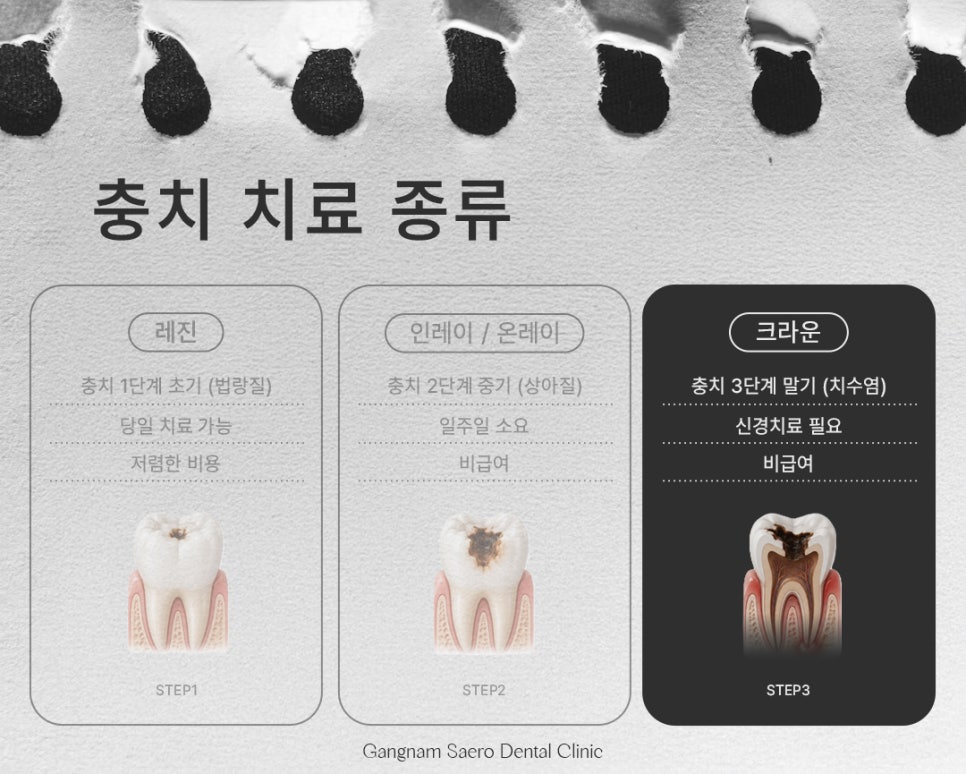
Crowns
are often chosen when the cavity is extensive and the tooth is significantly damaged,
or when root canal treatment has been performed.
Rather than filling only part of the tooth,
a crown covers the entire tooth with a prosthetic restoration,
so a larger area may need to be removed
and the treatment process may take longer.
Commonly used materials include
PFM, zirconia, and gold.
At this stage,
the cavity may have progressed beyond the dentin and close to the nerve,
or the tooth may already be significantly fractured or weakened.
There may be noticeable pain
and increased sensitivity to stimuli,
and in some cases, inflammation and pus may also occur.
Once the condition has progressed this far,
the cost and number of visits naturally increase,
and if treatment is delayed further, extraction may need to be considered.
Summary of Cavity Treatment Types
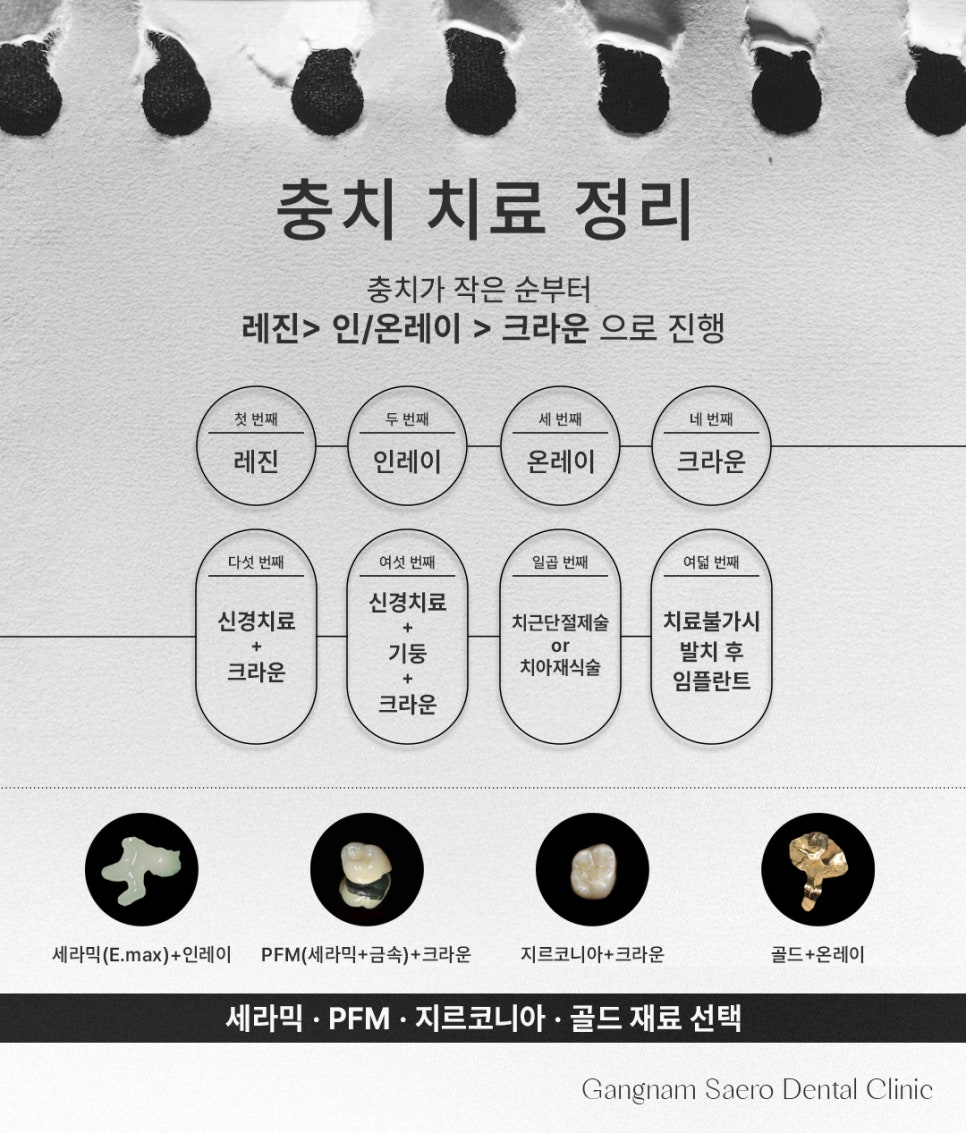
To summarize,
cavity treatment varies according to how far the cavity has progressed.
Early-stage cavity: Composite resin
Relatively simple and quick treatment
Moderate-stage cavity: Inlay / Onlay
A larger area must be removed, and a restoration must be fabricated
Advanced-stage cavity: Crown
Treatment may continue with a crown after root canal treatment
In other words,
even when the condition is called a cavity,
the same treatment is not used in every case.
The treatment method and material vary
depending on how far the cavity has progressed.
Why Is Choosing a Dental Clinic Important for Cavity Treatment?

Cavity treatment is relatively common,
so many people think,
“Wouldn’t the treatment be more or less the same wherever I receive it?”
However, in reality,
the easier and more common a treatment is,
the more likely it may be that the treatment area is defined broadly
or a larger-than-necessary treatment is recommended.
For example,
a condition that could be sufficiently treated with composite resin
may be explained as requiring an inlay or onlay,
or a crown may be recommended if the condition progresses,
which can be an overly aggressive approach.
In particular, if you have been receiving regular checkups
but are suddenly told that you have several cavities,
it may be worth checking the situation more carefully.
Therefore, when considering the types of cavity treatment,
you should look not only at the material
but also at how accurately your current condition is assessed
and whether the treatment is planned with the aim of preserving as much of the natural tooth as possible.
Cavity Treatment Types at 강남새로치과

강남새로치과
first focuses on preserving natural teeth
and accurately assesses the extent and condition of the cavity
before proposing a treatment plan suited to the individual case.
When composite resin is sufficient,
the clinic does not unnecessarily expand the treatment scope,
and even when an inlay or crown is needed,
the reason for that choice is explained fully
before discussing the treatment plan together.
In other words,
treatment is continued with the goal of providing care appropriate for restoring the current tooth,
rather than providing either excessive or insufficient treatment.
If you are considering cavity treatment at a nearby dental clinic,
we hope you will feel more reassured when consulting about your treatment options.
- This post was presented by a medical institution under a third-party contractual relationship and contains medical information; AI was used in part.