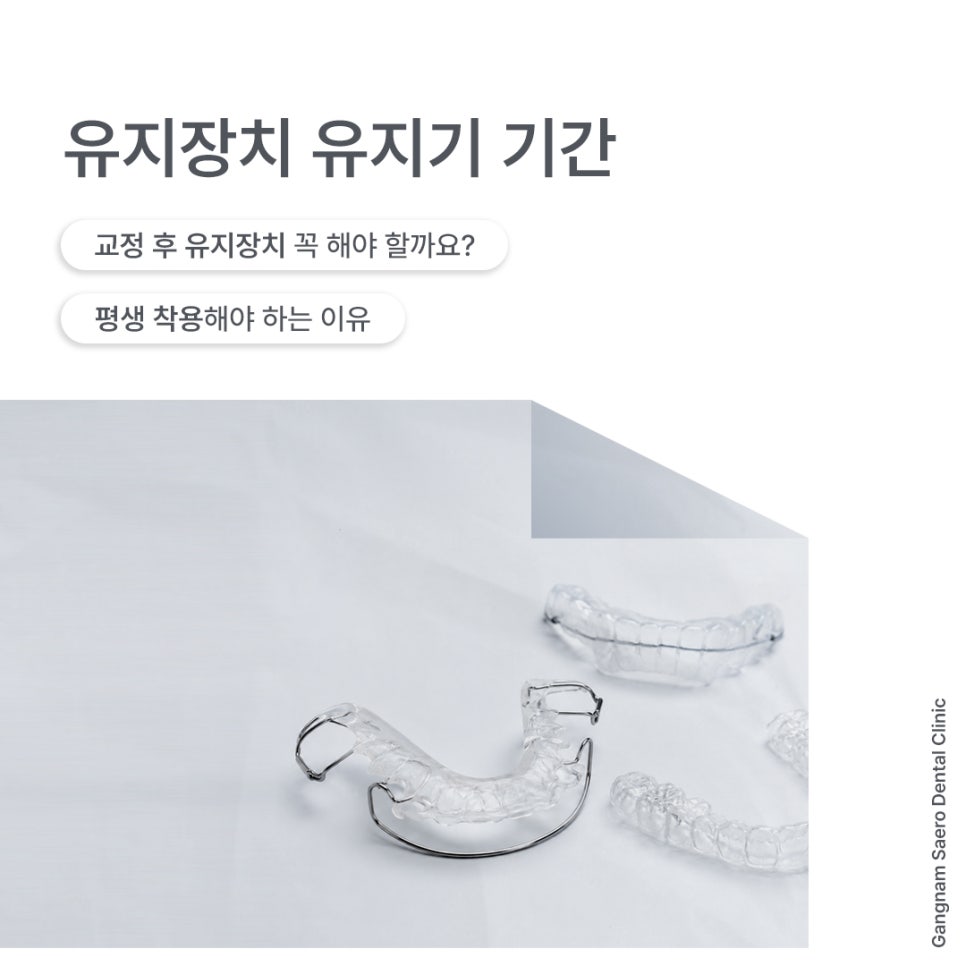
Do you really need to wear an orthodontic retainer?
Retainer wear period, retention period, lifelong retainer use, lifelong retention
Why Retainers May Need to Be Worn Long-Term
For those considering orthodontic treatment,
there is something they worry about as much as changes in their tooth alignment.
That is how long they need to wear a retainer after orthodontic treatment ends.
Why do you need to wear another appliance after treatment is complete?
Do you have to wear a retainer for the rest of your life?
Will your teeth move back if you stop wearing it for a short time?
There are many questions about retainers like these.
To maintain the straight alignment achieved through a long period of time and effort,
retention management, the final stage of orthodontic treatment, is very important!
Today, Gangnam Saero Dental Clinic will explain in detail
why orthodontic retainers are needed,
retainer wear periods, retention periods, and types of retainers.
Why You Need to Wear a Retainer After Orthodontic Treatment
Orthodontic treatment is not simply a treatment that moves the teeth.
The teeth are supported within the jawbone by tissue called the periodontal ligament.
When consistent force is applied through orthodontic appliances,
processes of resorption and formation repeatedly occur in the tissues surrounding the teeth,
causing the teeth to move to new positions.
However, removing the orthodontic appliance
does not mean that the tissues around the teeth immediately become stable.
They need time to adapt to their new positions,
and during this period, the teeth tend to try to return to their original locations.
This is called tooth relapse.
Retainers help prevent this relapse
and maintain the results of orthodontic treatment in a stable condition.
What Happens If You Do Not Wear an Orthodontic Retainer?
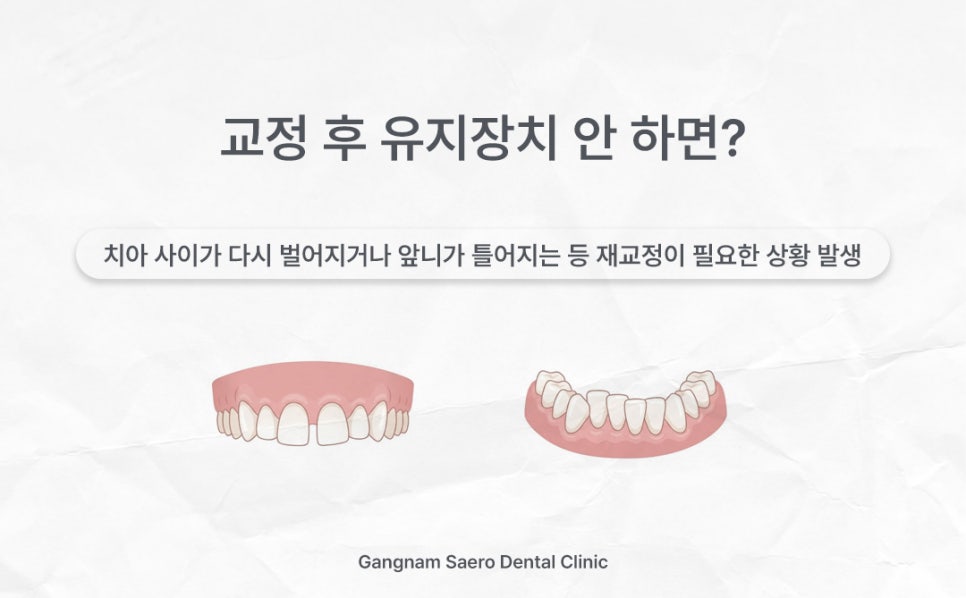
Many people think, “My orthodontic treatment is over, so everything is completely finished now,”
but in fact, orthodontic treatment can be considered complete only when it includes retention management.
The first six months after treatment are especially
an important period during which the tissues stabilize after tooth movement.
If retainers are not worn properly during this period,
the spaces between the teeth may reopen,
or situations requiring retreatment may occur, such as the front teeth becoming misaligned again.
In addition, teeth naturally shift little by little with age,
so changes in tooth alignment can occur even in people who have not had orthodontic treatment.
Therefore, if you want to maintain your orthodontic results for a long time,
it is important to follow the retention management plan recommended by your specialist.
Do You Need to Wear an Orthodontic Retainer for Life?
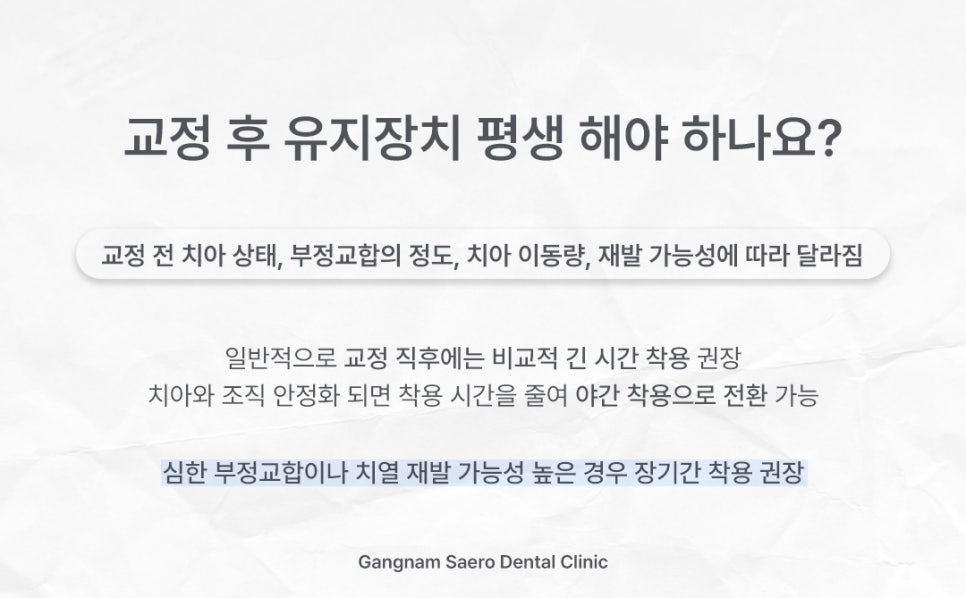
You may have heard that retainers need to be worn for life.
Strictly speaking, however, not everyone
needs to wear one for the same length of time.
The retainer wear period and whether lifelong retention is needed
depend on factors such as
the condition of the teeth before orthodontic treatment,
the severity of the malocclusion,
the amount of tooth movement,
and the likelihood of relapse.
In general, immediately after orthodontic treatment,
wearing a retainer for a relatively long period is recommended.
Once the teeth and surrounding tissues become stable,
many people reduce the wearing time and switch to nighttime wear.
However, long-term retainer use may be recommended
in cases of severe malocclusion or a high likelihood of relapse.
What matters is not a single correct answer to the question of how long you should wear one,
but receiving retention management suited to the current condition of your teeth!
Types of Orthodontic Retainers
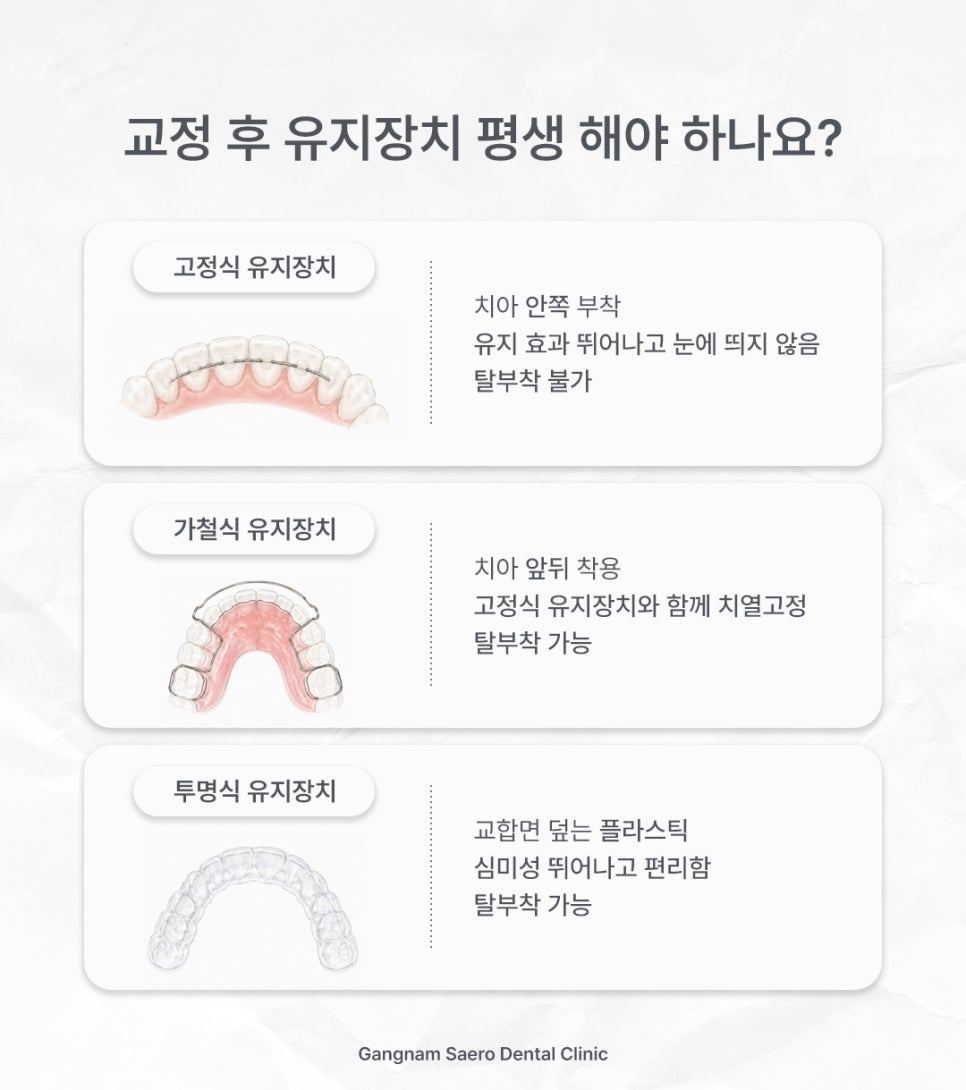
Retainers can be broadly divided into three types.
- Fixed Retainer
A thin wire is attached to the inner surfaces of the teeth.
It is not easily visible,
and you do not need to keep track of separate wearing times.
However, food can become trapped around the wire and tartar can form,
so thorough oral hygiene is necessary.
- Removable Retainer
This type can be put in and taken out by the wearer as needed.
It is often worn for longer periods initially,
and later mainly during sleep.
It is easy to clean and maintain,
but if it is not worn, its retention effect may decrease,
so the patient's cooperation is important.
- Clear Retainer
This is a retainer made of transparent plastic,
and many people prefer it because of its excellent appearance.
Although it is not very noticeable,
it may become deformed or damaged with prolonged use,
so regular checks are necessary.
How Do You Choose an Orthodontic Retainer?
A retainer is not selected simply
based on the type the patient wants.
The condition of the teeth before orthodontic treatment,
the direction of tooth movement,
the severity of the malocclusion,
and the likelihood of relapse
must all be assessed together.
Depending on the case, a fixed and removable retainer may be used together,
or additional retention management may be needed.
Therefore, even after orthodontic treatment is complete,
it is important to have a thorough consultation with a specialist
to determine the retention method that is right for you.
Maintaining Your Orthodontic Results
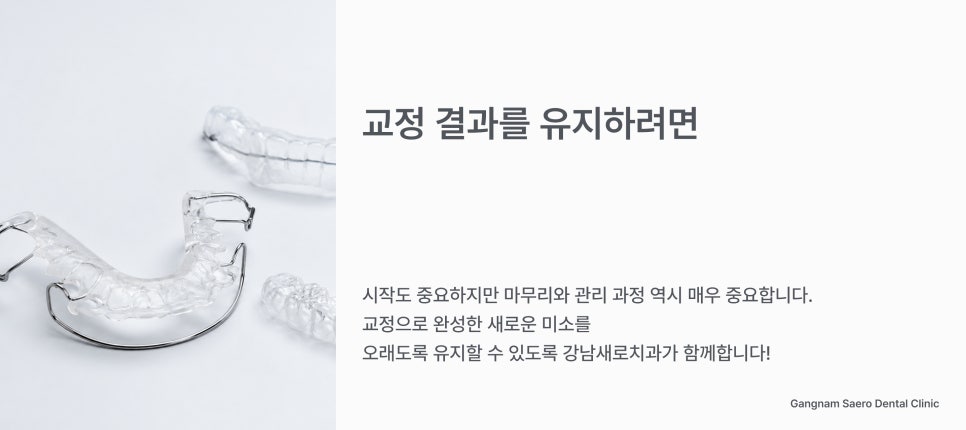
Starting orthodontic treatment is important,
but the finishing and management processes are also very important.
Even if a perfectly straight alignment has been achieved,
changes may occur again over time if retention management is not properly carried out!
Gangnam Saero Dental Clinic
carefully analyzes each patient's dental condition and orthodontic results
and develops a systematic retention management plan that takes the post-treatment period into account.
We will be with you so that you can maintain
the new smile achieved through orthodontic treatment for a long time!
A new smile,
a new beginning,
this is Gangnam Saero Dental Clinic.
- This post, including medical information, was provided by a medical institution under a third-party contractual relationship.