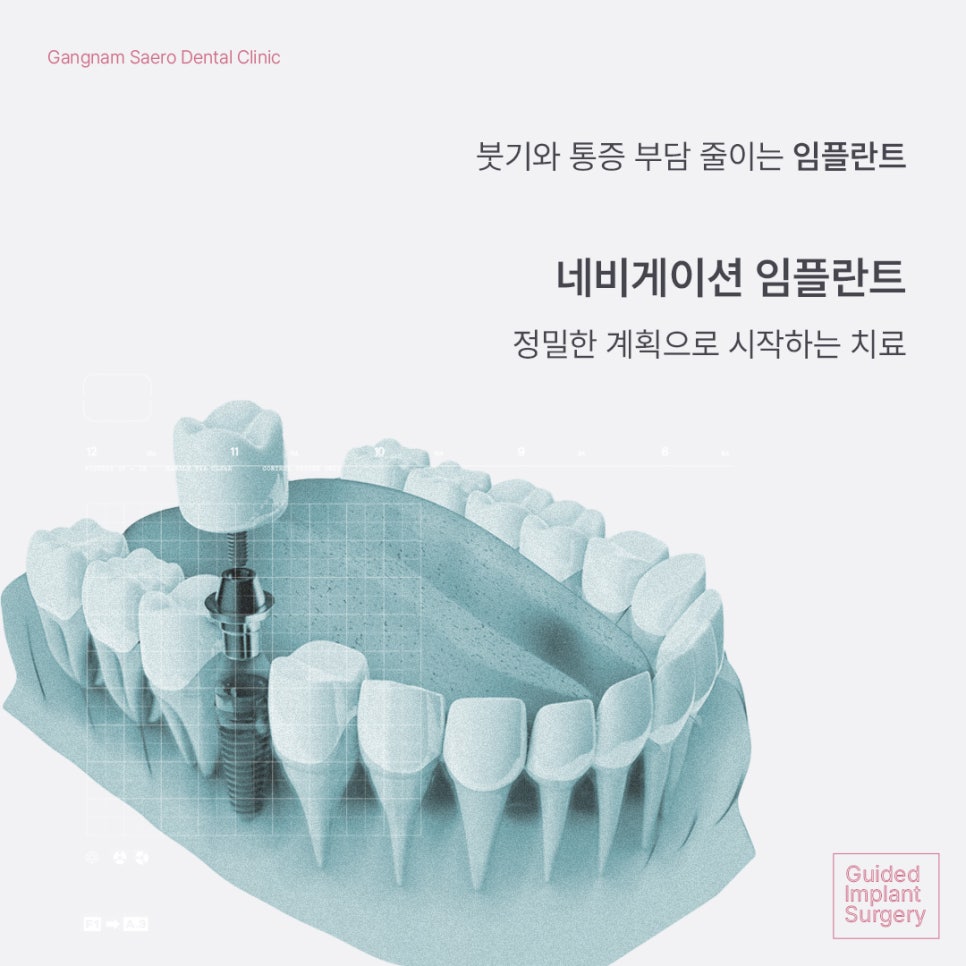
Implants with Less Swelling and Pain Burden
Navigation-Guided Implants
Treatment That Begins with Precise Planning
What is the biggest concern for people considering implants?
Cost is certainly important,
but what many people think of first
is the burden of the surgical procedure itself.
Will the gums need to be incised?
Will there be significant swelling after surgery?
Will the pain last for a long time?
Since implants involve placing an artificial tooth root into the jawbone,
it is natural to feel anxious about the surgical process.
However, in recent years, navigation-guided implants have been attracting attention
as a treatment method that uses digital equipment and precise analysis systems
to establish a more systematic surgical plan.
Let’s take a look at the principles and advantages
of navigation-guided implants introduced by Gangnam Saero Dental Clinic!
What Are Navigation-Guided Implants?
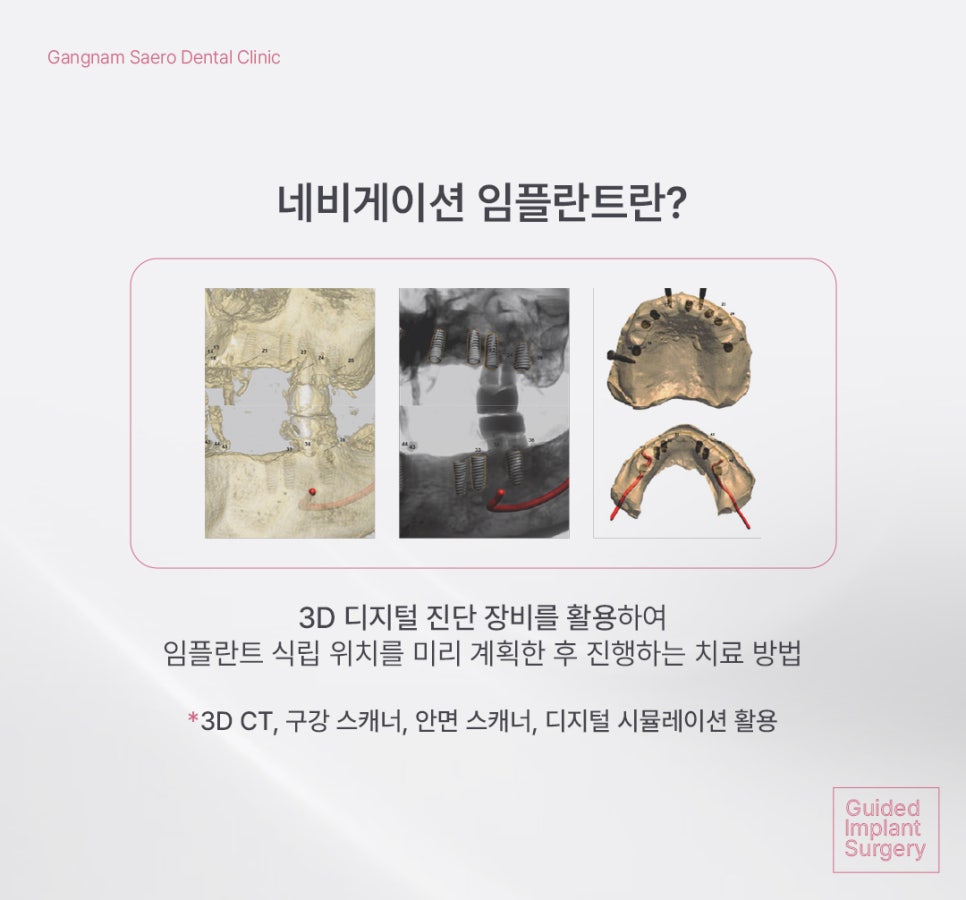
Navigation-guided implants
are a treatment method in which the implant placement site is planned in advance
using 3D digital diagnostic equipment before the procedure is performed.
While conventional treatment has involved some reliance on the clinician’s experience and judgment,
navigation-guided implants use
3D CT
an intraoral scanner
an facial scanner
digital simulation
and other tools to analyze the patient’s oral structure and jawbone condition
and design a virtual surgical procedure.
A surgical guide produced based on this plan is then used
to place the implant at the planned location,
enabling a more precise treatment plan to be established.
Precise 3D CT Diagnosis
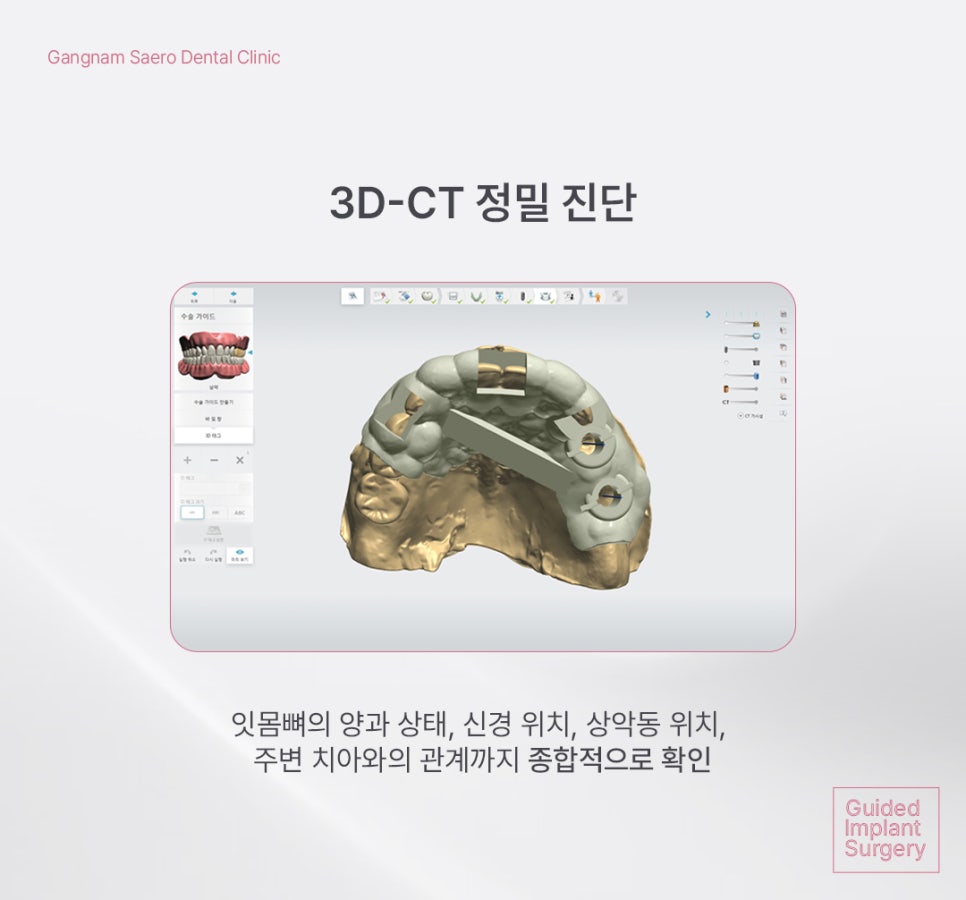
What is important in implant treatment
is not simply placing an implant where a tooth is missing.
The amount and condition of the jawbone,
the location of the nerves,
the location of the maxillary sinus,
and the relationship with the surrounding teeth
must all be assessed comprehensively.
Conventional two-dimensional panoramic imaging
is helpful for checking the overall structure,
but it has limitations when it comes to three-dimensional analysis.
In contrast, 3D CT
allows the jawbone and tooth structures to be viewed three-dimensionally,
making it possible to perform more detailed evaluations, including:
checking the condition of the jawbone
analyzing the implant placement site
checking the distance from the nerves
planning the surgical direction
A stable implant treatment plan
must be based on an accurate diagnosis.
3D Facial Scanner RAY FACE
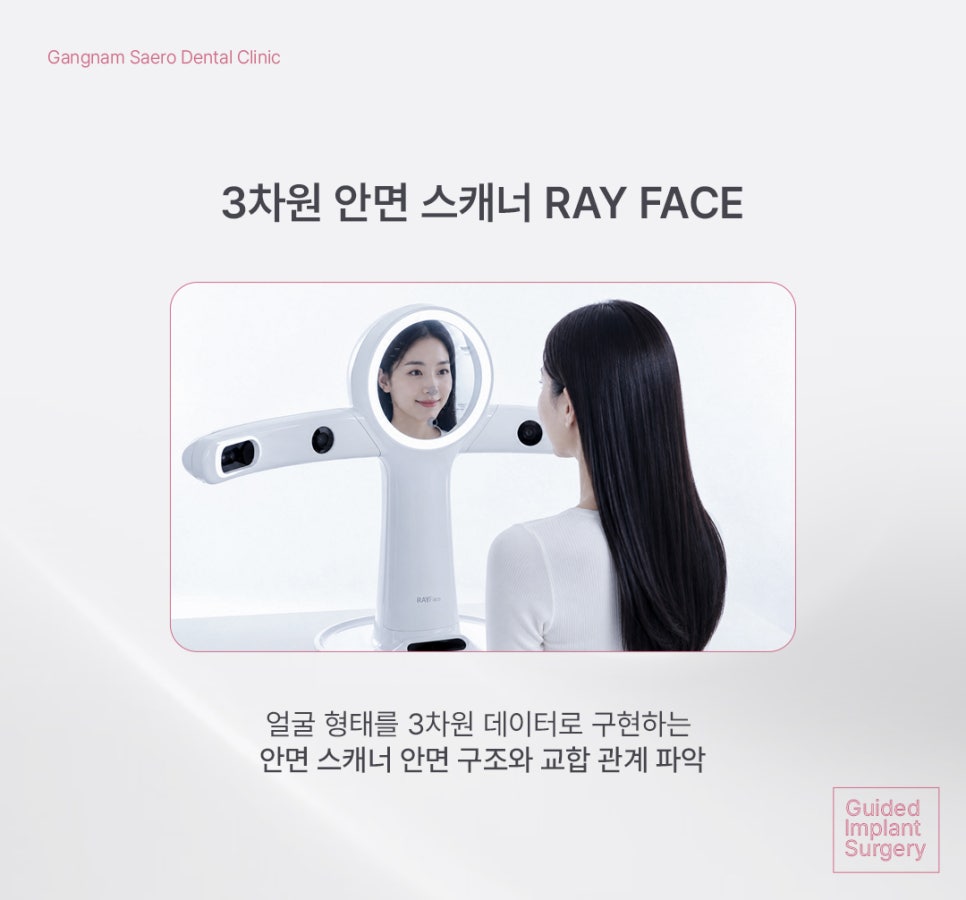
In implant treatment,
the balance of the entire face is important,
not just the teeth and gums.
RAY FACE
is a facial scanner that converts facial features into three-dimensional data.
By analyzing CT data together with intraoral data,
it helps assess the patient’s facial structure and occlusal relationship.
This makes it possible to predict changes before and after treatment
and provide easier-to-understand consultations for patients.
Digital Intraoral Scanner
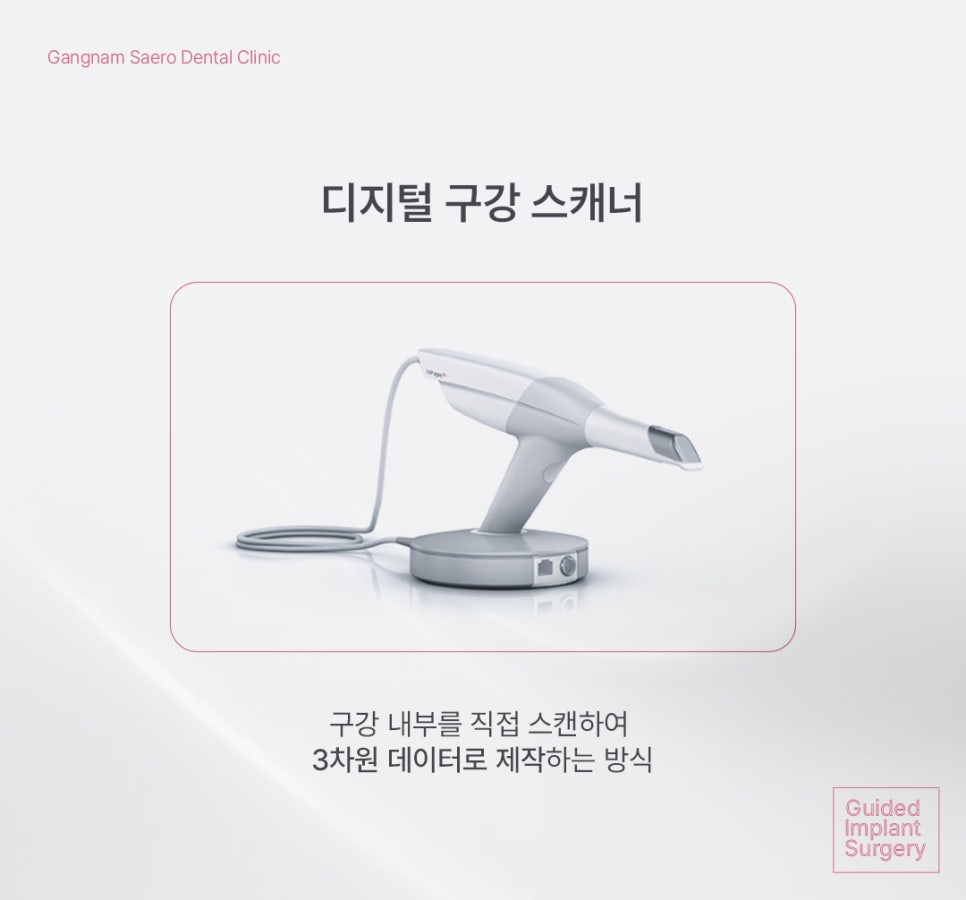
In conventional implant treatment,
rubber impression material
was often used to take dental impressions.
A digital intraoral scanner, however,
directly scans the inside of the mouth
and creates a three-dimensional model.
It can reduce
the discomfort caused by impression material,
the gagging sensation,
long production times,
and the possibility of material distortion
that may occur with conventional methods,
providing a more comfortable treatment environment.
Advantages of Navigation-Guided Implants
- The placement site can be planned in advance
Important factors that affect implant outcomes
include the placement site and direction.
Navigation-guided implants
analyze the following through virtual simulation before surgery:
implant depth
placement angle
the relationship with surrounding structures
This enables a more systematic approach to implant treatment.
- They may help reduce the burden of surgery
Depending on the circumstances, conventional implant treatment
may require gum incision and suturing.
Because navigation-guided implants are performed based on a location planned in advance,
the extent of the incision may be reduced in some cases.
Therefore, they may help reduce the burden of
swelling
bleeding
and pain
that can occur after surgery.
※ However, differences may occur depending on the individual’s gum condition, the number of implants being placed, and whether bone grafting is required.
- The treatment process can be planned efficiently
Conventional implant treatment
requires multiple stages,
from diagnosis and surgery to prosthesis fabrication.
Because navigation-guided implants are planned based on digital data,
the entire treatment process can be managed more efficiently.
The Choice of Clinician Is Also Important for Navigation-Guided Implants
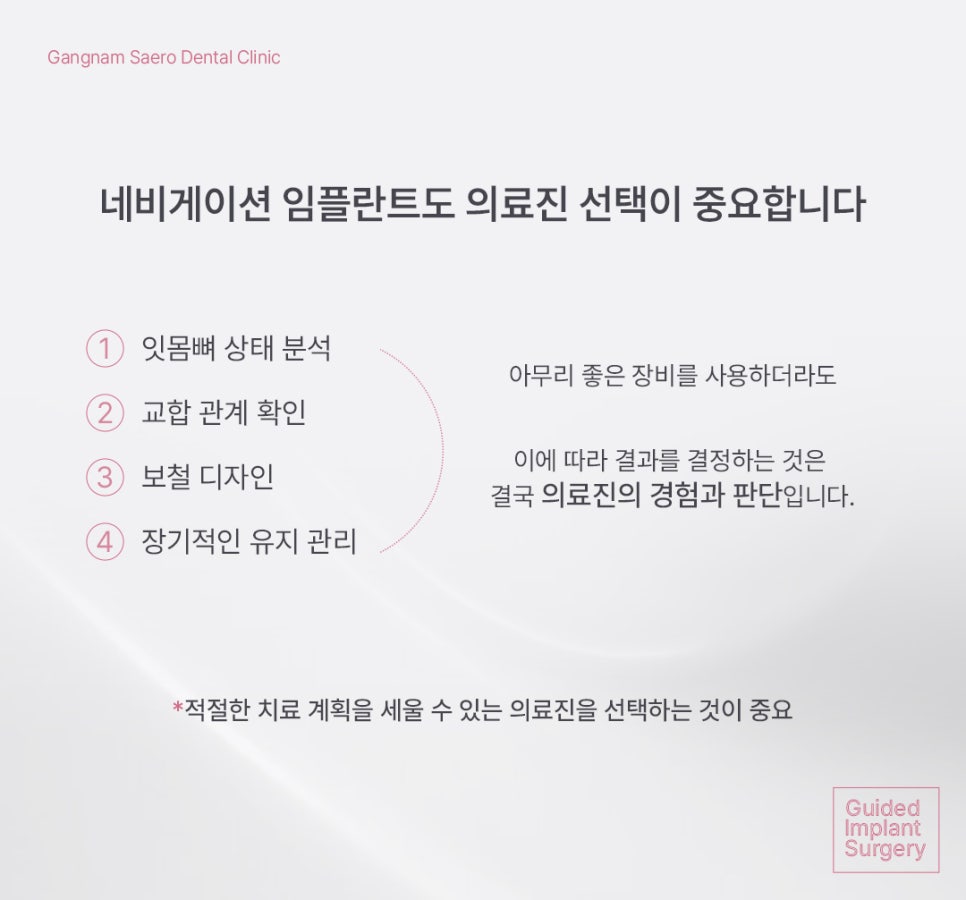
No matter how advanced the equipment may be,
the final outcome is ultimately determined by the clinician’s experience and judgment.
This is because implant treatment is not simply a matter of placing a tooth;
it must also take into account
the condition of the jawbone,
the occlusal relationship,
the prosthetic design,
and long-term maintenance.
Therefore, in addition to digital equipment,
it is important to choose a clinician
who can accurately assess the patient’s condition
and establish an appropriate treatment plan.
Implant Treatment That Begins with Precise Diagnosis
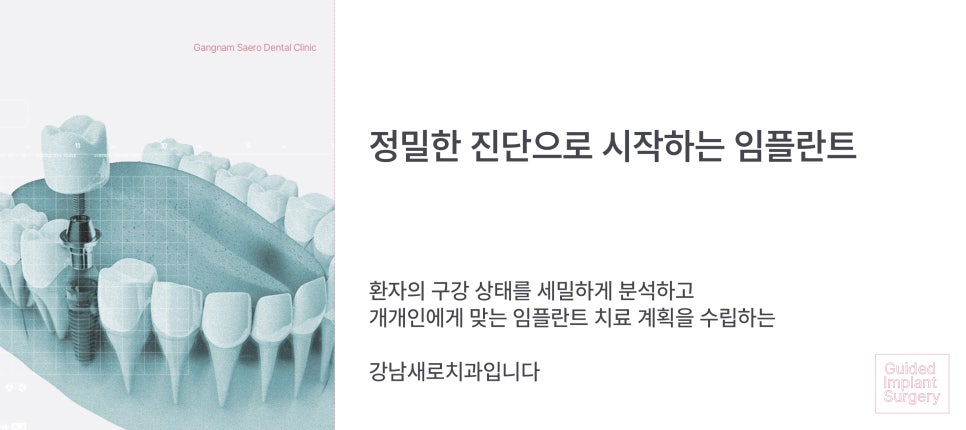
Gangnam Saero Dental Clinic
carefully analyzes each patient’s oral condition
and establishes an implant treatment plan tailored to the individual.
Based on precise analysis using a digital diagnostic system
and extensive clinical experience,
we strive to achieve more stable treatment outcomes.
If you are afraid of implants,
why not begin with an accurate diagnosis rather than vague concerns?
A new smile,
a new beginning,
Gangnam Saero Dental Clinic.
- This post is a medical information post provided by a medical institution under a third-party contractual relationship.