How to Transform Your Face Without Surgery
What Is Two-Jaw Orthodontic Treatment?
The Difference Between Two-Jaw Surgery and Two-Jaw Orthodontic Treatment
Underbite, a receding chin, protruding mouth, and facial asymmetry.
If you have concerns about your facial appearance,
the first treatment that may come to mind
could be two-jaw surgery.
However, surgery is not necessary in every case.
If your facial balance appears compromised
due not to a problem with the jawbones themselves,
but because of tooth alignment and bite issues,
you may consider non-surgical two-jaw orthodontic treatment
instead of two-jaw surgery.
Then what is two-jaw orthodontic treatment,
and in what cases can it be used?
Gangnam Saero Dental Clinic will explain!
What Is Two-Jaw Orthodontic Treatment?
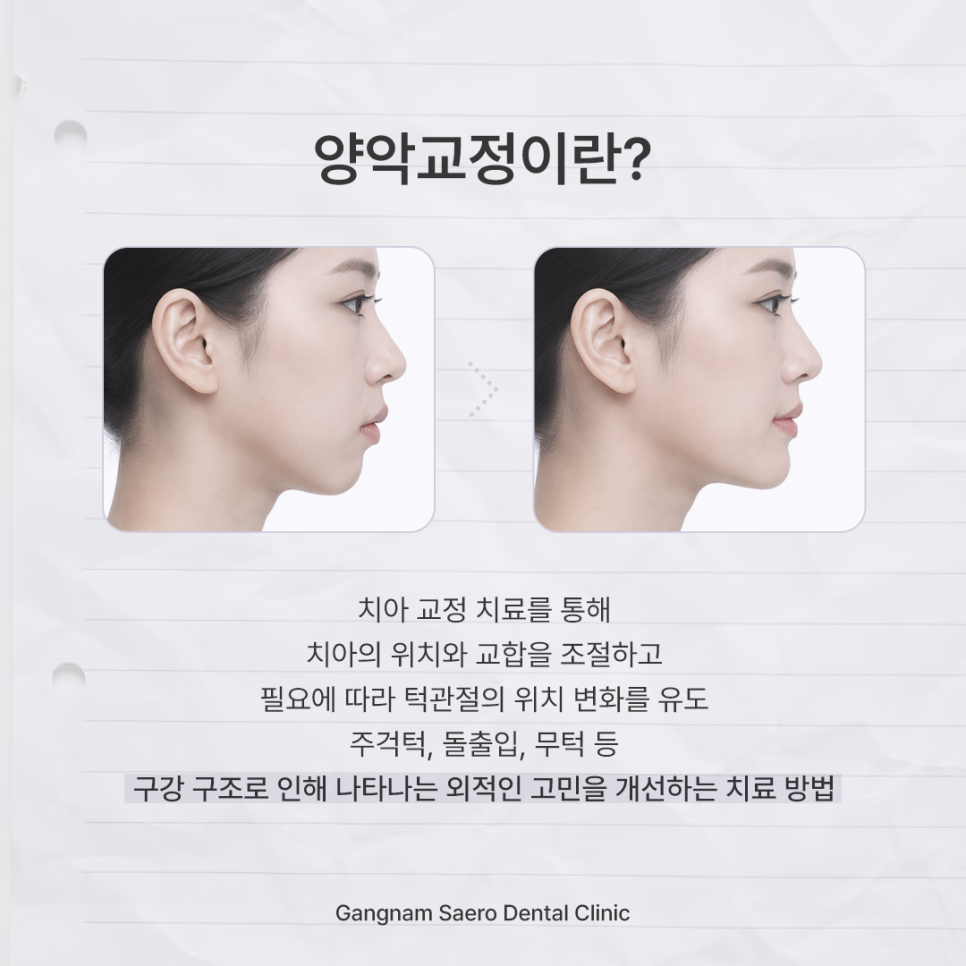
Non-surgical two-jaw orthodontic treatment
uses orthodontic treatment
to adjust the position of the teeth and the bite,
and, when necessary, to induce changes in the position of the jaw joints.
It is a treatment method intended to improve external concerns
such as an underbite, protruding mouth, or receding chin
caused by the oral structure.
While general orthodontic treatment
focuses on correcting crooked tooth alignment,
two-jaw orthodontic treatment considers not only tooth alignment,
but also the way the upper and lower teeth meet and overall facial balance!
However, an important point is that
two-jaw orthodontic treatment is not surgery
that directly moves the size or position of the bones themselves.
Therefore, if the skeletal problem is severe,
two-jaw surgery may be more appropriate.
Cases in Which Two-Jaw Orthodontic Treatment Is Possible
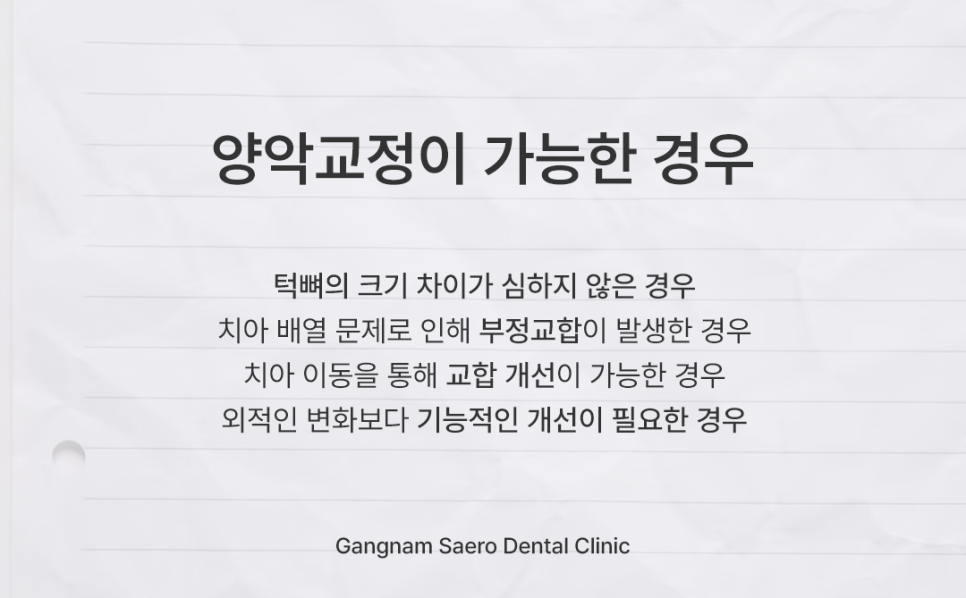
Non-surgical two-jaw orthodontic treatment
is not applicable to every case of an underbite, receding chin, or facial asymmetry.
The cases that may typically be considered include:
when the difference in jawbone size is not severe;
when malocclusion has occurred due to tooth alignment problems;
when the bite can be improved through tooth movement;
and when functional improvement is needed more than an external change.
For example, if the lower jaw is not actually significantly overdeveloped,
but the lower teeth protrude forward and make you look as though you have an underbite,
a direction for improvement may be found
through tooth movement!
Conversely, if there is a major difference in the positions of the jawbones themselves,
orthodontic treatment alone may have limitations.
Difference Between Two-Jaw Orthodontic Treatment and Two-Jaw Surgery
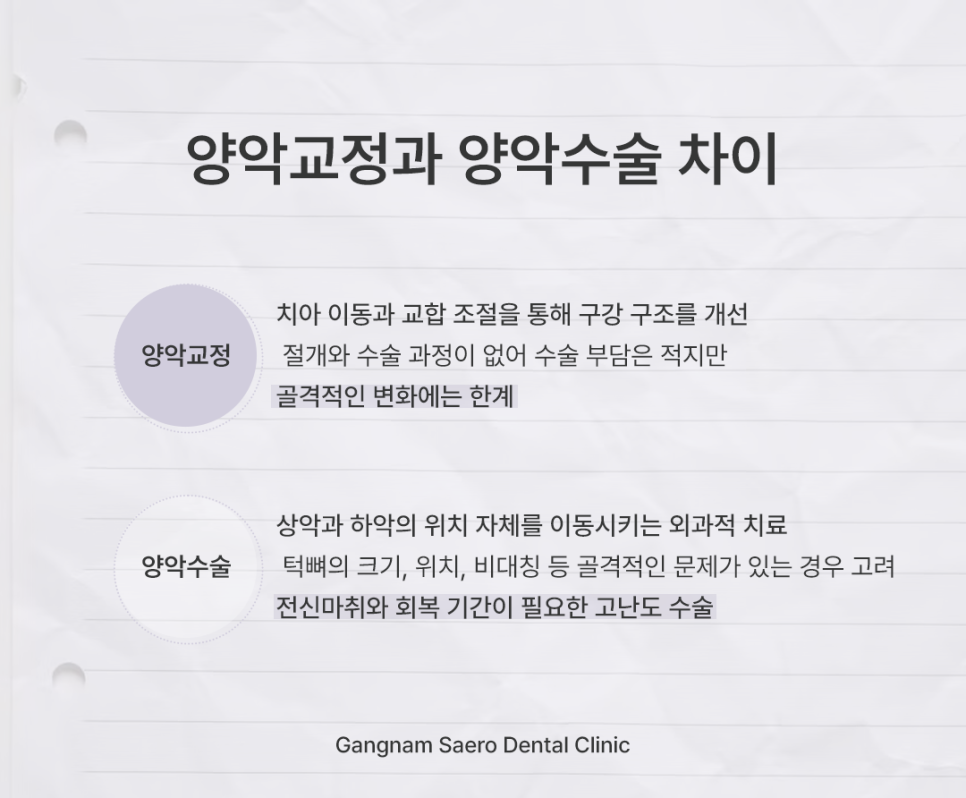
The biggest difference between
non-surgical two-jaw orthodontic treatment and two-jaw surgery
is what is being changed.
Two-Jaw Orthodontic Treatment
This method improves the oral structure
through tooth movement and bite adjustment.
Because it does not involve incisions or surgery,
there is less burden associated with surgery,
but it has limitations when it comes to skeletal changes.
Two-Jaw Surgery
This is a surgical treatment
that moves the positions of the upper and lower jaws themselves.
It may be considered when there are skeletal problems
involving the size, position, or asymmetry of the jawbones.
However, because it is a complex surgery
that requires general anesthesia and a recovery period,
the decision should be made after sufficient examination and consultation.
Principles of Two-Jaw Orthodontic Treatment
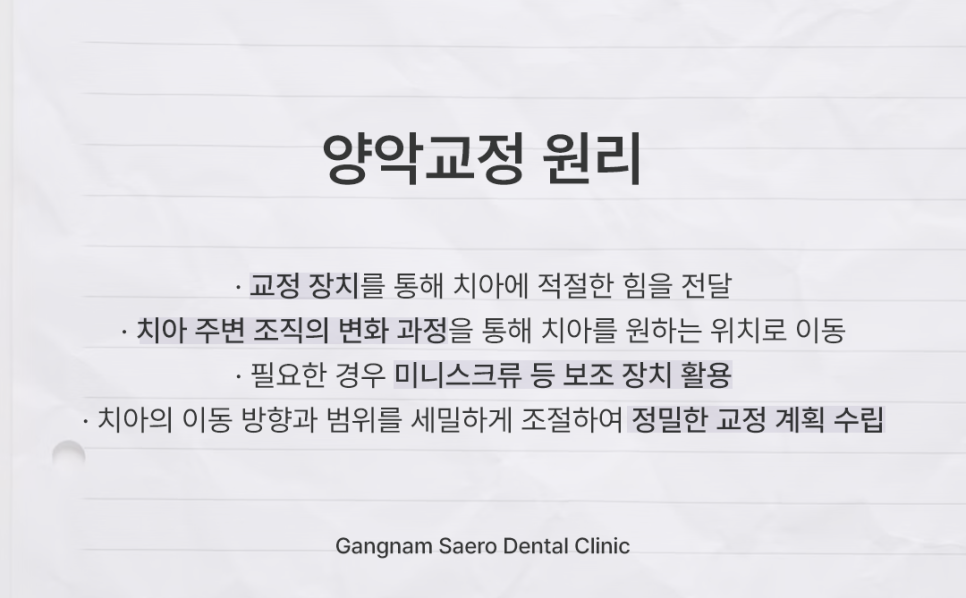
Non-surgical two-jaw orthodontic treatment
cannot be described simply as a process of straightening the teeth!
Because teeth move within the jawbone,
orthodontic appliances apply force,
and the teeth move into the desired position
through changes in the tissues surrounding them.
When necessary,
auxiliary devices such as miniscrews may be used
to control the direction and range of tooth movement
and create a more precise orthodontic treatment plan.
Two-jaw orthodontic treatment also
requires more than simply straightening the teeth,
so various auxiliary devices may be used!
Points to Check Before Two-Jaw Orthodontic Treatment
If you are considering non-surgical two-jaw orthodontic treatment,
the first thing to determine
is whether the cause of your facial concern
lies in your teeth or your bones.
Even if an underbite or protruding mouth appears similar on the outside,
in some people the cause may be the position of the teeth,
while in others it may be a jawbone growth problem!
If the causes are different but the same treatment method is applied,
it would naturally be difficult to expect satisfactory results.
Therefore, it is very important to accurately assess your current structure
through a diagnosis by an orthodontic specialist
and an oral and maxillofacial surgery specialist!
Facial Changes After Two-Jaw Orthodontic Treatment
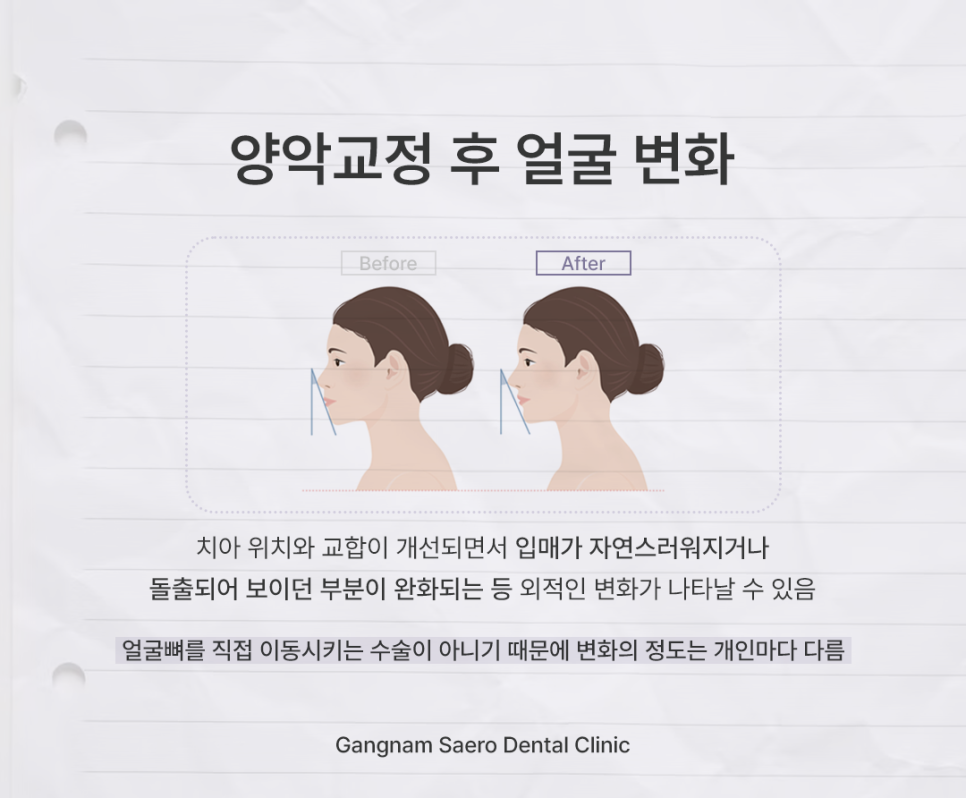
The aspect that people considering two-jaw orthodontic treatment
are most curious about is probably facial changes!
As tooth position and the bite improve,
external changes may appear,
such as a more natural lip line
or a reduction in the appearance of protrusion.
However, because two-jaw orthodontic treatment
is not surgery that directly moves the facial bones,
the extent of change varies from person to person.
The important thing is
to create a treatment plan that harmonizes with your existing facial structure,
rather than trying to create a major change at all costs.
Gangnam Saero Dental Clinic's Two-Jaw Orthodontic Treatment
Two-jaw orthodontic treatment
is not simply orthodontic treatment that moves the teeth.
It is a treatment that requires consideration of
tooth alignment,
the bite,
the jaw joints,
and facial balance together.
We hope this helped you understand it well!
Gangnam Saero Dental Clinic
works collaboratively with orthodontic specialists
and oral and maxillofacial surgery specialists
to accurately determine whether your condition is within the range treatable with orthodontics
or whether a surgical approach is necessary,
and then decides on the treatment direction.
Find a healthy bite and natural smile
with the method that is right for you!
A new smile
A new beginning
A fresh start
This is Gangnam Saero Dental Clinic.
- This post is a medical information post provided by a medical institution under a third-party contractual relationship.