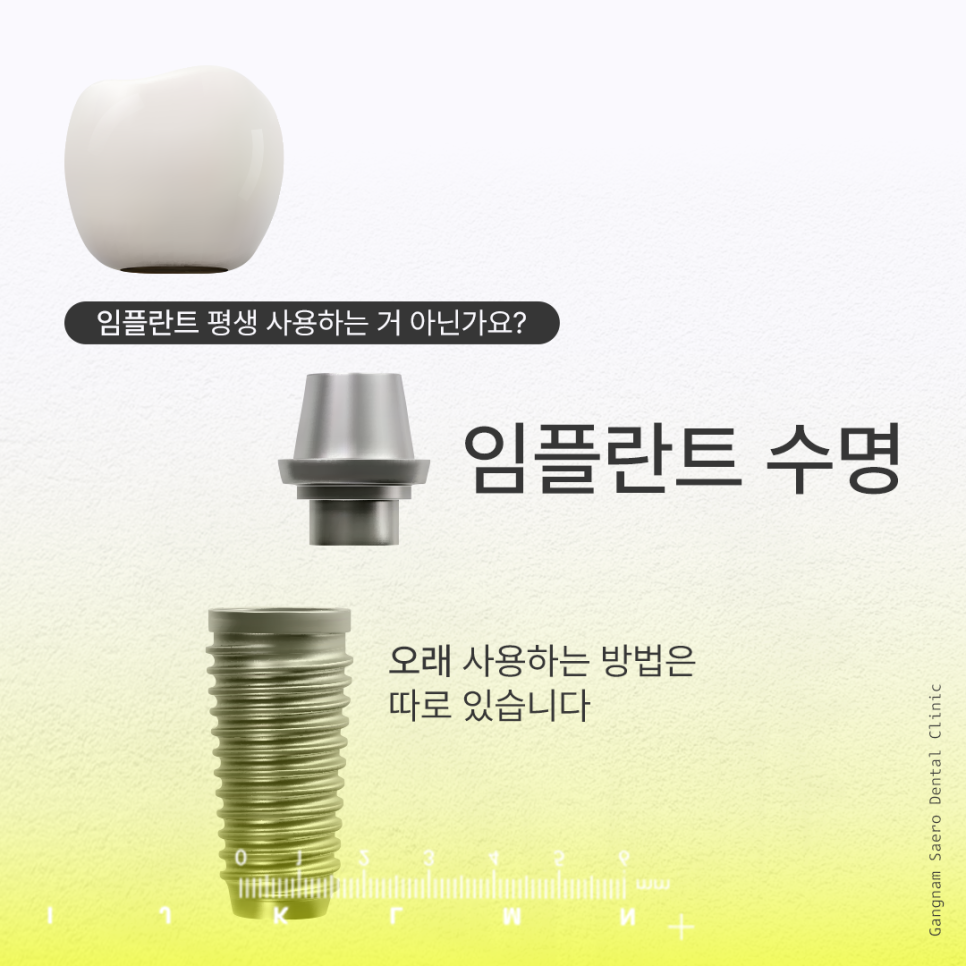
Aren’t implants meant to last a lifetime?
Implant Lifespan
There are specific ways to use them for a longer time
Implants require a considerable amount of money, even for the placement of a single implant.
Because of this,
many people think that once an implant is placed,
it can be used for the rest of their lives.
However, just like natural teeth,
the lifespan of an implant can vary depending on its condition and how well it is maintained.
According to long-term clinical data and follow-up results,
the average lifespan of an implant
is known to be approximately 15 to 25 years.
When we say that an implant has reached the end of its lifespan,
we are referring not to the visible prosthetic restoration,
but to a condition in which the artificial tooth root placed in the jawbone
can no longer be maintained.
Then, why can the same type of implant have a difference of more than 10 years in lifespan?
Gangnam Saero Dental Clinic explains the factors that determine implant lifespan.
Implant Lifespan and Oral Care
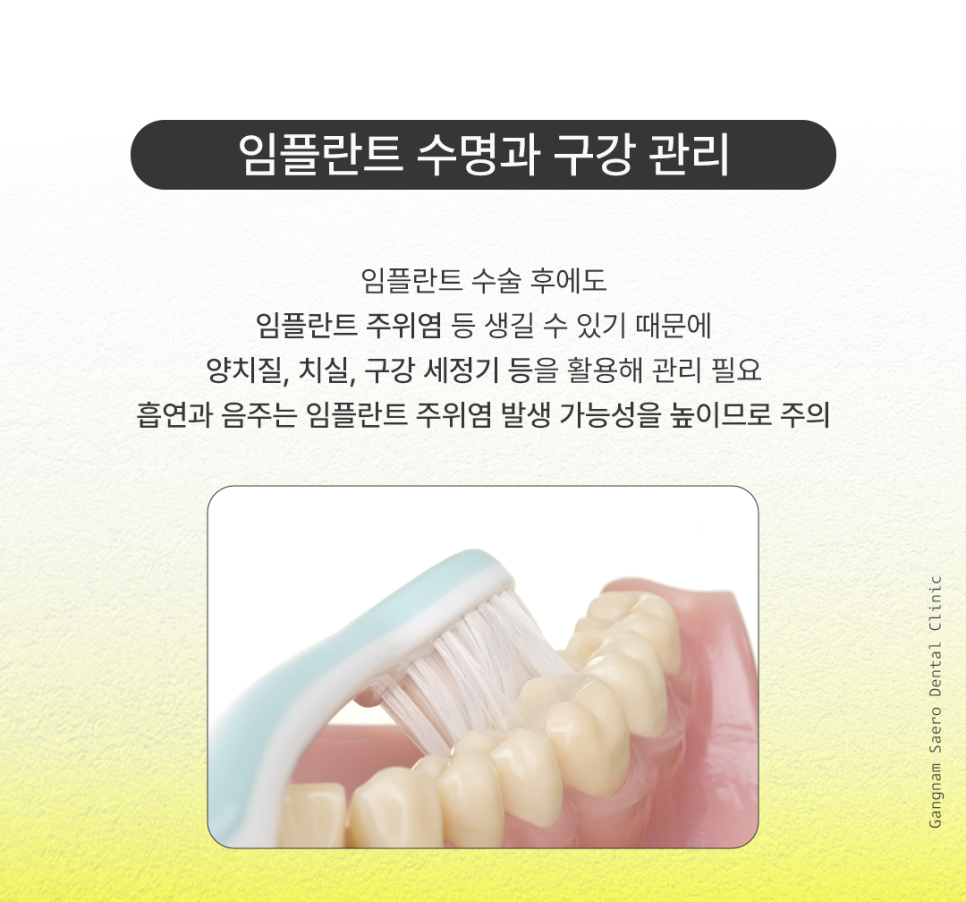
The most basic requirement for using implants for a long time
is maintaining good oral hygiene.
Even after implant placement,
you should consistently manage food particles and bacteria
that remain around the teeth and implants
by using a toothbrush, dental floss, and an oral irrigator.
One condition that requires particular attention
is peri-implantitis.
Peri-implantitis
is similar to periodontitis affecting natural teeth.
It is a condition in which inflammation develops in the gum tissue around an implant,
and the alveolar bone decreases as the inflammation progresses.
The problem is that, unlike natural teeth,
implants do not have internal nerves,
so in many cases, patients do not feel pain
until the inflammation has progressed considerably.
If the alveolar bone continues to be lost,
the artificial tooth root that was placed may become exposed,
which can eventually lead to the implant becoming loose or falling out.
Smoking and drinking alcohol can also
affect blood circulation and gum recovery,
potentially increasing the likelihood of peri-implantitis,
so caution is needed!
Regular Checkups for Lifelong Implant Use
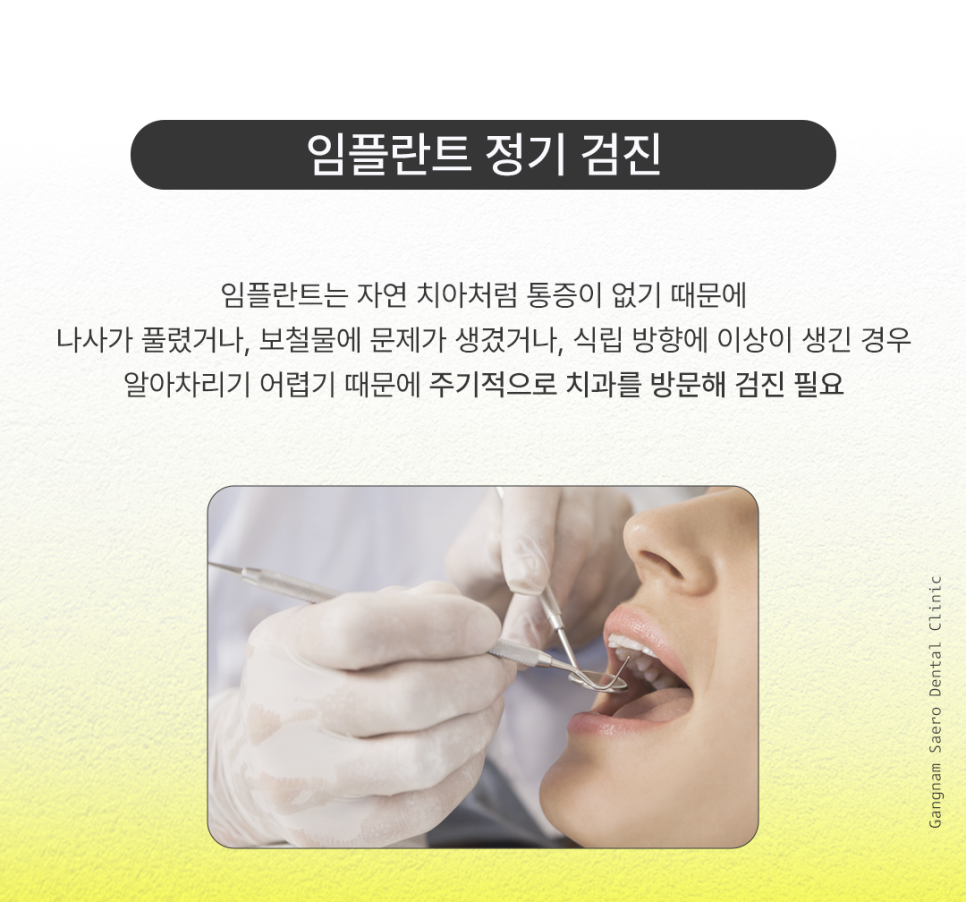
Implant care does not end
when the treatment is complete.
The condition of the implant
must be checked through regular examinations.
Even when a problem occurs,
implants do not have nerves that signal it through pain,
as natural teeth do.
Therefore, patients may have difficulty discovering problems on their own,
such as a loosened screw,
a problem with the prosthetic restoration,
or an abnormality in the placement direction.
For this reason, it is necessary to visit the dentist periodically
and check the condition of the gums around the implant
as well as the condition of the prosthetic restoration!
Choosing an Implant Company
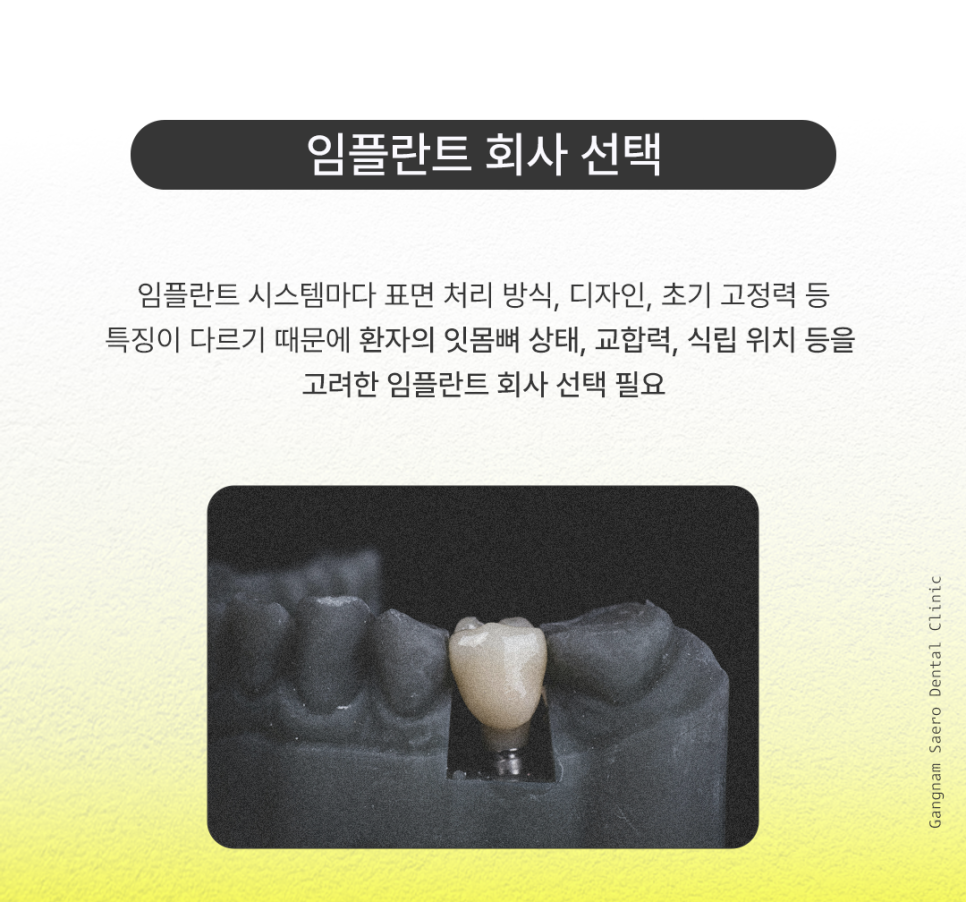
One of the factors that determines implant lifespan
is the implant system used for placement.
There are currently many different implant brands,
and each brand has different characteristics,
including its surface treatment method, design, and initial stability.
For example,
Astra is a brand with a record of maintaining the alveolar bone and extensive long-term clinical data,
while Osstem, a leading Korean implant brand,
has excellent initial stability and extensive clinical experience.
Dentium demonstrates strengths in initial stability
through its precise screw structure,
while Dentis, Warantec, and other brands
are also used clinically based on their respective technologies.
What is important
is not simply choosing one famous implant company,
but selecting an implant suited to the patient
by considering the condition of the jawbone, bite force, and placement location, among other factors.
The Role of the Dental Professional in Determining Implant Lifespan
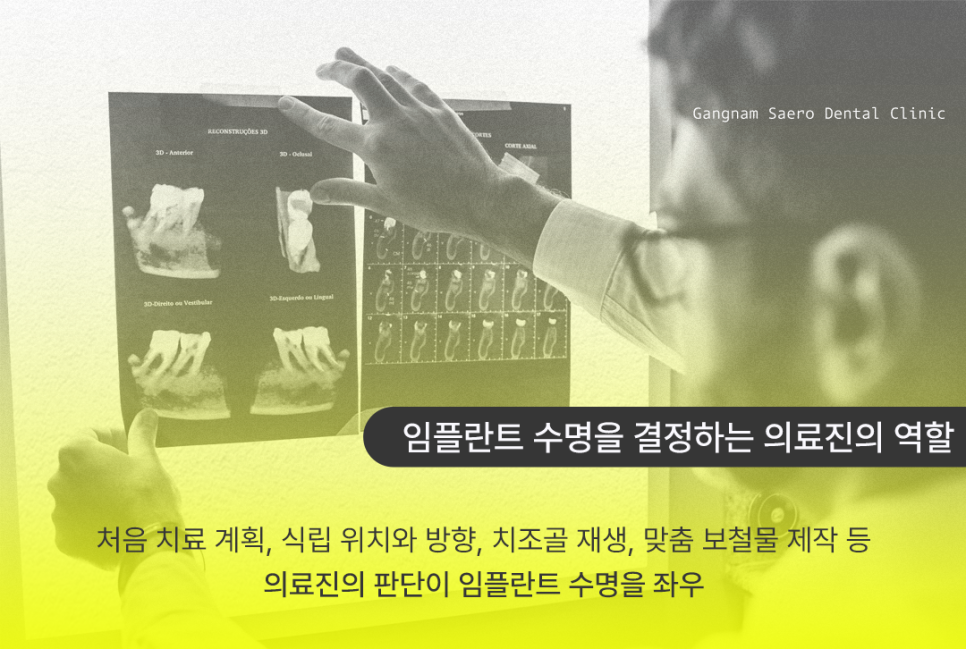
The most important factor in implant lifespan
is ultimately the judgment of the dental professional performing the surgery.
Even if an excellent implant is used
and it is maintained thoroughly,
if the initial treatment plan is incorrect
or the placement location and direction are inappropriate,
the implant’s maintenance period may be shortened.
The following points are particularly important.
Alveolar Bone Regeneration
Because implants are fixed in the jawbone,
the amount and condition of the alveolar bone are very important.
As time passes after a tooth is extracted,
the jawbone may naturally be resorbed.
How well the alveolar bone and gum structure are preserved and restored
during this process
determines implant stability.
Proper Placement Location and Direction
Implant treatment is not simply a matter of filling an empty space.
The placement location, number, length, and direction
must be planned accurately
so that chewing forces are not concentrated on one side
and the implant can be used stably for a long time.
If an implant is placed in the wrong direction,
unnecessary forces may be transferred to the implant and surrounding tissues,
which may lead to problems.
Custom Prosthetic Restoration
The prosthetic restoration, the final stage of implant treatment, is also important.
Because implants replace natural teeth,
chewing forces and balance with the surrounding teeth must be considered.
A custom-made prosthetic restoration must be fitted
after analyzing the patient’s bite, gum shape, and relationship with the surrounding teeth
in order to improve function and maintainability.
Choosing Implants for Long-Term Use
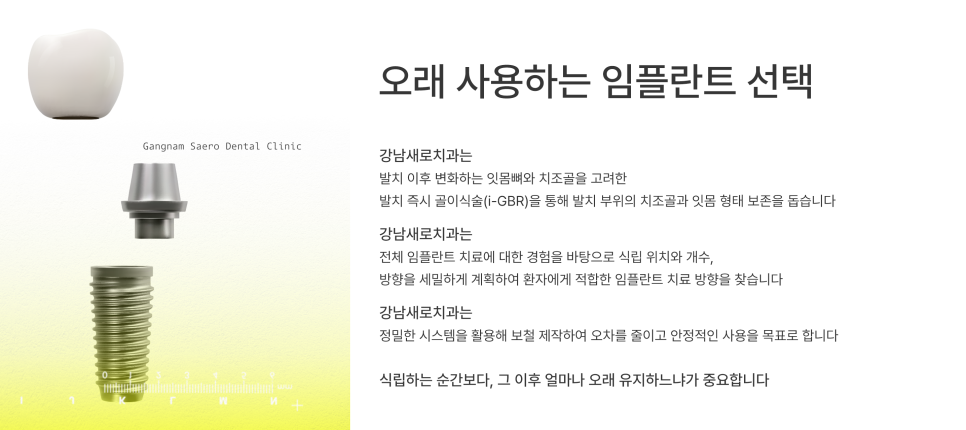
Gangnam Saero Dental Clinic
helps preserve the alveolar bone and gum shape at the extraction site
through immediate post-extraction bone grafting (i-GBR),
while taking into account changes in the jawbone and alveolar bone after extraction.
In addition, based on its experience with comprehensive implant treatment,
the clinic carefully plans the placement location, number, and direction
to determine an implant treatment approach suited to each patient.
Prosthetic restorations are also produced using a precise system
to reduce errors and aim for stable use.
With implants, how long they are maintained afterward
is more important than the moment they are placed.
Implants that can be used for a long time,
A new smile
A new beginning
A fresh start
This is Gangnam Saero Dental Clinic.
- This post is a medical information post provided by a medical institution under a third-party contractual relationship.