Hair loss is no longer a concern only for middle-aged people. Are you perhaps dealing with it silently on your own? These days, as hair loss concerns among younger people have increased, interest in hair transplantation has also risen. If the area of hair loss is small, a non-incisional hair transplantation method may be considered.
With less burden from scalp incision and scars that are less likely to be noticeable, it is one of the methods that people who prefer a natural-looking hair transplant are interested in. Today, for those people, we have organized frequently asked Q&A questions related to the topic of Apgujeong Seojin Plastic Surgery hair transplantation.
What Is Non-Incisional Hair Transplantation

Non-incisional hair transplantation is a corrective method in which follicles are directly harvested one by one from the back of the head without making an incision in the scalp, and then transplanted to the area affected by hair loss.
Unlike the incisional method, it has the advantage of a lighter burden from incision and suturing, and therefore less concern about scarring. It is also a method possible for people with short hairstyles, making it easier to naturally conceal signs of the procedure in daily life.
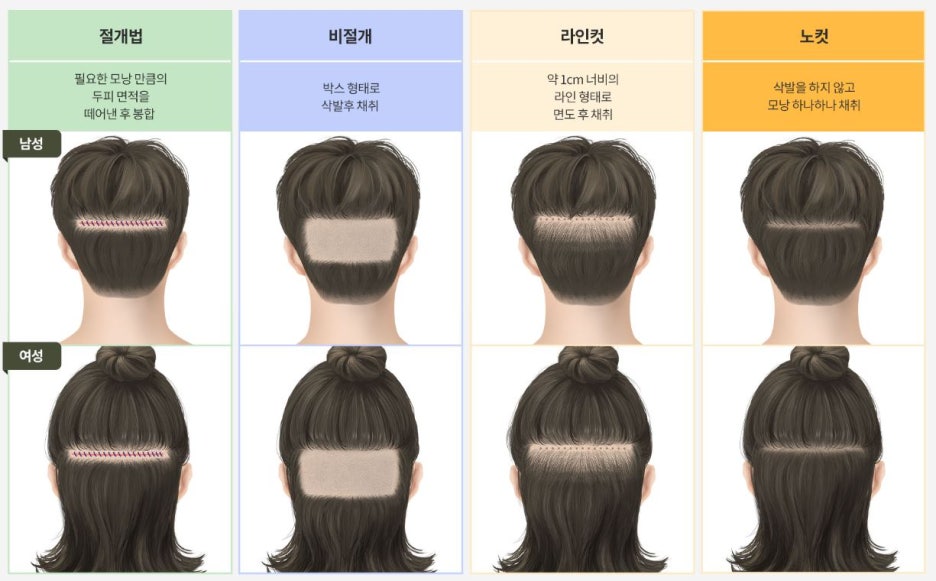
If the incisional method feels burdensome, or if you want to reduce scarring or recovery time, you may also consider the non-incisional method. Depending on the follicle harvesting method, it can be divided into the following types.
🌱 Various Non-Incisional Follicle Harvesting Methods
-
Non-incisional box cut: A method in which the hair is shaved in a box shape before harvesting.
-
Non-incisional line cut: A method in which the hair is shaved in a line about 0.5~1 cm wide before harvesting.
-
Non-incisional no-shave no-cut: A method in which follicles are harvested one by one without shaving.
5 Frequently Asked Q&As
Q&As on Non-Incisional Hair Transplantation at Apgujeong Seojin Plastic Surgery

Q. What is the difference between the incisional and non-incisional methods?
In the incisional method, follicles can be harvested all at once by making an incision in the scalp. It is suitable for people with a large area of hair loss, and the harvest amount is large, but suturing is required. In the non-incisional method, incision and suturing are not necessary, so the burden of pain is lower, but the possible conditions are limited.
Q. When can I return to daily life after a hair transplant?
In the case of non-incisional hair transplantation, daily life is possible from the day of the procedure. Because the non-incisional method does not place a heavy burden in terms of scars and pain, ordinary activities are possible the next day as well. However, if shaving is a concern, various methods such as line cut or no-shave no-cut can be considered.
Q. How high is the graft survival rate?
What matters in a hair transplant is the graft survival rate. The higher the graft survival rate, the more hair can remain after the transplant. In the case of the non-incisional method, if transplantation is performed promptly after follicle harvesting, a high graft survival rate can be expected.

Q. What about pain or side effects?
In the case of the non-incisional method, there is less concern about pain or pulling in the back of the head. There is also less concern about bleeding. However, some patients may experience temporary swelling or oozing. Still, these symptoms can naturally improve over time.
Q. Won't the back of the head look sparse after a non-incisional procedure?
This is one of the concerns for people considering the non-incisional method. In the case of partial shaving, follicles are harvested after shaving in a box shape, and if they are evenly harvested from a wide area rather than focusing on one spot, hair density can be maintained while expecting a natural result. If this method also feels burdensome, a no-shave no-cut hair transplant method can also be considered.
Choose the Hair Transplant Method That Suits You

So far, we have looked at frequently asked questions about Apgujeong Seojin Plastic Surgery hair transplantation and non-incisional hair transplantation methods.
Hair transplantation is one way to effectively improve hair loss for people who do not have much time. However, because the degree of hair loss and the condition of the scalp can vary from person to person, it is advisable to find and apply the method that suits you among the various options.
In particular, to increase the graft survival rate, careful attention is needed not only during the procedure but also in aftercare. After the follicles are transplanted carefully so they are not damaged, you must also follow the guidance provided by the medical institution at home so that the graft survival rate can be improved. Only then can the transplanted hair grow well after shedding, allowing the effects of the hair transplant to be expected.
Because hair loss appears in various forms depending on the individual, from crown hair loss to M-shaped hair loss, it is advisable to proceed with the method that best suits you.
In addition, to reduce side effects after surgery, it is advisable to refrain from smoking and drinking and to follow post-operative care well according to the medical institution's guidance.









Previous image
Next image