
Gynecomastia, also known as enlarged breast tissue in men, refers to a condition in which the chest area develops in a way that resembles female breasts.
This can cause not only physical changes but also psychological discomfort, and in many cases it can make social life difficult.
The causes of this condition vary, and it is important to choose an appropriate treatment method depending on the severity and type of symptoms.
In this post, we will cover the causes of gynecomastia, a self-check method you can use to assess it yourself, and information about surgery and health insurance coverage.
🔎 Causes of Gynecomastia
Gynecomastia in men occurs due to the proliferation of glandular tissue or excessive accumulation of fat tissue, and the main causes are as follows.
Hormonal imbalance:
It can occur when the balance between androgens, the male hormone, and estrogen, the female hormone, is disrupted.
It is especially common as a temporary condition in adolescent boys, and in most cases it resolves naturally as they grow.
Obesity:
When fat tissue accumulates excessively, estrogen can be produced in fat cells and stimulate glandular tissue.
In this case, symptoms may improve with weight loss alone.
Side effects of medication:
Taking certain medications (such as antidepressants, antihypertensives, and antifungal drugs) can affect hormones and cause symptoms.
Illness:
Some diseases, such as cirrhosis, kidney failure, and hyperthyroidism, can also be causes.

🧩 Types of Gynecomastia
Gynecomastia can be broadly divided into cases where glandular tissue has developed and cases where fat tissue has accumulated.
True gynecomastia:
This is caused by excessive proliferation of glandular tissue. It is characterized by a firm lump felt in the center of the chest.
Pseudogynecomastia:
This refers to a condition in which the chest enlarges simply due to fat accumulation, without proliferation of glandular tissue. A firm lump is not felt,
and it may improve through weight loss.
Combined type:
This is when both glandular tissue proliferation and fat accumulation are present. Most patients tend to have the combined type.
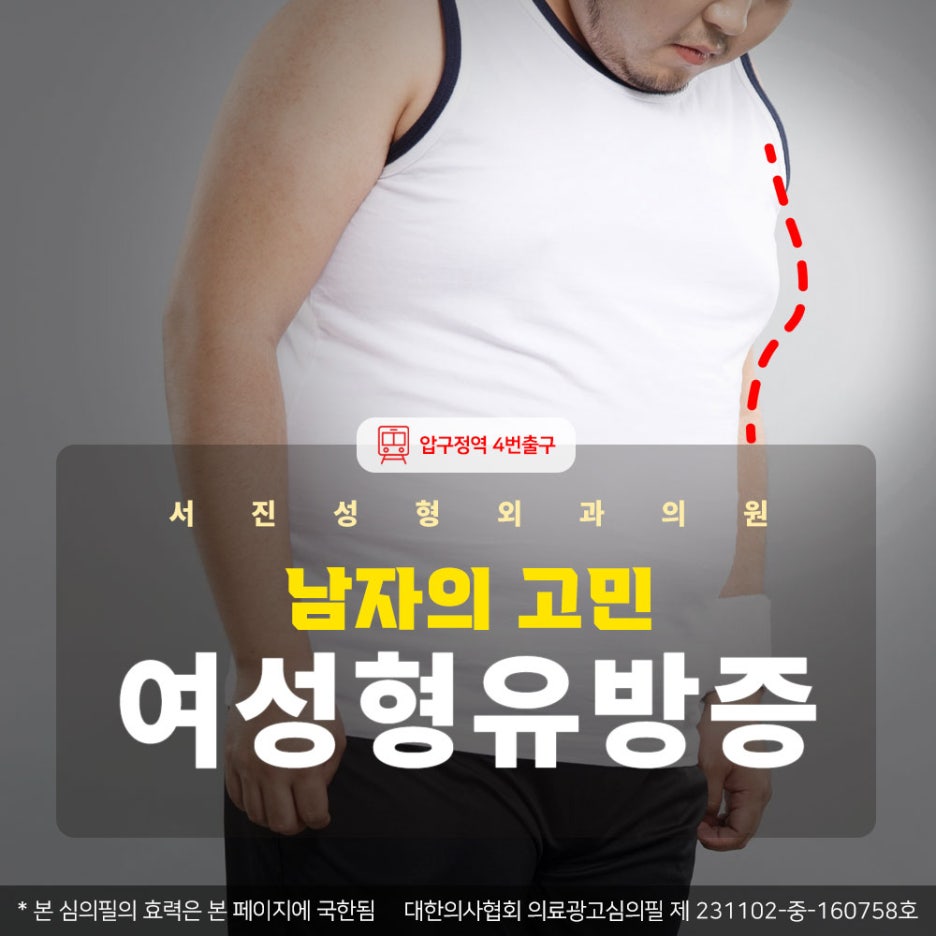
🪞 How to Self-Check for Gynecomastia
If you want to check for yourself whether surgery may be necessary, you can try a gynecomastia self-check. Use the checklist below to assess your condition.
A precise diagnosis is only possible through a visit to a medical institution, but this self-check for gynecomastia can help you understand your condition.
Gynecomastia self-check checklist
-
A firm lump can be felt in the chest area.
-
The area around the nipple is swollen or enlarged.
-
The chest area does not reduce even with dieting or exercise.
-
The area around the nipple feels firm or a lump can be felt.
-
The shapes of the left and right breasts have developed differently.
-
The lower chest is more sagging than the upper chest.
If 2 or 3 or more of the above gynecomastia self-check items apply to you, there is a possibility that you may have gynecomastia.
In particular, if a firm lump can be felt under the areola, it may be true or combined gynecomastia in which glandular tissue has developed, so
it is advisable to consult a medical professional after the self-check.
🛠 Gynecomastia Surgery Methods & Whether Health Insurance Applies
Treatment for gynecomastia may involve surgical or non-surgical methods depending on the cause and type of symptoms.
Pseudogynecomastia caused by simple fat accumulation can be improved with liposuction alone. However, if glandular tissue has developed, gland removal surgery must also be performed.
The surgery involves making an incision around the areola to remove glandular tissue, and liposuction may be performed together if necessary.
One of the most frequently asked questions is whether health insurance applies, and partial coverage is available only for true gynecomastia.
Health insurance is applied only when true gynecomastia is clearly confirmed and the glandular tissue is 2 cm or larger, or is clearly visible to the naked eye.
This requires an ultrasound examination before surgery to objectively confirm the size and condition of the glandular tissue.
However, liposuction is classified as a non-covered service and is not eligible for health insurance coverage.
Therefore, if you are considering surgery, it is important to consult the medical staff thoroughly about the surgical method and whether health insurance applies.
Gynecomastia can be sufficiently improved with proper management. Please refer to the gynecomastia self-check above to
assess your condition, and if necessary, we recommend visiting a medical institution for a detailed diagnosis.









Previous image
Next image