
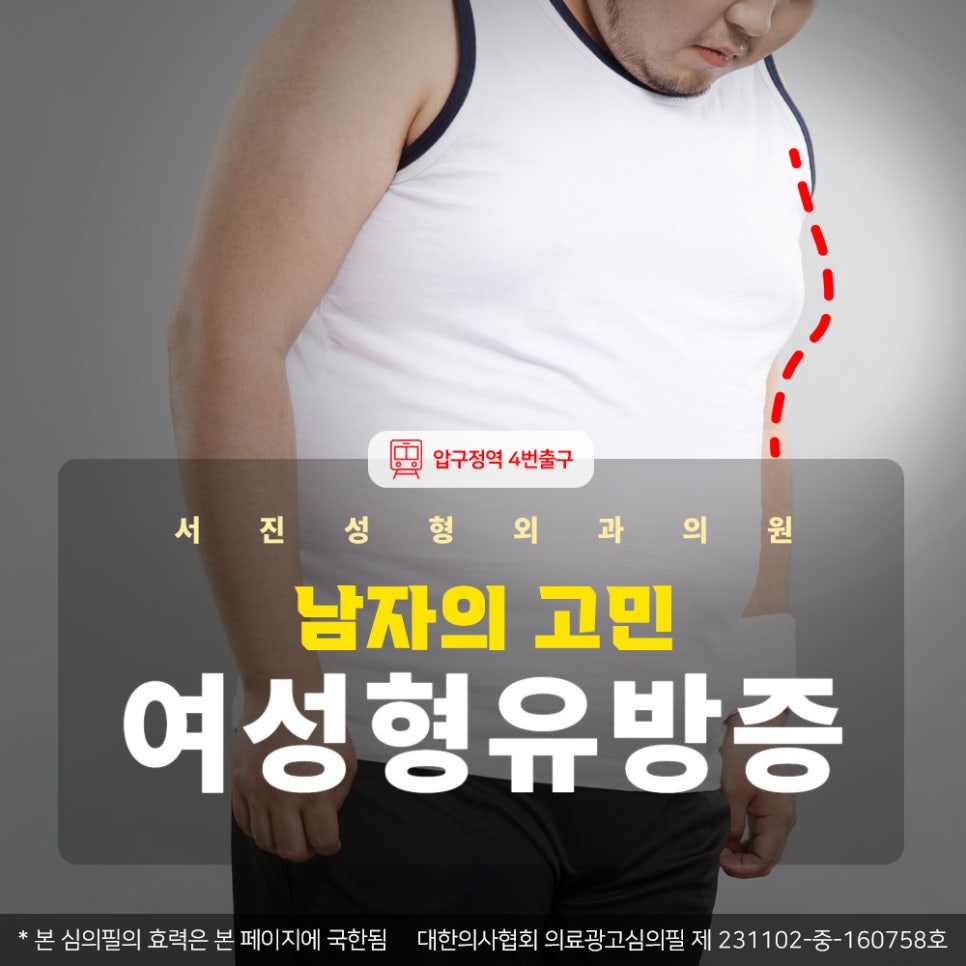
❓ What Is Gynecomastia?
Even though a person is male, when glandular tissue develops like that of a woman, or the nipple and the entire breast develop into a female-like chest shape due to various causes, this is called gynecomastia, or simply gynecomastia. Because this is not caused merely by having a lot of fat in the chest,
dieting or exercise alone is often not enough to improve it. If symptoms persist, it can lead to lowered self-confidence, and in severe cases,
avoidance of social interaction or difficulty maintaining a normal social life.
The development of gynecomastia can be influenced by various causes, including the following.
-
Hormonal imbalance: This occurs when female hormones are excessively secreted during adolescence or old age.
-
Obesity: Estrogen (a female hormone) is secreted in fat cells and can affect the development of glandular tissue.
-
Medication side effects: It may appear as a side effect from taking certain medications such as steroids or hair loss treatments.
-
Endocrine disorders: It can occur when an endocrine disorder causes abnormalities in hormone function.

🏋️ Can It Be Resolved with Exercise?
Many men try to address a larger chest by exercising or dieting.
However, as explained above, gynecomastia is often not just fat accumulation, but is accompanied by the development of glandular tissue.
In the case of pseudogynecomastia:
This refers to a condition in which there is excess fat around the chest without glandular tissue development, and it is also called fatty gynecomastia.
In this case, improvement can be expected through consistent exercise and dietary management aimed at reducing body fat.
In the case of true gynecomastia:
This is a condition in which glandular tissue develops due to the influence of female hormones, causing the nipples to protrude or enlarge.
In this case, even if fat is reduced through exercise or dieting, the glandular tissue remains, making a fundamental solution difficult.
Therefore, if the chest size does not decrease even with exercise or dietary therapy, or if a firm lump can be felt around the nipple, it is likely not simple obesity,
so it is necessary to check the condition through gynecomastia self-diagnosis.
📋 Types of Gynecomastia and Insurance Coverage
Gynecomastia is broadly divided into true and pseudogynecomastia, and it is important to identify the exact cause and manage it accordingly.
The severity of gynecomastia can be diagnosed by dividing it into several stages.
If gynecomastia self-diagnosis suggests a high likelihood of true gynecomastia, you can check whether health insurance and actual medical expense insurance benefits may apply.
Generally, when a detailed examination confirms true gynecomastia of Simon grade 2A or higher, health insurance and actual medical expense insurance benefits may apply.
However, actual medical expense insurance varies depending on each individual's policy terms, so it is advisable to check with the insurance company.
The checklist for gynecomastia self-diagnosis is as follows.
-
The chest is large or developed like a woman’s
-
The area around the nipples is raised or large
-
The chest does not reduce even with dieting or exercise
-
The area around the nipples feels hard or a lump can be felt
-
The shapes of the left and right chests are developed differently
If many of these items apply, you may want to consider a professional consultation. Gynecomastia self-diagnosis helps with an initial check.
👨⚕️ Recommended Candidates for Treatment
After gynecomastia self-diagnosis, if the following apply, you may want to consider management for improvement.
✔️ When it does not improve with exercise or dieting:
In particular, if gynecomastia self-diagnosis shows a true type in which a firm lump can be felt under the nipple, a surgical approach is often needed.
✔️ When the appearance causes significant stress:
This refers to cases where the chest shape lowers self-confidence or causes psychological discomfort, interfering with social life.
✔️ When glandular tissue development is clear:
This refers to cases where the proliferation of glandular tissue is confirmed through tests such as ultrasound.
Approaches for improvement include glandular tissue removal, liposuction, and, if necessary, combining these with skin-tightening procedures.
Even when there is excess fat, liposuction may also be considered to create a firm and flat chest.
Gynecomastia self-diagnosis helps with understanding the initial condition, but an accurate diagnosis and treatment plan should be established through consultation with a medical professional and detailed examinations.






 Previous image
Next image
Previous image
Next image