Men’s chests developing a rounded, feminine-looking shape are commonly referred to as gynecomastia. In particular, gynecomastia in your 20s, a period when people are sensitive to physical changes and appearance, can cause psychological discomfort beyond simply being a body-shape issue. Many people worry about a noticeable chest line during seasons when clothing becomes lighter, but it is often hard to clearly distinguish whether this is just fat accumulation or the development of internal tissue, which can delay proper action. Today, we will take an in-depth look at the causes of this condition, the differences by type, and possible approaches. 📝
🧬 Why does gynecomastia in your 20s occur?
It usually appears temporarily during puberty due to hormonal imbalance and then naturally disappears as a person becomes an adult. However, if gynecomastia in your 20s persists after growth has finished,
it is necessary to consider several complex causes.
The most representative reason is an imbalance in the ratio of female and male hormones in the body. When body fat increases, the secretion of female hormones within fat cells can be promoted, which may stimulate breast tissue. In addition, nowadays it is not uncommon for endocrine system abnormalities to occur due to Westernized eating habits or irregular lifestyle patterns. It can also appear as a side effect of taking certain medications or supplements, so it is important to examine your current condition from multiple angles. 🏃♂️

🔍 How to distinguish fat-type from true gynecomastia
To understand your condition, it is important to check the internal composition of the chest. This is broadly divided into pseudogynecomastia (fatty type) and true gynecomastia.
Pseudogynecomastia (fatty type): This is a form in which excess fat accumulates around the chest rather than due to the development of glandular tissue. It is often accompanied by overall obesity, and the chest feels generally soft to the touch.
True gynecomastia: This is a condition in which actual glandular tissue has abnormally enlarged due to hormonal influence. When touching around the nipple, you may feel a hard lump or experience pain.
Self-check points: If, when looking in the mirror, the area around the nipple is especially rounded and protruding, or if the shape of the two sides of the chest is asymmetrical, or if the chest size does not change even after losing weight, you may suspect glandular tissue development among cases of gynecomastia in your 20s. 🔎
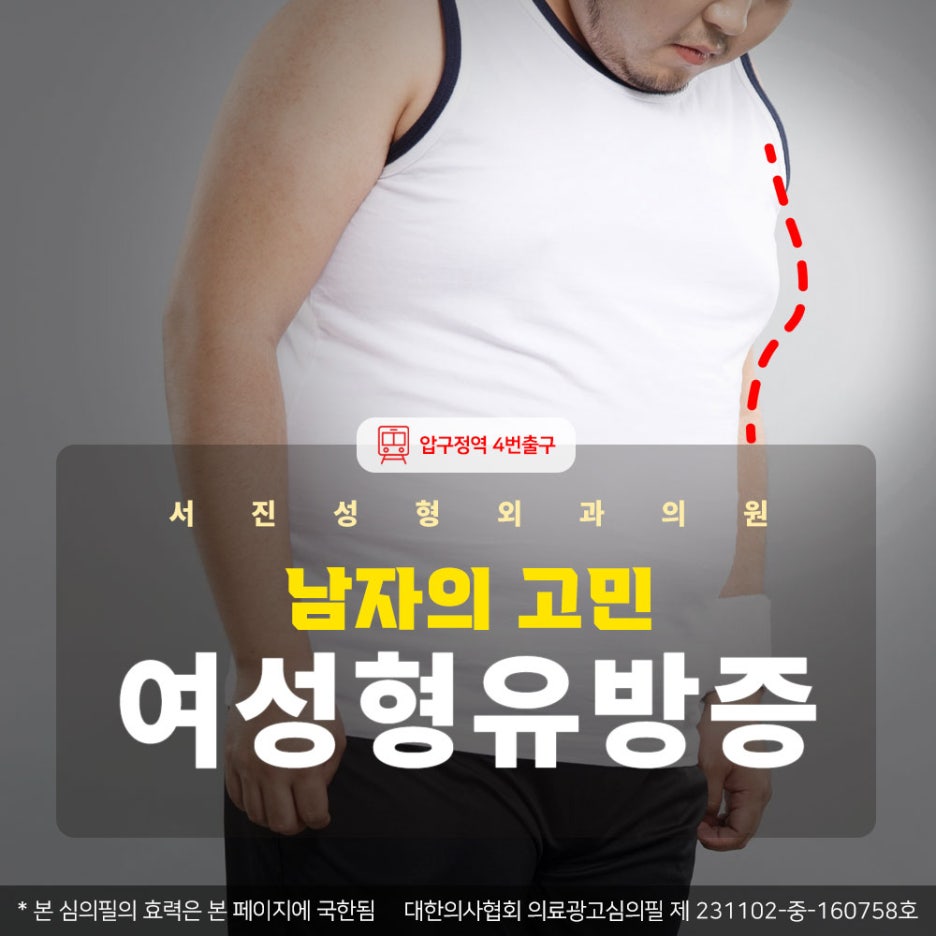
🏃 Can exercise or lifestyle management bring changes?
Many people try intensive chest workouts or dieting to reduce chest fat. However, in cases of gynecomastia in your 20s involving glandular tissue development, it is difficult to expect a fundamental change through exercise alone. In fact, if you overdo exercises that build the pectoralis major, the developed muscles may push the glandular tissue forward, which can have the opposite effect and make the chest look more prominent.
Of course, if it is a fatty type, some improvement is possible through consistent aerobic exercise and dietary control. This is because lowering body fat also reduces fat in the chest area. However, if the tissue itself has changed, the priority should be to determine your current stage through a careful evaluation by a specialist rather than forcing exercise. In terms of lifestyle habits, efforts should also be made to avoid high-calorie foods and drinking, which can affect the hormonal environment.
🏥 When consultation is needed and treatment methods
If you are experiencing severe stress in daily life or even symptoms of social withdrawal, it is worth considering active measures. In particular, if moderate or more advanced development is confirmed based on Simon grade criteria,
it is reasonable to seek medical help.
The key to treatment is to appropriately remove abnormally developed glandular tissue and reduce excess surrounding fat to create a flat chest line.
At this time, rather than removing as much as possible indiscriminately, a balanced adjustment process that considers chest elasticity is required. These days, methods that use as small an incision as possible to reduce scarring are used, and precision equipment may also be used to minimize tissue damage. 🩺
Gynecomastia in your 20s is a physical condition, but it is also an issue directly connected to self-esteem. Rather than leaving it alone and believing that time will solve it, we recommend analyzing the clear cause when early symptoms appear and setting a management approach that is appropriate for you. Confirming the right information and responding properly will be the first step toward healthy physical change.









Previous image
Next image