
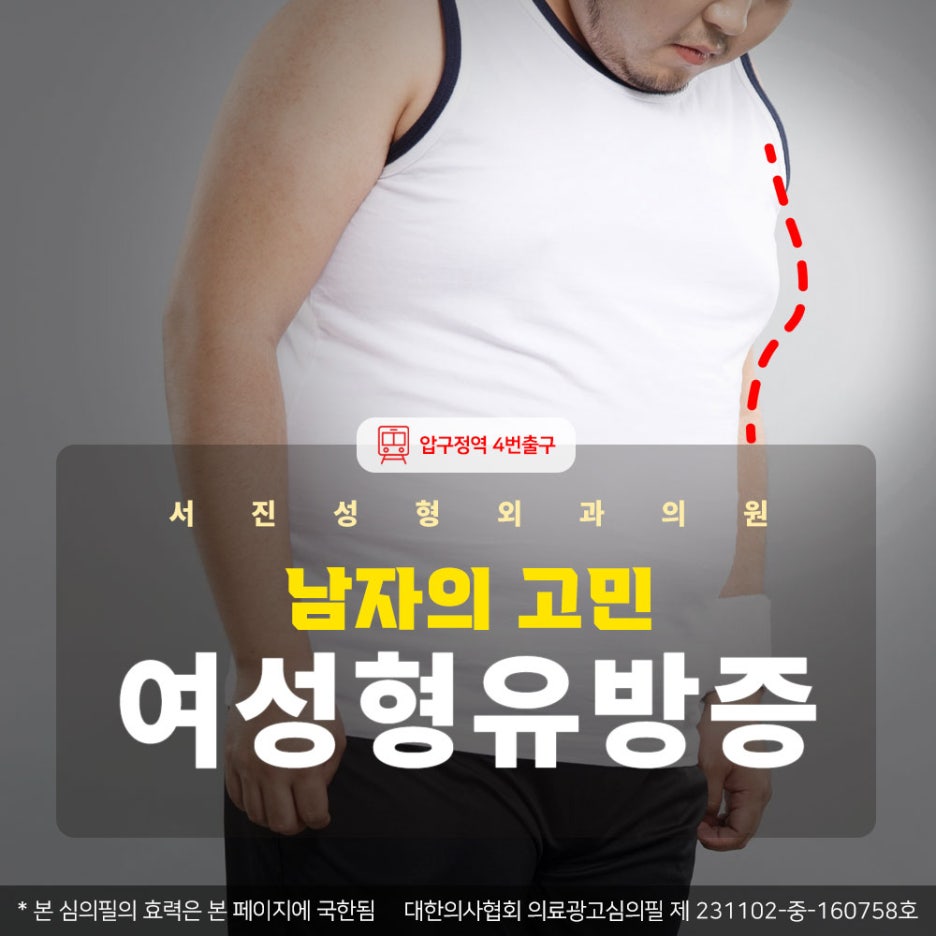
During the summer, when clothing becomes thinner, or when using public transportation, many men feel discomfort due to protrusion in the chest area.
It is sometimes dismissed as a problem caused simply by weight gain, but there are cases that cannot be resolved with exercise or diet alone. Medically, this is
called gynecomastia, and it can be accompanied not only by physical changes but also by psychological shrinking. In this article, we will take a closer look at its medical definition and the gynecomastia insurance coverage criteria that many people are curious about.
🔍 What Is Gynecomastia?
It refers to a condition in which a man's chest develops in a rounded way, similar to a woman's chest. This is broadly divided into two types. The first is the 'true' type, in which glandular tissue actually
develops, and the second is the 'false' type, in which the chest appears enlarged simply due to fat accumulation.
There are various causes. It may appear temporarily during puberty due to hormonal imbalance and then disappear, but if it persists into adulthood, natural improvement is difficult to expect. In addition, obesity that promotes estrogen secretion in the body, the effects of certain medications, or endocrine disorders can also be causes. Since it can go beyond a simple cosmetic issue and lead to reduced confidence in daily life and social avoidance, it is recommended to receive a clear diagnosis.

📌 The Concept of Gynecomastia and Insurance Coverage Criteria
When considering surgery, many people check whether gynecomastia insurance benefits apply in order to reduce the financial burden. In South Korea, health insurance and reimbursement for medical expenses may be available if certain conditions are met. However, this does not apply to every case; it is determined according to the medical assessment standard known as the Simon Scale.
In general, gynecomastia insurance benefits apply when the condition is at least Simon classification stage 2 (Grade 2-a) and the proliferation of glandular tissue is objectively confirmed through ultrasound or similar examinations. Here, stage 2 means that the chest is moderately enlarged and the boundary of the areola begins to sag downward to some extent. Another important indicator is that the glandular tissue must be found to be 2 cm or larger. When these requirements are met, the condition is recognized not as a simple cosmetic concern but as treatment for a disease, making gynecomastia insurance processing smoother.
⚠️ Cases Where Insurance Coverage May Be Difficult
On the other hand, there are situations in which benefits are difficult to obtain. The most representative case is when it is the 'false' type made only of fat, without the development of glandular tissue. Conditions that require only liposuction are usually classified as cosmetic and are therefore likely to be excluded from gynecomastia insurance coverage.
In addition, early symptoms corresponding to Simon classification stage 1 (Grade 1) are also often outside the reimbursement scope. Stage 1 means that the enlargement of chest tissue is minimal and there is no visually clear change. Furthermore, because payment may vary depending on preexisting conditions before treatment and the detailed terms of the coverage policy individually signed up for, it is essential to thoroughly review the terms of your own plan in advance. When consulting about gynecomastia insurance, it is advisable to clearly confirm the numerical results of your examination.
📋 What Should Be Prepared Before Surgery?
If you decide to improve the symptoms, it is recommended to make a systematic plan in advance. First, rather than judging by visible appearance alone, you should undergo a detailed examination at a place equipped with diagnostic imaging tools such as ultrasound. Through this, the distribution of glandular tissue and the amount of fat must be objectively understood in order to secure supporting evidence for a gynecomastia insurance claim.
The surgical method generally involves removing the glandular tissue and, if necessary, suctioning nearby fat to balance the area. After surgery, a compression garment should be worn for a certain period if needed so that the treated area settles properly, and strenuous exercise should be avoided. Because each person's body structure and symptom severity are different, it is best to establish a suitable plan through a detailed examination. If you check both the gynecomastia insurance eligibility and the post-treatment management system in advance, you may achieve more satisfactory results.
In conclusion, concerns about chest shape are no longer something to deal with alone. If you understand the medical criteria well and use the gynecomastia insurance system wisely,
it can become a stepping stone to resolving both physical discomfort and psychological concerns at the same time. Through consultation, I hope you can clearly understand your current stage and return to a healthy daily life.









Previous image
Next image