
In the past, hair transplantation was mainly chosen by middle-aged and older people as a way to conceal hair loss. Recently, however, more people have been seeking solutions at an earlier age for cosmetic purposes, such as improving their appearance and addressing personal concerns. The younger the person, the more strongly the opinions of others and everyday styling can affect their quality of life. For this reason, it is more important than anything to create a result that blends in like the person’s own natural hair, rather than simply filling in sparse areas.
💇 Reasons for the Growing Demand for Hair Transplantation Among People in Their 20s and 30s
As this is a period when social activity is at its peak, interest in first impressions and appearance management is naturally high. When the hairline begins to recede or hair density decreases at an early age due to irregular lifestyle habits or stress, it is easy to experience psychological distress. For these reasons, hair transplantation in one’s 20s and 30s has become a positive option for restoring confidence in social relationships and creating a neater overall image. The fact that early action allows for more flexible responses can also be an advantage.
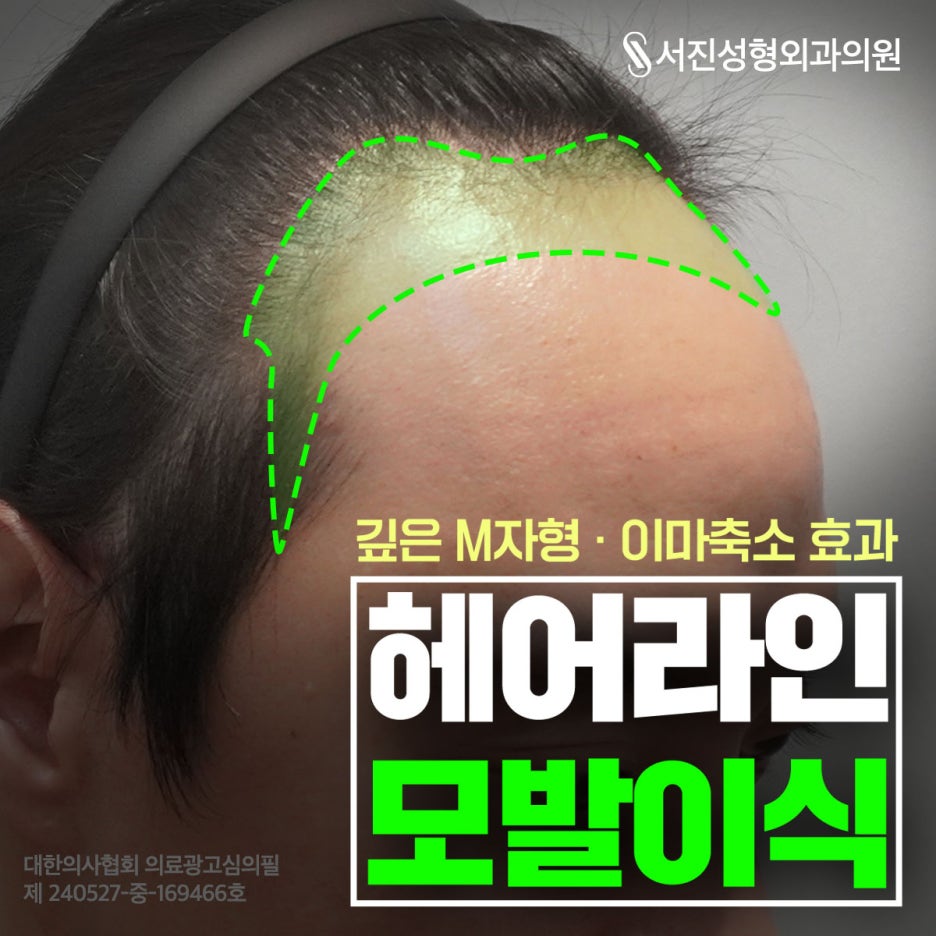
📏 Purpose of Forehead and Hairline Correction
In men, many cases involve softly filling in the sharply recessed areas of an M-shaped hairline to create more dimensional facial contours. Women may also seek to refine an angular or asymmetrical forehead line into a rounder, more harmonious shape, creating the appearance of a smaller face. In this way, hair transplantation in one’s 20s and 30s is not limited to concealing areas of concern. It primarily takes an aesthetic approach by reshaping the hairline to suit the person’s natural face shape and the proportions of their facial features.
The process of obtaining hair from the back of the scalp is broadly divided into the strip method, which involves removing a certain section of the scalp, and the non-incisional method, in which grafts are harvested one by one. Those who want to preserve their hairstyle as much as possible may consider the strip method, while those who want to minimize visible marks may consider the non-incisional method. Depending on the situation, options such as Line Cut, in which the hair is shaved in narrow strips to reduce the burden of shaving the entire head, or No-Cut, which is performed without cutting the hair, may also be used.

⚖️ Different Design Goals from Hair Loss Coverage
Large-scale transplantation for middle-aged and older adults primarily aims to improve density and reduce the appearance of extensive areas of hair loss. By contrast, design for younger people focuses on visual harmony at conversational distances. The direction and angle in which the hair grows, as well as differences in hair thickness, must be carefully considered. Hair tends to become thinner and contain more fine strands toward the forehead, while thicker strands are more common as it extends toward the crown.
Reflecting these characteristics, hair transplantation for people in their 20s and 30s often involves placing fine, soft single-hair grafts along the very front of the hairline, followed by progressively thicker hair farther back. To prevent the boundary from looking artificial, it is preferable to carefully determine the placement of grafts according to their type.


🩹 Postoperative Care and Considerations for Hair Transplantation in Your 20s and 30s
To achieve a satisfactory outcome, the care process after transplantation should be given as much importance as the transplantation itself. Even if a large amount of hair is harvested and transplanted, it may be lost over time if it does not become stably established. The graft survival rate, or how well the follicles attach to the scalp and continue to grow, can vary depending on the quality of the entire process, from diagnosis and harvesting to transplantation and postoperative care.
To improve initial graft retention, care should be taken for approximately two weeks to prevent physical impact or friction on the transplanted area. In addition, it is beneficial to avoid alcohol and smoking for the time being, as they constrict blood vessels and interfere with the supply of nutrients. A continued commitment to care may also help prevent additional hair loss.
Rather than applying a standardized design as-is, a precise evaluation that reflects each person’s different head shape and hair texture should come first. Instead of excessively lowering the hairline out of impatience, a precise plan should be supported by a long-term perspective so that the result remains natural even with age. We recommend carefully determining the direction of hair transplantation in your 20s or 30s after thorough research and a detailed consultation.









Previous image
Next image