
Hello.
I’m Kim Hawon from Milia Dermatology.
Many people worry about small, bumpy, grain-like spots on the face.
At first, you may think they are acne, but they do not squeeze out,
and they simply stay in place like tiny dots.
They often appear around the eyes or on the cheeks,
so they are difficult to cover with makeup,
and they do not go away over time,
which can be frustrating.
In cases like this,
there is a high possibility that it is milia.
Because it is difficult to tell by appearance alone,
a precise diagnosis is needed.
Today, let’s talk about what milia is
and how it can be treated.
💡 What is milia?

Milia are benign skin lesions
that appear as small, firm, grain-of-rice-like bumps
on the skin’s surface.
They usually form around the eyes, between the eyebrows, on the cheeks, and on the eyelids,
and are small, about 1 mm in size,
with a white or yellowish color.
They are cyst-like lesions formed when sebum and keratin become trapped in the skin,
and from the outside, they can look as if tiny oil particles are embedded in the skin.
That is why they are also called “oil seeds”
or “milk spots.”
❓ We asked a dermatology clinic about milia:
Why do they occur?
Milia occur when the skin’s keratin and sebum
are not properly expelled
and become trapped inside the pores.
They can develop more easily in oily skin,
when exfoliation care is insufficient,
or due to genetic factors.
In other words, if pores become blocked
or dead skin cells do not shed properly,
keratin builds up in the skin
and turns into small cysts.
To accurately determine the cause,
it is best to have the condition closely examined
through a dermatology consultation for milia.
💆♀️ How is milia treated?
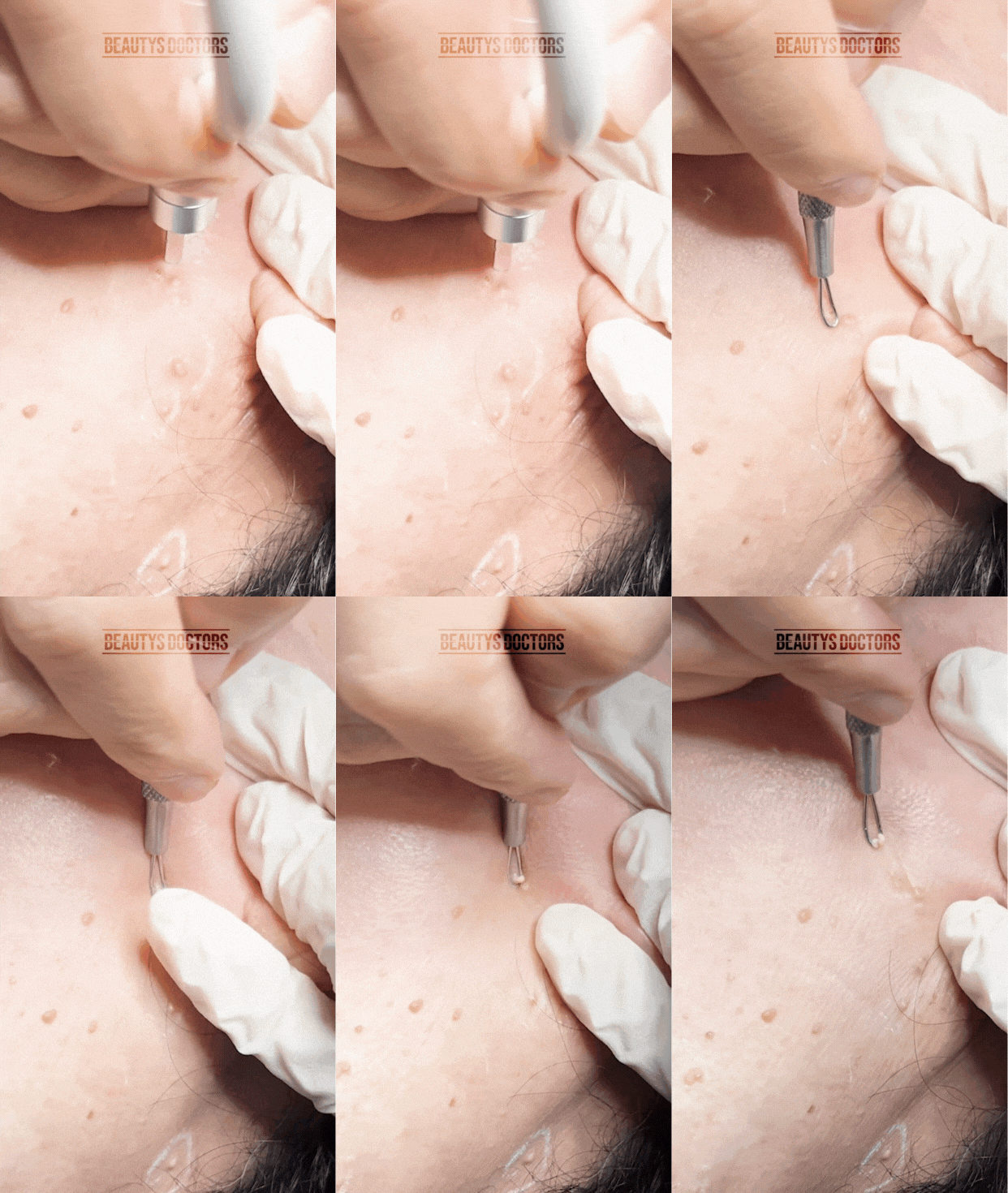
Small milia may disappear naturally,
but in most cases, dermatology treatment is needed.
The most common method is
CO2 laser treatment.
The CO2 laser gently opens the surface of the milia
and allows the trapped keratin and sebum to be released.
If needed, it can be performed under local anesthesia,
and after the procedure, hydrocolloid dressing is used
to support recovery.
It usually recovers within a few days,
and one advantage is that it leaves almost no scar.
Depending on the skin condition, electrocautery
or a minor incision procedure may also be used.
However, do not try to squeeze it at home
or touch it with a needle!
This can lead to infection,
pigmentation,
or scarring.
Be sure to receive safe treatment at a
dermatology clinic with medical staff.
🧴 How to prevent milia

🧴 Thoroughly wash your face twice a day
🧴 Cleanse thoroughly after makeup
🧴 Use a gentle exfoliant 1–2 times a week
🧴 Strengthen the skin barrier with consistent moisturizing
When the skin becomes dry, dead skin cells accumulate
and sebum production increases,
which raises the likelihood of milia.
Regular care and daily habits
are the most important points in preventing milia.
💡 Key points when choosing a dermatology clinic for milia

Milia are difficult to diagnose
based on appearance alone.
They can look similar to other conditions,
such as syringomas and flat warts.
Therefore, rather than choosing a clinic simply by its laser equipment,
you should choose a place where experienced medical staff
make the diagnosis themselves and adjust treatment in detail.
Results vary depending on laser depth, intensity, and interval between treatments,
and if the energy is too weak,
there will be no effect,
and if it is too strong,
scarring or pigmentation may occur.
In particular, milia around the eyes or in areas with thin skin
require even more delicate adjustment.
For this reason, rather than choosing a dermatology clinic for milia based only on equipment,
it is important to choose medical staff who accurately assess skin thickness and lesion depth
and perform treatment with customized energy.
💬 Q&A
Q1. How many treatment sessions are needed?
👉 In most cases, it can be removed in one session,
but if it recurs or there are many lesions,
treatment is divided over 2–3 sessions.
Q2. Will a scar remain where the milia disappeared?
👉 Because only the epidermis is opened with a micro laser,
scars are almost never left behind.
However, after treatment, you must use sunscreen
to help prevent pigmentation.
Q3. Can I wash my face or put on makeup right after the procedure?
👉 From the day after the procedure,
gentle face washing and makeup are possible.
However, do not rub the area where a scab has formed
and wait for it to fall off naturally.
Q4. How can recurrence be prevented?
👉 Thorough cleansing,
combined with exfoliation and moisturizing,
can help reduce the recurrence rate.
If the skin is dry or oily,
regular care is also recommended.
Q5. How can milia and syringomas be distinguished?
👉 Milia are white, firm, grain-like bumps,
while syringomas tend to be skin-colored or slightly reddish
and appear more spread out.
However, they are difficult to distinguish with the naked eye,
so a professional dermatology diagnosis is the most accurate.
📌 Today’s summary
1️⃣ Milia are small, firm, benign skin lesions.
2️⃣ They form as sebum and keratin build up.
3️⃣ They can be safely removed with CO2 laser treatment, etc.
4️⃣ Accurate diagnosis and choosing an experienced dermatology clinic for milia are key.
5️⃣ Improve daily habits to help prevent recurrence.
Although milia may seem like just a cosmetic issue,
if the approach to care and treatment is wrong,
it can lead to scarring instead.
With detailed treatment from a milia dermatology specialist
and consistent care,
recover clear skin.
Thank you for reading.
This was Kim Hawon from Milia Dermatology.