
Hello.
This is Kim Ga-eul from Beautys Doctors.
When you start looking into lifting procedures,
the first names you usually come across are
Ulthera and Shurink.
If you search for them, both are described as
ultrasound lifting,
that is, using the HIFU principle.
For first-time users,
it is only natural to wonder what the difference is.
Some people say Ulthera is better,
while others recommend Shurink for its effect
and its cost-effectiveness.
So many people want to know
how different the actual results are,
how long they last,
and why the price difference
is as much as 3 to 4 times.
So today, I’ll clearly organize
the differences between Ulthera and Shurink.
💡 Principles and effects of Ulthera and Shurink
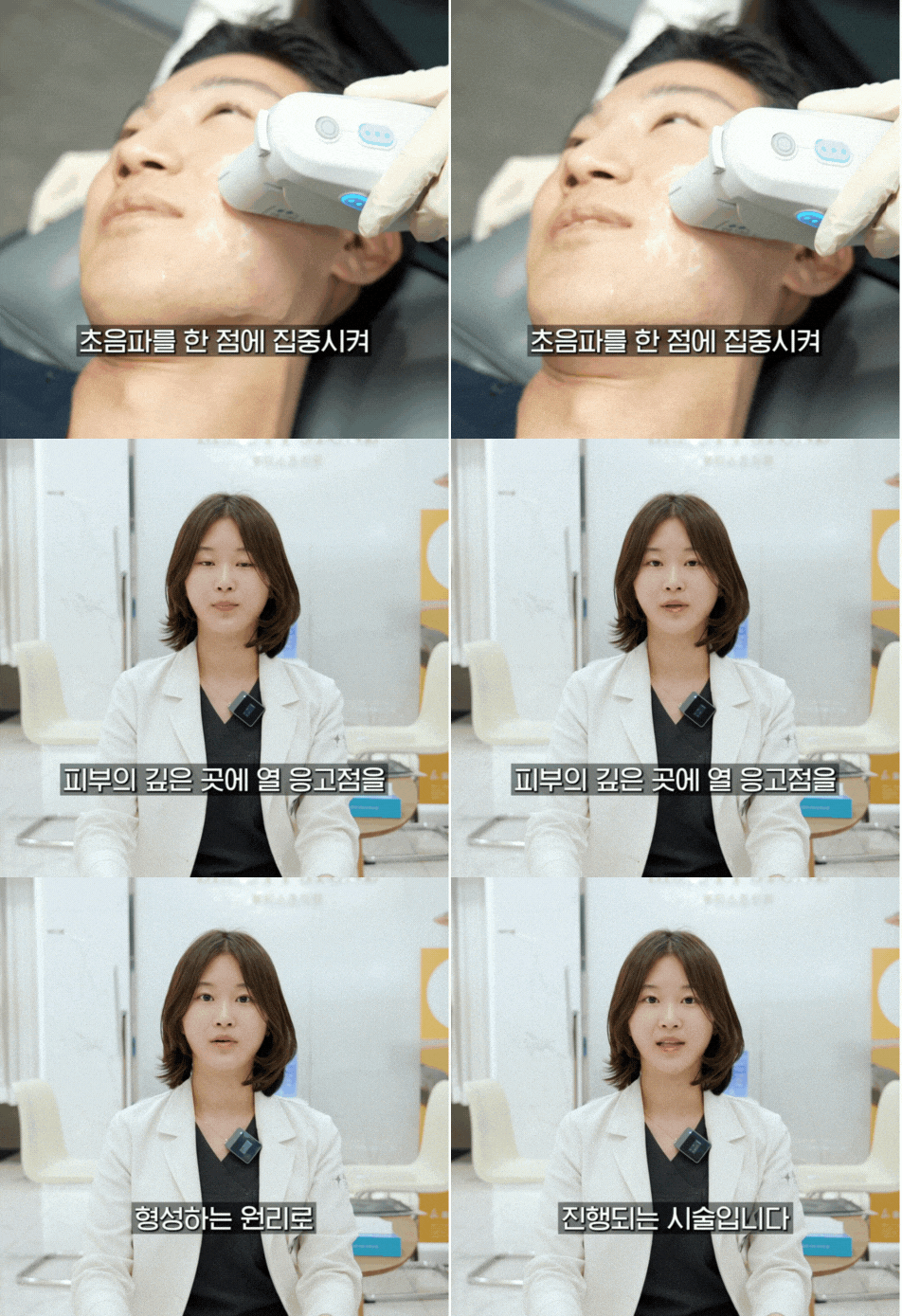
Both devices
deliver high-intensity focused ultrasound (HIFU) energy
deep into the skin,
forming thermal coagulation points.
Through this process,
protein denaturation and tissue contraction occur,
tightening sagging skin upward
and promoting collagen regeneration to improve elasticity.
Ulthera uses real-time ultrasound imaging
to check the skin structure,
then delivers energy precisely
to the desired layer.
By using 1.5 mm, 3.0 mm, and 4.5 mm tips,
each layer can be targeted,
and in particular, the 4.5 mm tip reaches
the SMAS layer, providing a deep lifting effect.
The delivery method is dot-based,
so energy is delivered evenly,
which has the advantage of gradually improving
elasticity over time after the procedure
and maintaining the effect for a long period.
Shurink uses the same principle,
but its energy density and precision
are lower than Ulthera’s.
When using the linear delivery method (MP mode),
a wide area can be covered at once,
and it has the advantage of being less painful.
However, rather than strongly lifting deep layers,
it is closer to improving skin texture
and providing light elasticity care.
In other words, Shurink’s effect is focused more on
gentle, natural elasticity improvement
rather than deep lifting.
If you are curious about the effect of 300 Shurink shots!
⚖️ Summary of the differences between Ulthera and Shurink

Ulthera can be expected to provide
more precise and stronger lifting in terms of effect.
Rather than immediately after the procedure,
the lifting gradually builds over time,
and the changes tend to last longer.

On the other hand, Shurink’s effect
appears immediately but is cumulative.
Regular maintenance is needed,
and after about 2 to 3 months,
sagging may be felt again.
Even just comparing how long they last,
Ulthera is relatively longer,
while Shurink is shorter-lasting.
That said, both devices
undergo the collagen remodeling process
and share the point that they induce gradual improvement.
In terms of price,
the difference is clear.
Ulthera is an original device approved by the FDA,
and the cost of one treatment
is about 4 times higher than Shurink.
However, Shurink’s effect
is less burdensome and more accessible,
so it is considered a cost-effective lifting option.
To sum up, Ulthera offers excellent effect
and durability but is expensive,
while Shurink’s biggest difference is that
it allows repeated maintenance with a gentle approach
and a reasonable cost.
💬 Tips for choosing between Ulthera and Shurink

If your skin is thick, sagging is noticeable,
and you want to define your facial contours clearly,
Ulthera is more suitable.
That is because it can deliver energy
stably to deeper layers.
On the other hand, if your skin is thin,
or you are worried about fat loss because you have fuller cheeks,
or if you are sensitive to pain,
Shurink, which allows for a gentler approach,
may be a better fit.
The approach also varies
depending on age.
If sagging is noticeable in your 30s or older, Ulthera;
if you are in your 20s and your elasticity has not declined much yet,
Shurink alone may be satisfying enough.
In the end, the important thing is
to accurately assess your own skin condition
and choose the lifting treatment that fits it.
💬 Frequently Asked Q&A
Q1. Can Ulthera and Shurink
be received at the same time?
Yes.
Both are HIFU lifting treatments,
but because their energy strength and depth differ,
pairing them may create synergy
depending on your skin condition.
For example, if Ulthera tightens the deep layers
and Shurink’s effect refines the skin texture,
you may achieve a more natural and balanced lifting result.
Q2. When does Shurink’s effect
start to appear?
Right after the procedure,
you can feel an immediate Shurink effect,
with the skin texture becoming more refined
and a slight improvement in elasticity.
However, after 2 to 4 weeks,
when the collagen regeneration process
is in full swing,
you will experience the skin becoming smoother
and denser.
Q3. How long does the Ulthera effect
last?
With Ulthera, rather than immediately after the procedure,
the effect gradually increases over 1 to 2 months.
In many cases, one treatment lasts about 1 year
to 1 year and 6 months,
though there are individual differences depending on skin condition and lifestyle habits.
If you have any other questions about the differences between Ulthera and Shurink,
please feel free to leave a comment anytime.
I’ll reply personally.
Thank you for reading.
This was Kim Ga-eul.