Hello.
This is Wie Youngjin from Beauty Doctors.
When considering laser hair removal,
many people first ask,
“When is the best time to start?”
To get straight to the point,
winter is the most stable and efficient time
to begin laser hair removal.
Why winter hair removal tends to produce better results
In winter, skin tone is relatively lighter,
and because there is less exposure to UV rays,
the risk of post-procedure pigmentation and erythema is lower.
Also, because outdoor temperatures are lower and sweat and sebum production decrease,
inflammatory reactions after laser treatment tend to be relatively mild.
Most importantly,
there is more time.
Since laser hair removal is not a procedure that ends in a short period,
a planned approach that starts in winter is necessary
in order to create a satisfactory result by summer.
Why GentleMax Pro Plus uses two wavelengths
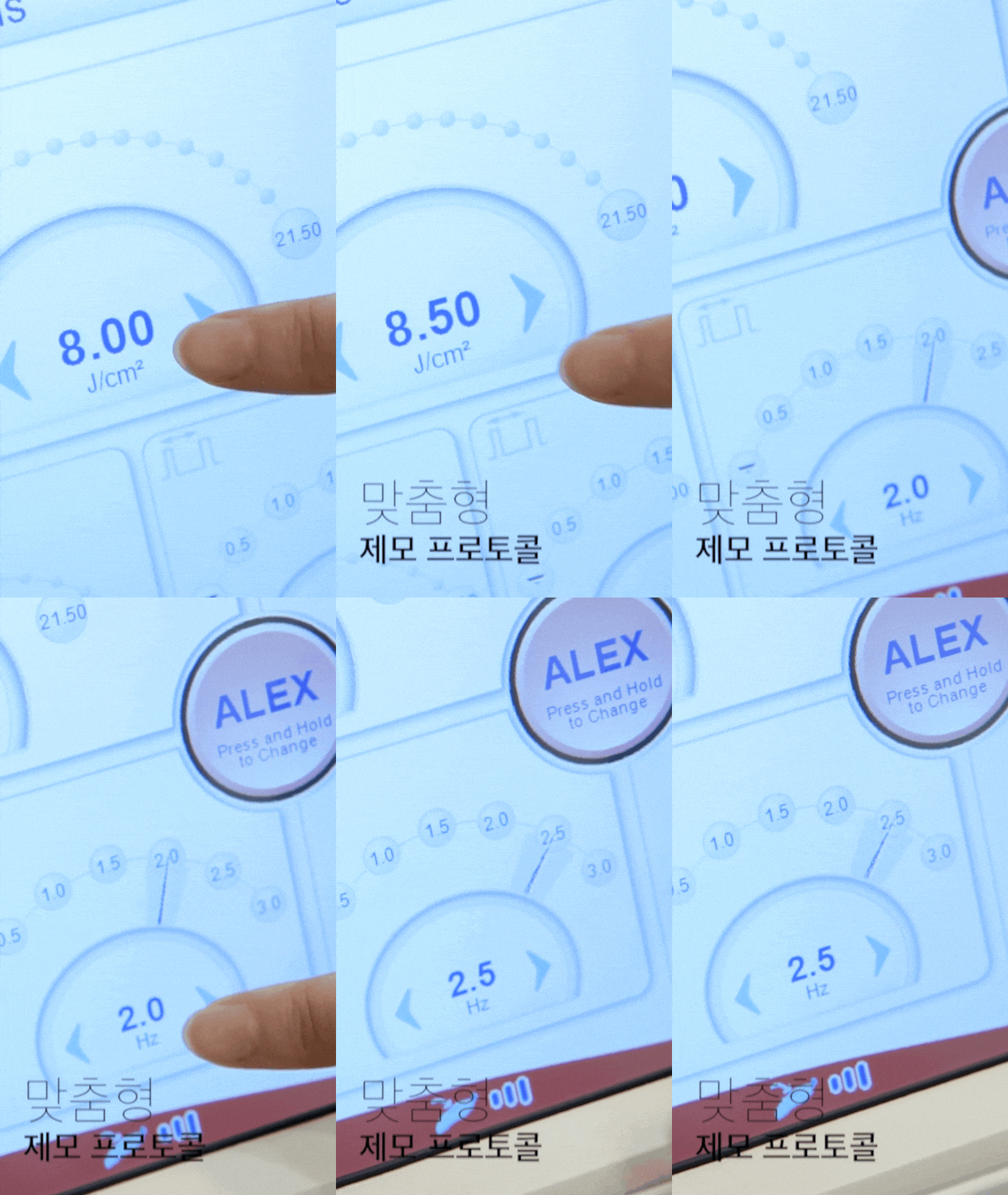
The key feature of GentleMax Pro Plus is
that it is a dual system that can selectively use
755nm and 1064nm wavelengths
from a single device.
This is not about different tips or simply a difference in output,
but about different laser wavelengths (types of light) themselves.
755nm (Alexandrite)
It has a high melanin absorption rate,
so it is efficient for fine, relatively shallow hair,
and it responds well on lighter skin tones.
1064nm (Nd:YAG)
Because it penetrates more deeply into tissue,
it can be applied more stably to thick, deep follicles,
especially male beard hair or deeply rooted hair along the jawline.
Because the two wavelengths can be selected according to the situation,
precision hair removal planning is possible,
considering differences in skin tone, hair thickness, and treatment area.
Why hair can still grow after more than 10 sessions
Even after receiving laser hair removal multiple times,
some people may feel as if the hair is growing back.
This is not an abnormal situation,
but a structural characteristic of laser hair removal.
Hair grows through a cycle of
anagen → catagen → telogen.
Laser is most effective on follicles in the anagen phase,
so it cannot remove all hair at once.
Therefore, hair removal is more accurately understood
not as a procedure that “completely eliminates” hair,
but as a process in which the density and thickness of hair
gradually decrease as sessions accumulate.
The real meaning of “permanent hair removal”
At the level of individual follicles,
laser can cause permanent destruction.
However, overall, because each treatment reduces hair density
by a certain percentage,
very fine hair may remain in some areas over time.
Even in such cases,
many people can maintain a clean result
with only a few maintenance sessions.
Will the effect weaken over time?
Laser hair removal is
an approach based on proportions,
not absolute numbers.
Because the structure is such that 10 out of 100 are reduced,
and then 1 out of 10 is reduced,
changes may feel slower
toward the later stages.
This is not a decrease in effectiveness,
but a natural difference in how it is perceived
when most of the hair has already been removed.
Factors just as important as the device in hair removal
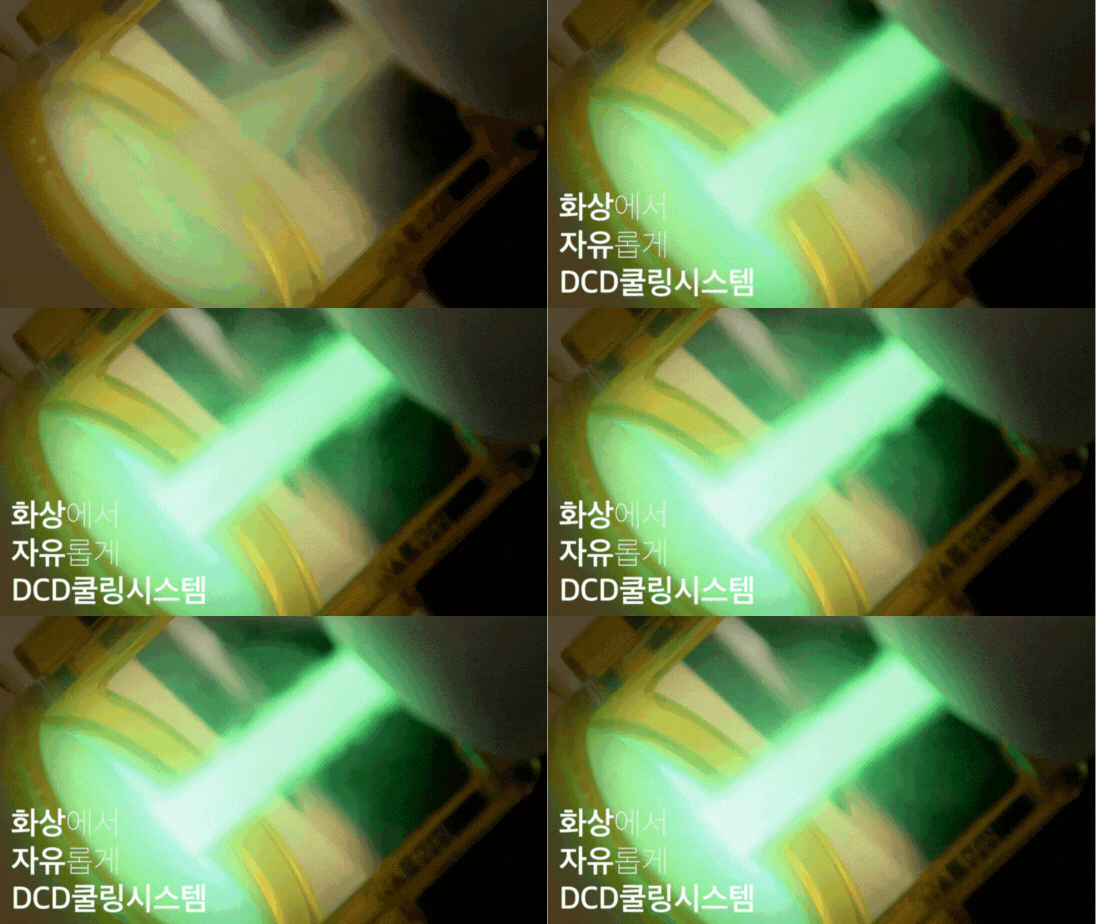
A device with excellent output stability and cooling system
is certainly important.
GentleMax Pro Plus is also designed
with dual wavelengths and a DCD cooling system
to reduce pain and the risk of thermal damage.
But laser hair removal is not a procedure
where a good device alone guarantees the same result.
By treatment area, skin tone, and hair thickness,
-
wavelength selection
-
energy settings
-
treatment interval
-
overlap level
If these factors are not adjusted in detail,
it can lead to burns, pigmentation, and differences in effectiveness.
Laser hair removal Q&A (Frequently asked questions)

Q. How painful is hair removal treatment?
Pain varies depending on the area, hair thickness, and energy settings.
GentleMax Pro Plus uses a DCD cooling system
to rapidly cool the skin right before treatment,
helping ease pain and warmth.
Q. Can I go back to daily life right away after treatment?
In most cases, yes.
However, immediately after treatment,
temporary erythema or warmth may occur,
so it is better to avoid saunas, strenuous exercise, and alcohol on the same day.
Q. When should I shave?
Shaving is recommended the day before or on the day of treatment.
If the hair is left too long, laser energy may disperse,
which can increase skin irritation.
Q. Can I combine waxing or tweezing with laser hair removal?
It is not recommended.
Because laser hair removal targets the follicles,
methods that pull out the roots can reduce its effectiveness.
Q. Is hair removal possible if the skin is dark?
Yes.
The 1064nm wavelength has a relatively lower melanin absorption rate,
so it can be used on darker skin tones
while reducing the risk of epidermal damage.
Q. What is the appropriate treatment interval?
It varies by area,
but it is usually done at 4 to 6 week intervals.
It is important to adjust the interval
according to the hair growth cycle.
Q. Is it okay to receive treatment in summer?
It is possible,
but the risk of pigmentation from UV exposure may increase,
so sun protection becomes even more important.
That is why starting in winter is often recommended.
Q. Does the skin become dry after hair removal?
You may feel temporary dryness.
After treatment, it is good to use enough moisturizer
to help restore the skin barrier.
Laser hair removal is a procedure whose results can differ
depending on when you start
and how you use each wavelength.
Winter is
the most stable time to begin hair removal,
and hair removal based on an understanding of dual wavelengths
becomes a process that considers skin condition as well,
not just hair removal alone.
Thank you for reading.
This was Wie Youngjin.