Hello.
I’m Kim Hawon from Yeongdeungpo Dermatology.
Today,
I’d like to talk in depth about tattoo removal,
which many people worry about
but hesitate to start because
it feels intimidating.
Tattoo removal is not simply a procedure
that uses a laser.
It is closer to a treatment
that must selectively remove pigment
while minimizing damage to the skin tissue.
So the process of removing a tattoo
is much more precise
than the process of getting one.
In actual consultations at Yeongdeungpo Dermatology,
when discussing tattoo removal,
it is often not just for cosmetic purposes,
but requires a medical approach that also considers
skin condition and the recovery process.
The Core Principle of Laser Tattoo Removal

Tattoo pigment particles are
much too large for our body’s immune cells
to process naturally.
So the goal of laser tattoo removal
is to break these pigment particles
into very small pieces.
Pico Laser
This is the method most commonly used
in tattoo removal these days.
Among those considering tattoo removal
at Yeongdeungpo Dermatology,
many first check whether a Pico laser is used
in order to reduce thermal damage.
By concentrating high-power energy instantly
for an extremely short time,
measured in one trillionth of a second,
it uses a photoacoustic shockwave effect
to “break apart” the pigment.
Thermal damage is relatively low,
and the recovery process is generally more stable.
To put it simply, if a nanosecond laser
is like breaking a rock into pebbles,
then a Pico laser is more like
crushing pebbles into sand or dust
very finely.
As the particles become smaller,
they are more easily carried out of the body
through the lymphatic system.
That is why Pico lasers have an advantage
in terms of treatment speed and evenness.
Can Tattoo Removal Erase It Completely?
Whether tattoo removal can be done completely
is very closely related to the amount and depth of the tattoo.
In consultations at Yeongdeungpo Dermatology,
what is checked first is not the color of the tattoo,
but how deeply and how many times it was applied.
If a tattoo was layered over multiple sessions
or repeatedly created in very deep layers,
then even if most of the pigment is removed,
a very faint trace may remain.
On the other hand,
for tattoos that are comparatively shallow and simple,
such as lettering tattoos, eyebrow tattoos,
or eyeliner tattoos,
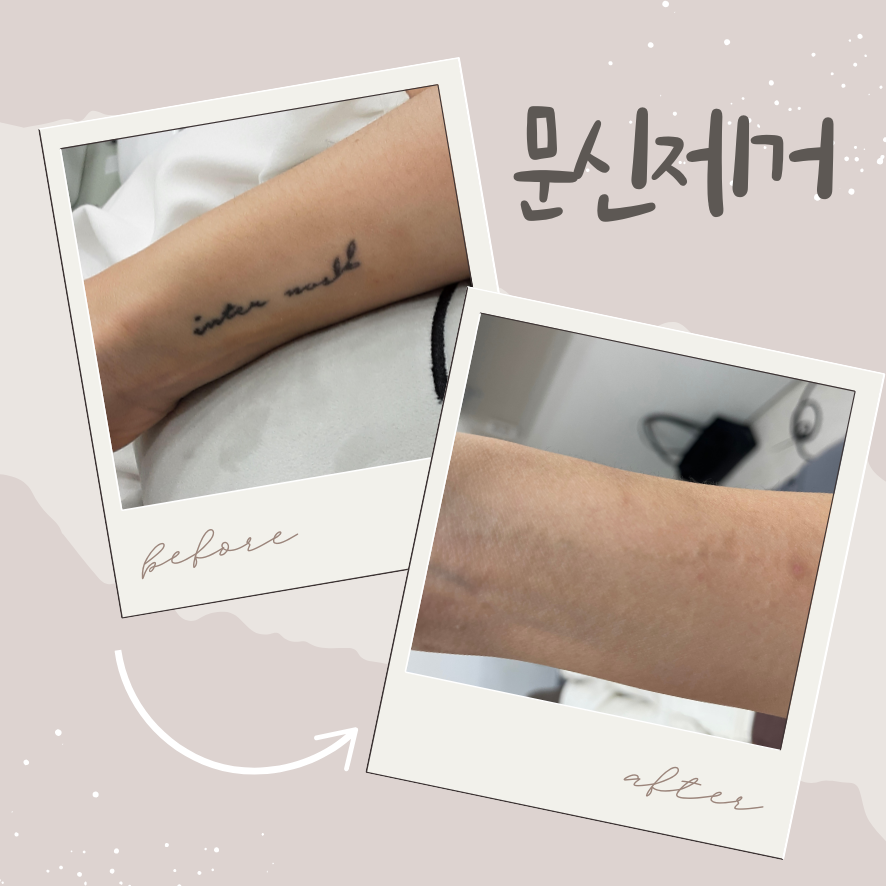
there are many cases where they can be removed
quite cleanly.
So when asked, “Can it be erased completely?”
the answer is determined by looking at
the tattoo’s design, color, amount, and depth
together at Yeongdeungpo Dermatology.
Black Tattoos and Color Tattoos
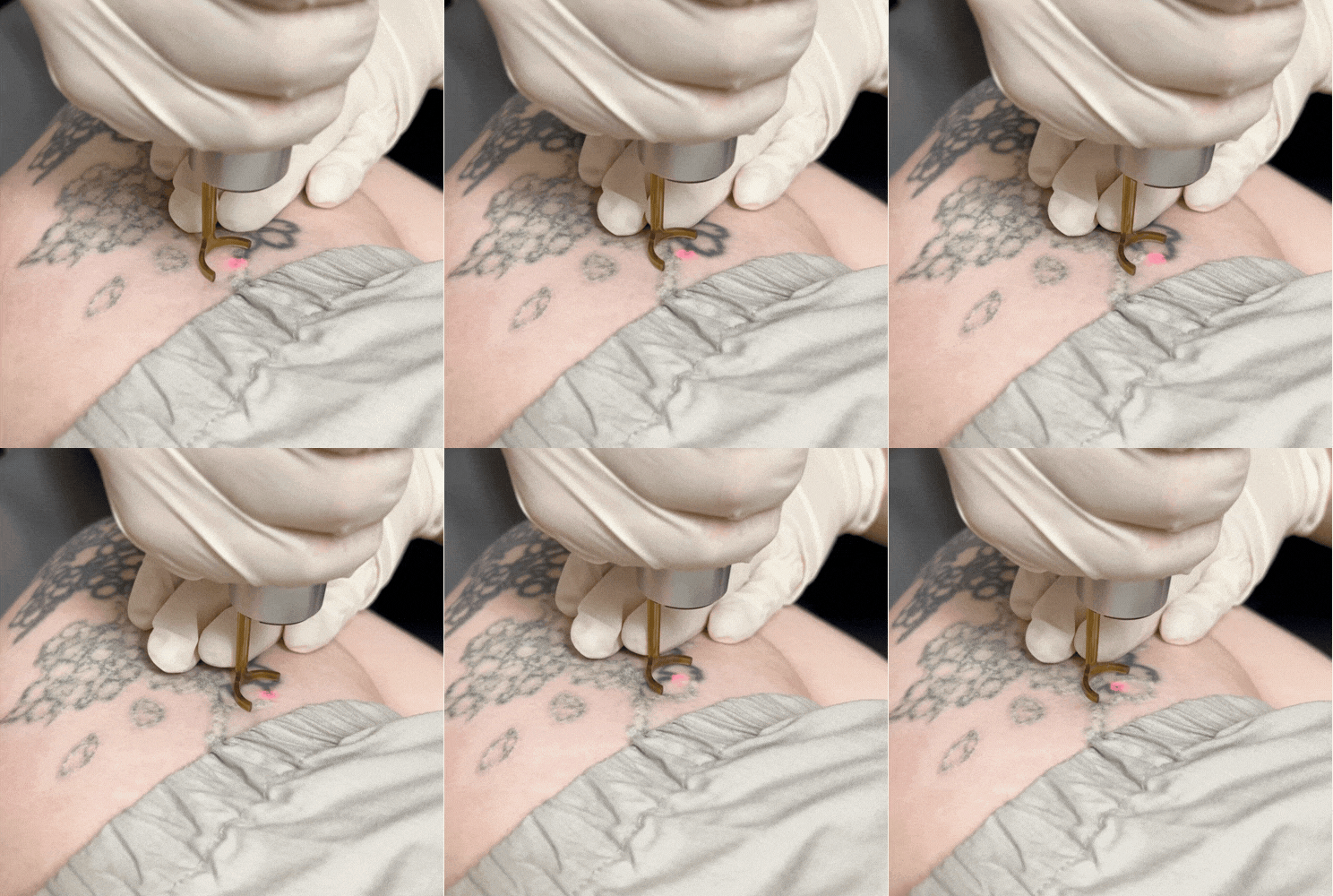
Is there a difference in how difficult they are to remove?
There is definitely a difference.
Black tattoos absorb most laser wavelengths well.
So among tattoo colors,
they are one of the easiest to remove.
Color tattoos become more difficult to remove
as more colors are mixed in.
This is because different colors respond
to different laser wavelengths.
When discussing color tattoo removal
at Yeongdeungpo Dermatology,
there are quite a few cases where it is necessary
to explain from the beginning
that multiple sessions will be needed.
The usual removal order is to remove black first,
then proceed step by step with red,
and then blue tones.
The more colors are mixed into a tattoo,
the more the number of treatment sessions
may naturally increase.
How Many Sessions Are Needed to See Results?

This is one of the most frequently asked questions
in the clinic.
To get straight to the point,
there are many cases where change can be felt
even after just one session.
Especially in the early sessions,
when the amount of pigment is large
and the color is dark,
it is clear to see that it has become lighter.
But as treatment progresses,
the amount of remaining pigment gradually decreases,
and from that point on,
the speed at which the color fades
may feel relatively slower.
This does not mean the treatment is going wrong;
it is a very natural part of the tattoo removal process.
Tattoo Removal Treatment Process
In general, tattoo removal is done
at intervals of 4 to 8 weeks.
At Yeongdeungpo Dermatology as well,
we often adjust the treatment interval individually
while observing skin recovery speed
and pigment response.
It is most important to give the skin
enough time to recover.
Step 1 | Immediately After the Procedure
The treated area turns white,
which is called frosting.
This is a normal temporary response caused by gas
as the pigment is destroyed.
Step 2 | 1 to 2 Weeks
Tiny scabs, itching, and redness
may appear.
From this stage on, phagocytes begin
carrying away the broken-down pigment.
Step 3 | After One Month
You can visually confirm that the pigment
is gradually fading.
As the sessions continue,
the density of the remaining pigment decreases,
so the experience of the practitioner at Yeongdeungpo Dermatology
in finely adjusting the laser intensity
plays an important role in the outcome.
Possible Side Effects and Management
The reason the medical staff’s expertise is important
in tattoo removal is
because of side effect management.
When considering tattoo removal at Yeongdeungpo Dermatology,
it is important to look not only at whether it can be erased,
but also at how the skin recovers.
Hypopigmentation
If the laser energy is excessive,
normal melanocytes can also be damaged.
The skin may appear lighter,
so delicate energy adjustment according to the patient’s skin response
is essential.
Blisters
Due to the photoacoustic shockwave,
temporary blisters may form in the dermis.
If they are not popped and are managed
in a sterile state,
they can recover without scarring.
Hyperpigmentation (PIH)
If sun protection is neglected after the procedure,
the color may become darker instead.
Rejuvenation cream and sunscreen
must be used together.
Checklist for Successful Tattoo Removal
🐨 Whether multiple laser wavelengths
that can respond to various colors
are available
🐨 Whether a cooling system is used together
to reduce pain and skin damage
🐨 Whether there is sufficient clinical experience
to consider not only removal,
but also the skin texture
Yeongdeungpo Dermatology
Tattoo removal is not a short
and simple procedure,
but a process of slowly tidying the skin
while protecting it.
If you let go of impatience
and follow verified equipment
and skilled judgment,
you can expect clean skin recovery
without regret.
Since an accurate diagnosis of your current condition
comes first, if you are considering it,
I recommend starting with a consultation.
Thank you for reading.
This was Kim Hawon from Yeongdeungpo Dermatology.