Hello.
This is Beauty's Doctor, We Youngjin.
The marks left behind after acne has passed
are more than just simple “spots”
in both type and treatment approach.
Medically, they can be broadly divided into three types.
① Atrophic scar
This is a form that looks sunken, as if the skin has caved in.
It is caused by damage to the dermis,
which breaks down the collagen structure.
② Post-inflammatory erythema
This is a red mark left behind
after inflammation as blood vessels remain dilated.
③ Hypertrophic scar
This is a scar that remains in a raised form
because the skin has regenerated excessively.
Among these,
the one that causes the longest-lasting and deepest stress is
an atrophic scar.
It cannot be completely covered with makeup,
stands out even more under lighting,
and makes the overall skin texture look rough.
Today, I’ll talk in a little more depth
about the treatment of atrophic acne scars.
In particular, I’ll focus on the CureJet + Juvelook treatment approach,
which is drawing attention as a recent alternative
instead of the acne scar laser that many people first think of.
- Acne scar treatment: what method comes to mind first?
Most people think,
“Acne scars = laser.”
In fact, laser has long been established as the standard treatment.
Laser treatment can be broadly divided into two types.
① Ablative laser treatment
A representative example is the CO₂ laser.
It gently removes the skin surface,
intentionally creating a wound,
and during the healing process,
it induces new skin regeneration
and collagen production.
✔ Advantages
– Relatively strong scar-improving effect
– Clear improvement possible for deep scars
✔ Disadvantages
– Significant pain
– Redness, oozing, and scab formation
– Downtime ranging from several days to several weeks
– Restrictions on daily life
It is a treatment that is powerful, but also places a heavy recovery burden.
② Non-ablative laser treatment
Representative devices include
Fraxel, Pico, and Secret-type systems.
While minimizing damage to the skin surface,
it delivers thermal energy to the dermis
to stimulate collagen regeneration.
✔ Advantages
– Relatively quick recovery
– Reduced surface damage
✔ Disadvantages
– Tingling and redness may occur
– Repeated sessions are needed
– Immediate change is limited
In this way,
both ablative and non-ablative lasers are effective methods,
but they share common factors:
🔹 Pain
🔹 Redness
🔹 Recovery time
🔹 The burden of repeated treatments
That is why these days,
many people are asking,
“Can we maintain the effect
while reducing the burden?”
- CureJet and Juvelook, a new approach
For those who hesitate about laser treatment
because of pain and downtime,
the alternative being considered is
CureJet + Juvelook combination treatment.
It is not simply a “less painful procedure,”
but a completely different treatment approach.
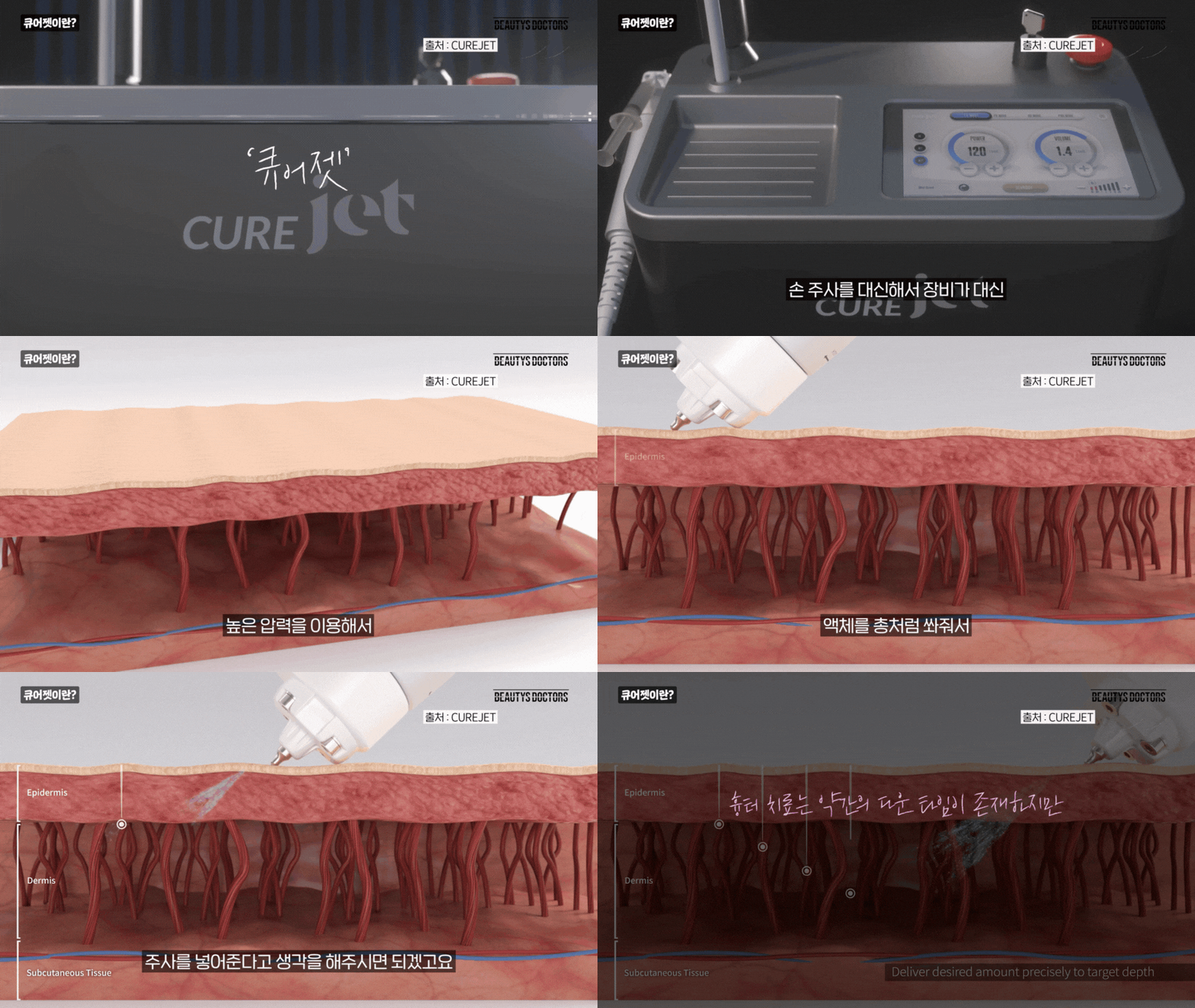
① CureJet – Needle-free high-pressure injection system
CureJet is not a method that uses needles
like a regular hand injection.
It uses the principle of high-pressure jet delivery
to instantly penetrate liquid into the skin.
Simply put,
it is a device that delivers medication to the dermis
n
without needles.
✔ Almost no needle marks remain
✔ Reduced chance of bruising
✔ Significantly less pain
In particular,
for those who fear injections,
the psychological 부담 is also greatly reduced.
② Juvelook – a collagen-regeneration-inducing ingredient
Juvelook
stimulates fibroblasts within the skin
to promote collagen production.
The essence of atrophic scars is
“collapse of the dermal structure.”
Therefore, rather than simply smoothing the surface,
the key is
✔ dermal restructuring
✔ increased collagen density
✔ improved skin texture
✔ restored elasticity
③ The synergy of the two procedures
The advantage of CureJet + Juvelook is
that it does not stop at simple drug delivery.
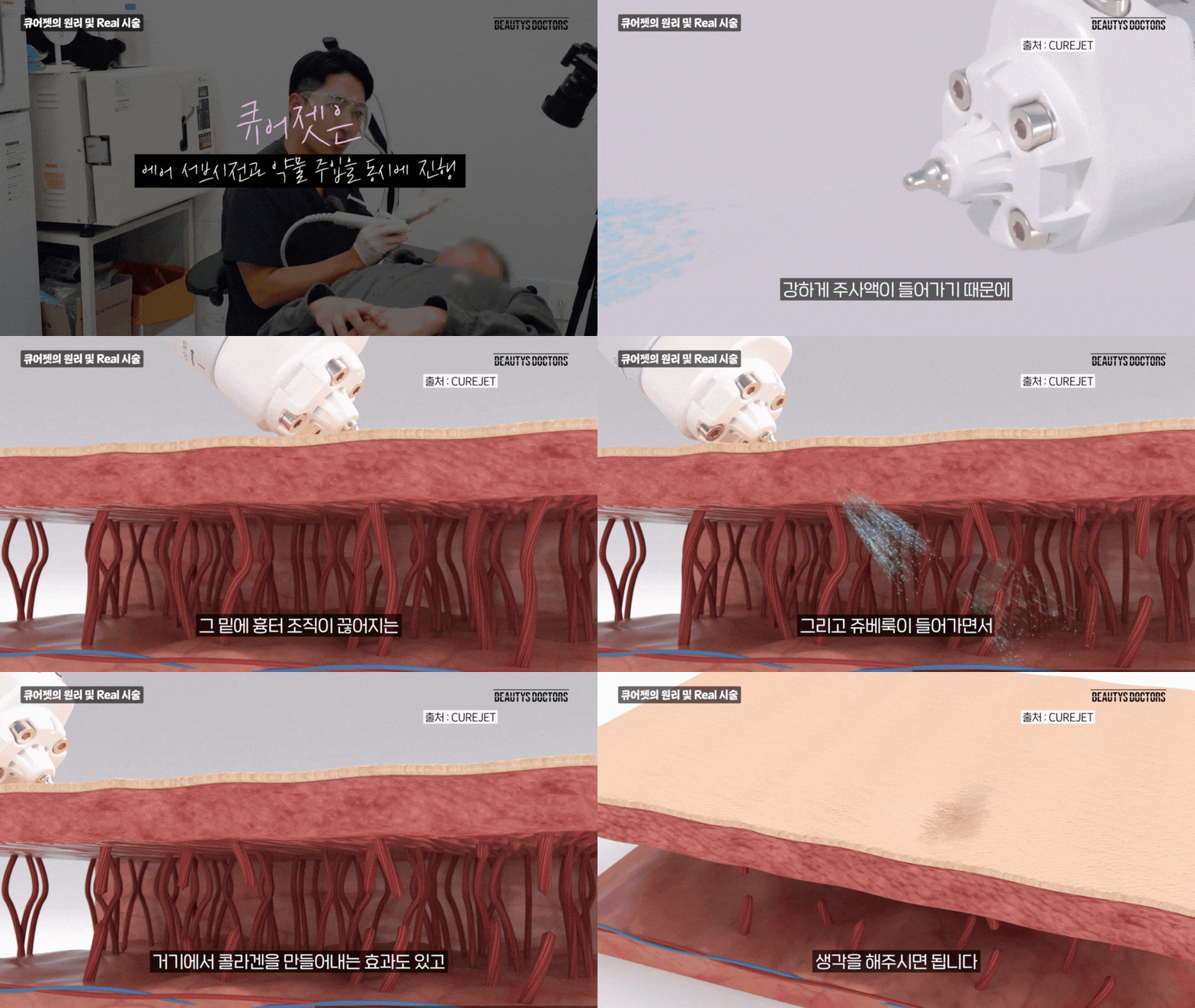
During the high-pressure injection process,
fibrous tissue adhered beneath the scar
is partially separated,
creating an air subcision effect.
In other words,
the tissue that was binding the sunken base
is loosened,
and Juvelook enters that space,
where collagen production takes place.
With repeated treatments,
you can expect
✔ reduced scar depth
✔ a flatter skin surface
✔ overall improvement in skin texture
- These people are especially good candidates
✔ Sensitive skin that stayed red for a long time after laser treatment
✔ Those who have postponed treatment because of pain
✔ Those who want a natural-looking recovery
✔ Office workers who need to maintain daily life without downtime
It is suitable for those who want gradual improvement
n
without strong ablative treatment.
- Things to check before treatment
No matter how good the device is,
it does not apply equally to every skin type.
✔ Customized skin planning
The intensity and number of sessions vary
depending on scar depth, width, and skin thickness.
✔ Medical staff expertise
The design of injection depth and treatment area
greatly affects the outcome.
✔ Realistic expectations
Atrophic scars
are not a condition that disappears 100% in one session.
With the goal of gradual improvement,
several planned sessions are needed.
Key points
🔹 Acne scar lasers are effective,
but there are burdens of pain, redness, and downtime
🔹 CureJet + Juvelook
reduces pain with a needle-free method and
uses collagen regeneration
to improve the skin from within
🔹 With the added air subcision effect,
it also helps ease the structure of depressed scars themselves
✦
There is no single right answer
to acne scar treatment.
What matters is
choosing the method that suits your skin condition.
Rather than simply choosing the strongest treatment,
a sustainable method with less recovery burden
may be the better choice.
If you have been struggling with acne scars for a long time,
I hope this post has helped you find a direction.
Thank you for reading.
This was Beauty's Doctors, We Youngjin.