Hello.
I’m Dr. Kim Jang-ju 🙂
“Lately, my face seems a bit bigger.”
“My jawline feels less defined.”
Many people come in with concerns like these.
In situations like this, the first procedure that comes to mind is Botox.
However, not all concerns about facial contours can be solved simply with Botox.
Today, before considering Botox, let’s take a step-by-step look at facial habits and salivary glands—two things that are worth checking at least once.
1️⃣ Is Botox really necessary?

Botox is a procedure used to reduce the masseter muscle, which is the jaw muscle,
or to reduce the volume of the salivary glands.
It is a procedure with clear effects in practice,
but the important point is that not every concern about face shape
can necessarily be resolved only with a procedure.
Small habits repeated in daily life can make the face look wider,
or make the jawline appear less defined.
This is something I often explain during consultations as well.
2️⃣ If the salivary glands get bigger, does the face look bigger too?

One cause of the area beside the jaw looking swollen is salivary gland enlargement.
The salivary glands are broadly divided into the parotid glands, located below the ears,
and the submandibular glands, located under the jaw.
When these areas become enlarged,
the jawline does not stand out clearly
and the face can look overall dull.
In particular, when the parotid glands are enlarged,
the boundary between the neck and face becomes less distinct,
giving the impression that the contours are drooping downward.
In some cases,
it can even create the impression of volume gathering in the lower face,
like a so-called “toad face.”
If your face looks wider or your jawline seems to have disappeared even though your weight has not changed much,
you need to consider the influence of the salivary glands as well, not just fat.
3️⃣ Why do the salivary glands get bigger?
The salivary glands normally play the role of secreting saliva when chewing food
or when the mouth is dry.
But when certain habits are repeated,
this function can become overactivated,
and the glands may gradually change in a way that makes them larger.
When the salivary glands become enlarged like this,
the jawline becomes less defined,
the face can look spread out,
and as the boundary between the neck and face breaks down,
the contours may look dull.
🔍 Major habits that can cause salivary gland enlargement
✔️ Frequent drinking
When you drink alcohol often,
diuresis reduces the body's water content,
and to compensate,
the salivary glands begin to work more actively.
If this process is repeated,
the salivary glands can be continuously stimulated
and gradually enlarge.
✔️ Overeating, frequent meals
A habit of eating food frequently also continues to stimulate the salivary glands.
In particular, irritating diets such as salty foods
or spicy foods increase saliva secretion even more,
which can easily lead to an increase in salivary gland volume.
As these stimuli accumulate,
they can lead not just to a temporary change
but to a structural change.
4️⃣ Before Botox, the essential “distinction process”
Just because the jawline has become less defined,
does not mean Botox should automatically be chosen.
That can actually be an inefficient approach.
The first step is to accurately distinguish whether the face looks bigger because of the masseter muscle,
because of the salivary glands,
or because of fat.
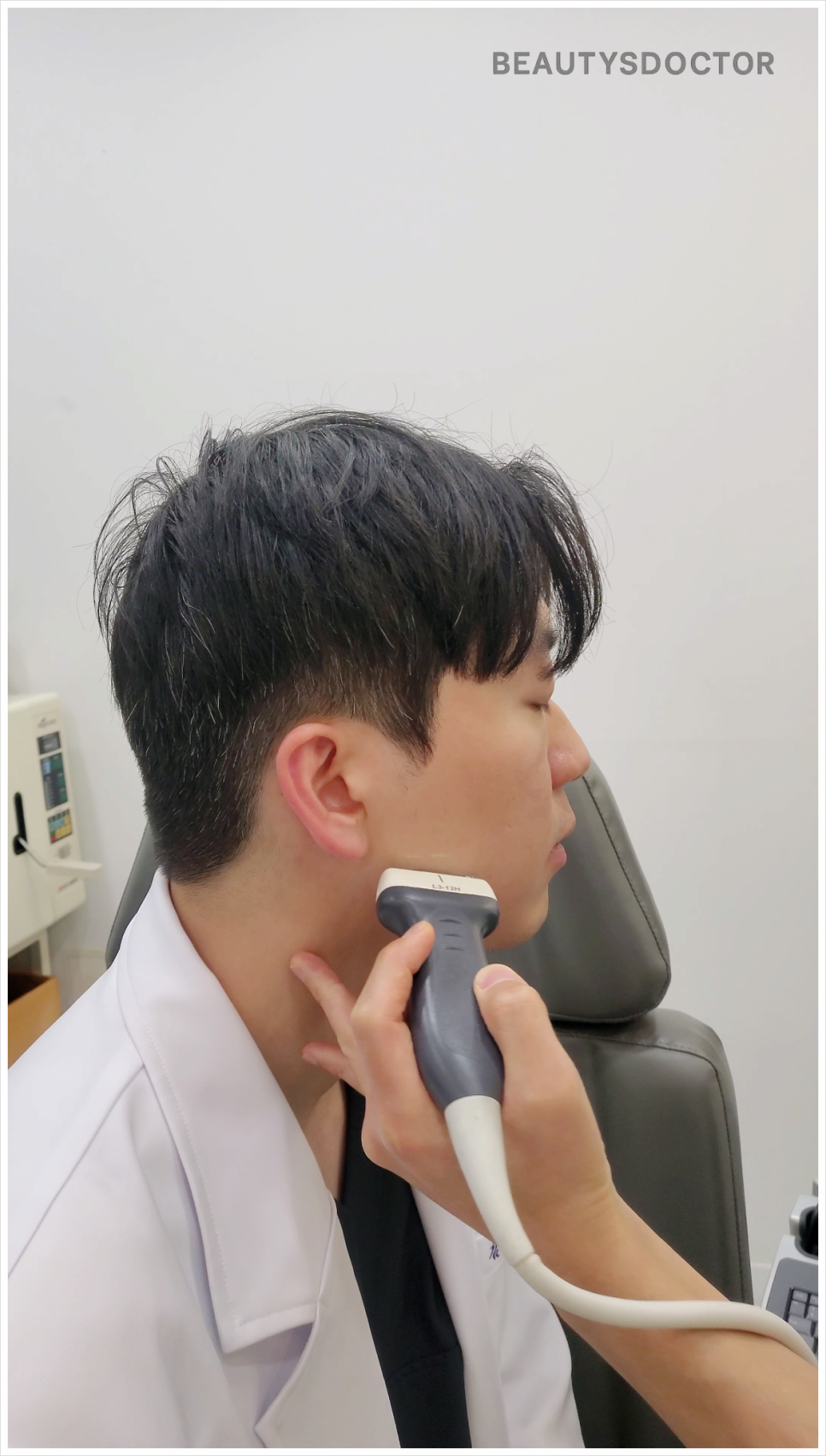
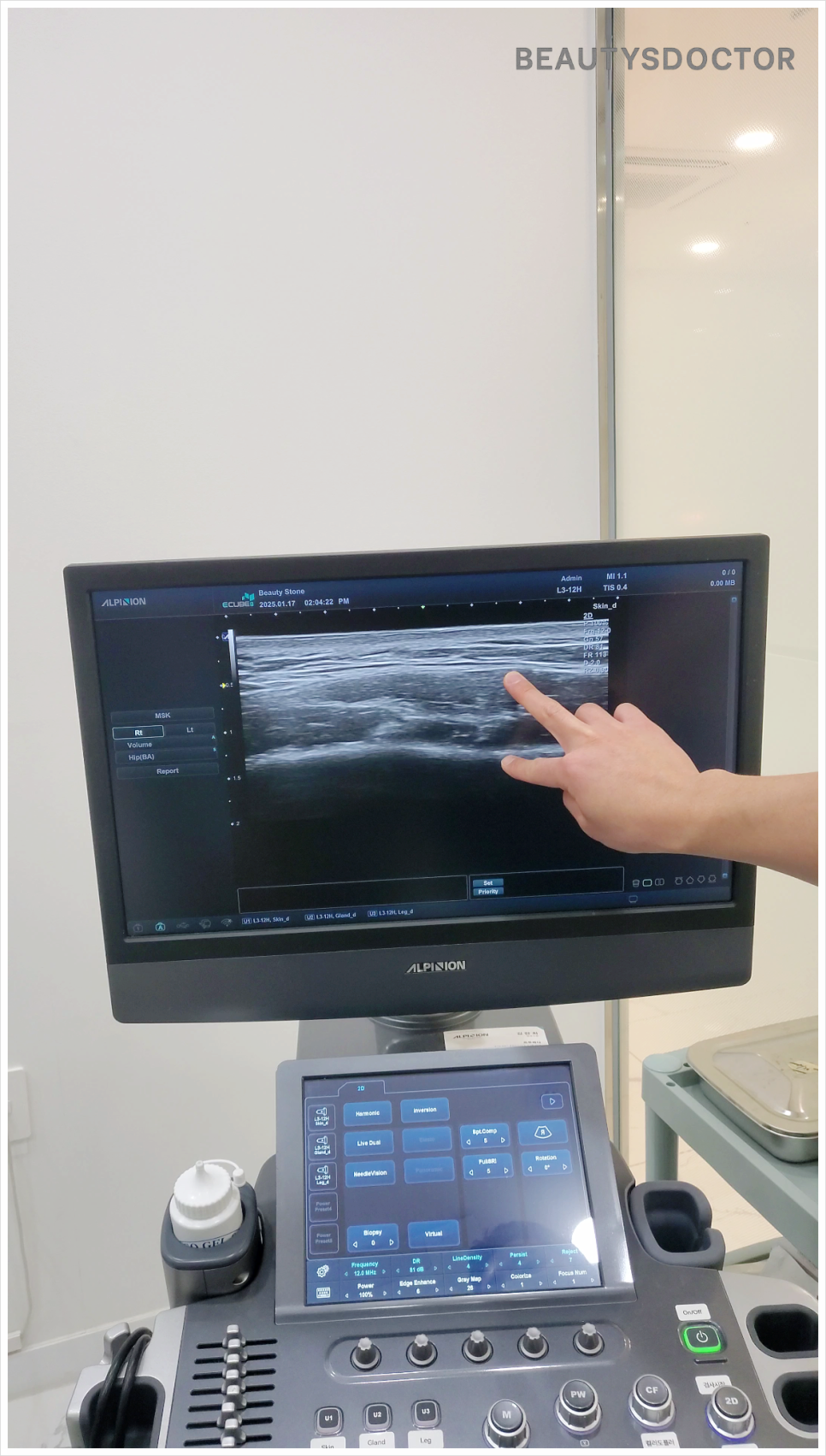
Recently, ultrasound equipment has often been used for this kind of assessment.
A representative device is “Alpinion ultrasound.”
With this device,
you can check muscle thickness and salivary gland size in real time,
which are difficult to confirm from the skin surface.
This allows a plan to be made so that the procedure is performed accurately only on the areas that truly need it.
In clinical practice as well,
before Botox procedures,
ultrasound diagnosis is increasingly important for reducing unnecessary procedures
and for establishing a more precise contour plan.
📌 What is Alpinion ultrasound?
It is an ultrasound diagnostic device that can assess soft tissues such as muscles, fat, and salivary glands under the skin in high resolution.
By using this device,
you can directly check the thickness of the masseter muscle
and the condition of the salivary glands,
which helps avoid unnecessary procedures
and supports the creation of a precise treatment plan tailored to each individual’s condition.
5️⃣ What determines the result is not the procedure, but the plan
If you are considering jaw Botox,
rather than simply deciding whether or not to undergo the procedure,
it is important to first understand why this area looks wide
and what structural cause is behind it.
Recently,
through pre-procedure ultrasound analysis,
it has become increasingly important to check the condition of the muscles and salivary glands,
and to approach only the necessary areas accurately.
When this process is done properly,
unnecessary procedures can be reduced,
and the result can be more natural.
👉 Facial contouring is
not simply a matter of reducing size,
but a process of understanding structure
and achieving balance.
When approached with this in mind,
you can create a more defined change without overdoing it.
Is Botox really the only way to make the face look smaller?
Not necessarily.
Just by adjusting your lifestyle habits
and properly understanding your facial structure,
you can create a much more refined contour than you have now.
The important thing is not to undergo procedures unconditionally,
but to know exactly what direction your face needs.
If today’s content was helpful,
please take a moment from now on to check your facial habits 😊
Thank you for reading.
This was Kim Jang-ju.