Hello.
This is Wi Young-jin.
Recently, during consultations,
I’ve been hearing more and more people say things like,
“My face seems to be getting bigger.”
“My jawline feels less defined.”
These are concerns that
more and more people continue to mention.
In particular, when the double chin seems more noticeable than before,
or when the facial contours feel like they’ve collapsed,
one of the first things that comes to mind
is a lifting procedure.
Among them,
Ultherapy is drawing more attention
as a way to improve firmness without surgery.
Today,
I’ll explain why Ultherapy lifting,
which is often used to improve a double chin,
is effective,
starting from the principle
and moving through how it is applied.
Why does a double chin develop?
A double chin is not simply a problem caused by increased fat.
In reality,
changes in the deeper structures of the skin also play a role.
In particular,
problems often begin as the elasticity of the SMAS fascial layer,
which supports the face, declines.
This fascial layer
supports the skin and fat layer,
but as aging progresses,
it gradually becomes looser.
In this state,
subcutaneous fat
descends downward with gravity,
and as a result,
a volume builds up under the chin,
forming a double chin.
If this process repeats,
the jawline collapses
and the facial outline appears blurred.
In other words,
a double chin forms through a combination of
reduced fascial elasticity,
the effects of gravity,
and sagging fat.
That is why simple dieting alone
is often not enough to improve it,
and an approach that lifts the deeper layers of the skin
becomes necessary.
What is the principle behind Ultherapy?
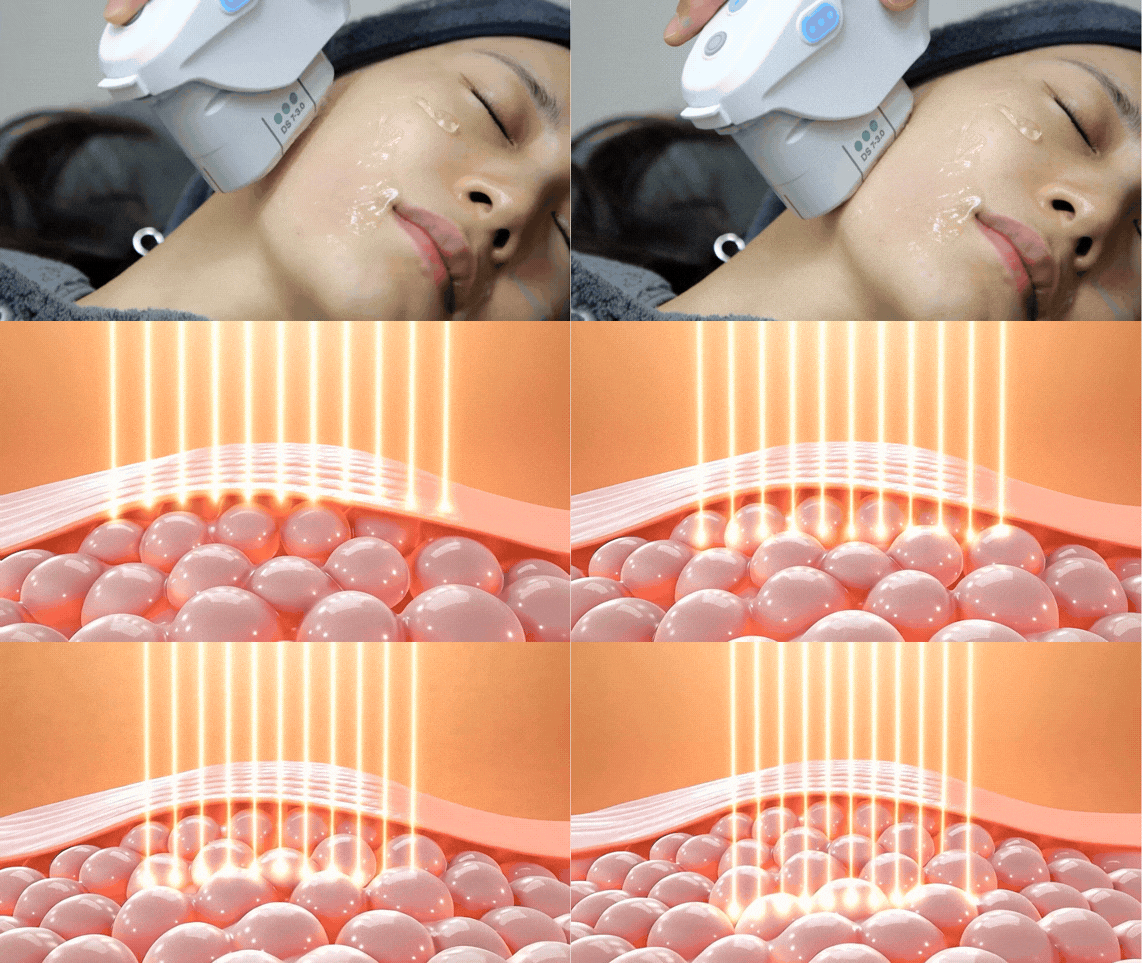
Ultherapy is a lifting procedure
that uses high-intensity focused ultrasound (HIFU)
to deliver energy
into the deeper layers of the skin.
Its 특징 is that
it acts directly on the internal structure,
not on the skin surface.
In particular,
it precisely delivers energy to the SMAS fascial layer,
forming thermal coagulation points
and inducing tissue contraction.
The heat delivered at this time
is around 60 to 70 degrees Celsius,
a temperature suitable for contracting tissue.
To explain this reaction simply,
it is similar to the way
an squid curls up when heated.
Inside the skin as well,
the area receiving the thermal stimulus
contracts immediately,
creating a pulling-up effect.
This is the core of Ultherapy lifting.
In addition, after the procedure,
the collagen regeneration process is activated,
so over time,
you can expect a dual effect:
improved skin firmness and density.
The fact that these changes can be induced
without an incision or threads
is the advantage of non-surgical lifting.
What does Ultherapy 600 shots mean?

In Ultherapy,
600 shots is not just a number,
but a design unit
for lifting the entire face in a balanced way.
In other words,
rather than focusing on one area,
it is a full-face lifting concept
that is performed with the overall facial structure in mind.
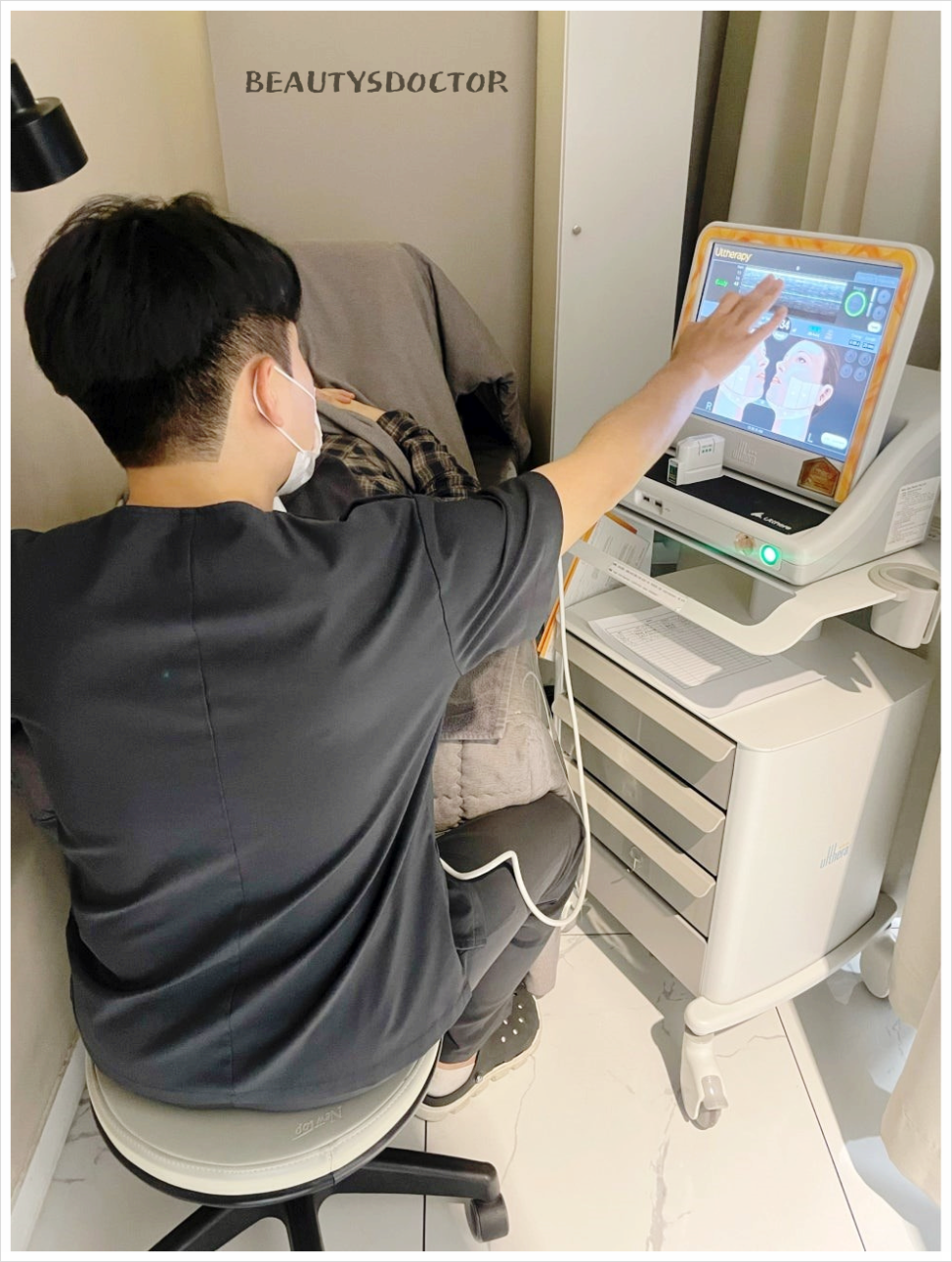
Before the procedure,
ultrasound imaging is used
to check the thickness of the skin and the depth of the fat layer,
and a plan for energy delivery
is then designed accordingly.
This process is important because
even on the same face,
each area differs in thickness and structure.
For example,
thin areas are treated delicately without excessive stimulation,
while areas that need firmness
are approached more deeply and broadly.
The depth of the tips used
is also applied differently.
A depth of 4.5 mm
targets the SMAS fascial layer,
and a depth of 3.0 mm
mainly acts on the area beneath the dermis.
Through this layered approach,
areas where sagging is more likely to appear,
such as the jawline and beneath the cheeks,
can be improved more intensively.
The important point here is
a design that lifts naturally
n
without hollowing the cheeks.
How long does the Ultherapy effect last?
With Ultherapy,
you can feel a change even after a single session.
Usually,
the effects last for about 6 months to 1 year,
and in particular, when performed with a sufficient number of shots,
collagen production continues
and gradual improvement follows.
Rather than immediately after the procedure,
many people notice the most visible changes
between 2 and 3 months afterward.
Of course, the results
may vary depending on the individual’s skin condition, firmness level,
lifestyle habits, and other factors.
In general,
managing it about once a year
can help maintain a natural lifting effect.
Who is it suitable for?
Ultherapy is
not just a simple firmness treatment,
but a procedure that induces change
deep within the skin’s structure.
Therefore,
it can be a suitable option for people who are concerned about a double chin or a sagging jawline,
people whose V-line has become less defined,
those who want a natural lift without surgery,
and those who want to continue consistent firmness care
as part of their routine.
Changes in facial contours
are often not just a surface issue,
but begin with changes in the deeper structures of the skin.
Therefore,
rather than only caring for the surface,
a deeper approach that also considers the lower layers is needed.
If you’ve recently looked in the mirror
and felt that your jawline has become less defined,
you may want to check whether it is not simply a change in weight,
but a structural change.
Thank you for reading.
This was Wi Young-jin.