Hello,
I’m Kim Jang-ju from Beauty’s Doctor.
As spring begins and the warm wind starts to blow,
many people actually feel that their skin has become even drier.
Although daytime feels mild,
the cold, dry air in the morning and evening
causes skin moisture to evaporate quickly.
Especially during this season, the skin feels tight,
white flakes appear,
and
the lips and the area around the nose
often crack easily.
Even in the consultation room at Hongdae Entrance Station Dermatology,
whenever spring comes around,
I often hear concerns like,
“Even if I apply moisturizer, my skin gets dry again quickly.”
“My skin keeps feeling tight and has become more sensitive.”
At times like this, the product many people think of first
is Vaseline.
Although it is a familiar, long-standing product,
many people do not actually know exactly
how to use it or what skin types it suits best.
So today, I’ll organize a bit more detail
about Vaseline, which can help protect skin
during dry seasons.

Can dry skin be managed with Vaseline?
In spring,
the temperature difference between day and night is large,
and dry winds continue to blow,
so the skin barrier can easily weaken.
Outdoors,
it is exposed to cold wind and dust,
and indoors,
low humidity and heating
cause moisture inside the skin to evaporate quickly.
When the moisture in the skin decreases like this,
it goes beyond simple dryness.
The skin feels tight, the surface becomes rough,
flakes lift up,
and even a stinging sensation may appear.
Some people feel tightness immediately after washing their face,
while others repeatedly experience cracking in specific areas
such as the hands, heels, and lips.
When I counsel patients at Hongdae Entrance Station Dermatology,
these dry-skin symptoms are often a sign
that the skin barrier has weakened.
People have long used methods to reduce moisture loss
by creating a protective film on the skin
to prevent dryness.
In the past, animal fats were used,
while today, products that form a protective barrier
in a more refined way are used.
A representative example is Vaseline.
Rather than directly supplying moisture to the skin,
Vaseline helps prevent the moisture that is already there
from escaping.
If you understand this and use it properly,
it can help with dry-skin care.
What is Vaseline?
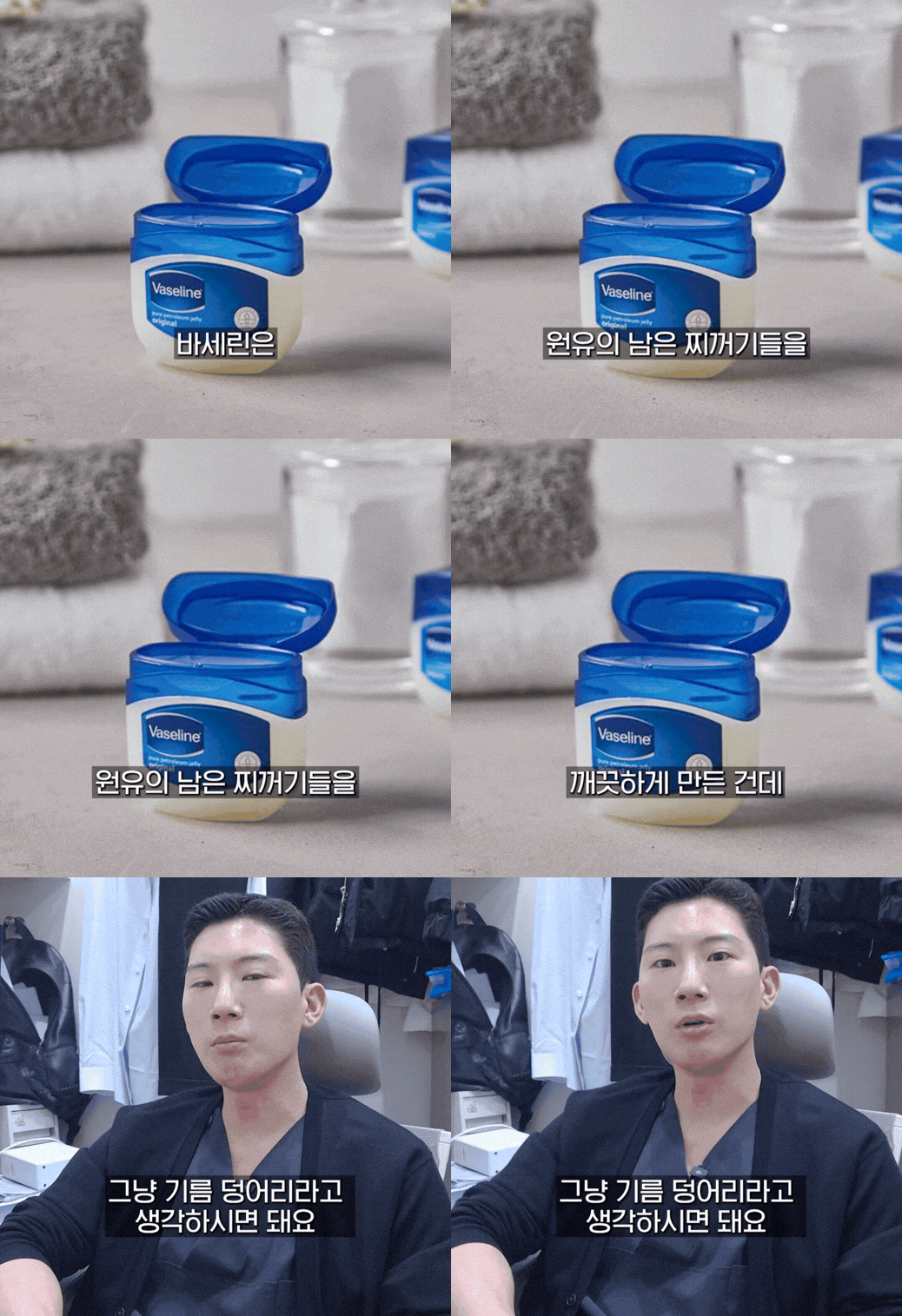
Vaseline is a type of petroleum jelly
made by refining petroleum.
Because it is made through a refining process,
it can be used on the skin,
and it has long been used for skin protection.
It is generally nearly colorless,
has little to no scent, and when applied to the skin,
it forms a thin protective film.
This film reduces moisture evaporation from the skin surface
and helps protect the skin from external irritation.
In other words, it is less of a functional product
that absorbs deeply into the skin and brings about changes,
and more of a product that protects the skin surface.
At Hongdae Entrance Station Dermatology as well,
for people whose skin dries out easily,
we explain that when using Vaseline,
it is better to apply it after moisturizer.
This is because supplying moisture first
and then forming a protective barrier on top
is more effective.
Main effects and how to use Vaseline

Because Vaseline mainly protects the skin surface,
it is best to use it selectively on dry areas.
Finishing step for moisturizing
Vaseline is not a product that supplies moisture,
but one that prevents moisture from escaping.
Therefore, it is more effective to apply lotion or cream first
and then add a small amount at the final step.
It is especially helpful for areas that become rough easily,
such as the elbows, knees, hands, and heels.
Lip protection
The lips have few sebaceous glands,
so they easily crack in dry weather.
In such cases,
applying a small amount of Vaseline
can help protect the surface of the lips.
If you apply a thin layer before bed,
it may help reduce dryness overnight.
Protecting damaged skin
When the skin has become weakened due to
minor abrasions or irritation,
Vaseline may help reduce external irritation
and protect the skin surface.
However, it is best to avoid using it on wounds with infection.
Protecting the hairline
Before dyeing your hair,
if you apply a thin layer of Vaseline to the hairline,
it can help reduce hair dye from getting on the skin.
In this way, Vaseline is better used thinly
after gently applying moisturizer, rather than
thickly over the entire face.
At Hongdae Entrance Station Dermatology as well,
we often recommend using Vaseline as a localized protective product.
Precautions when using Vaseline
Because Vaseline is a product that coats the skin surface,
there are a few precautions to keep in mind when using it.
First, it is best to avoid using it on wounds that are already infected.
If there is oozing or pus,
it may worsen the condition.
Also, if you apply too thick a layer,
your skin may feel clogged
and it can trigger breakouts.
In particular, for skin with a lot of sebum production,
care is needed when using it over the entire face.
If you have sensitive skin,
it is better to test a small amount before using it.
Depending on the product,
some may contain additives,
so checking the ingredients is also important.
In consultations at Hongdae Entrance Station Dermatology,
we also explain that Vaseline should be used
after considering your skin type.
Vaseline and dry-season skin care
During dry seasons,
it is good to apply moisturizer immediately after washing your face
and then use a small amount of Vaseline
at the final step.
Because Vaseline works to trap moisture in the skin,
moisture needs to be supplied first.
In many cases, it is more helpful to use it before bed
than before going outdoors.
Especially if your hands or feet are very dry,
applying Vaseline and then wearing cotton gloves or socks
can enhance the moisturizing effect.
However, it is best not to overuse it on the face.
At Hongdae Entrance Station Dermatology as well,
when managing dry skin,
we emphasize using it on the appropriate areas rather than overusing it.
Vaseline is a simple and convenient
skin protectant.
However, it does not suit every skin type,
so it is important to use it according to your skin condition.
For dry-skin care,
it is good to consider moisture supply and barrier formation together.
Even small habits can help reduce dry skin.
Immediate moisturizing after cleansing
Minimizing irritation
Focused protection for needed areas
Keeping these three things in mind may help.
If dryness keeps recurring,
it is possible that the skin barrier has weakened.
Through a consultation at Hongdae Entrance Station Dermatology,
you can also check the care method
that suits your current skin condition.
If you have any other questions related to Hongdae Entrance Station Dermatology,
please leave them in the comments.
I will answer them myself.
Thank you for reading this long post.
This was Kim Jang-ju.