Hello.
This is Beauty's Doctor, Wee Youngjin.
When consulting about Botox in the clinic,
there are questions I get very often.
"Is Botox safe?"
"What if resistance develops?"
"Why does a square jaw get smaller?"
"Can I drink alcohol?"
Botox is a popular procedure,
but understanding how it works and the precautions involved
leads to more stable results.
So today,
from Botox safety
through its mechanism of action, treatment areas, and resistance,
I’ll summarize it based on clinic standards.
- Is Botox really safe?
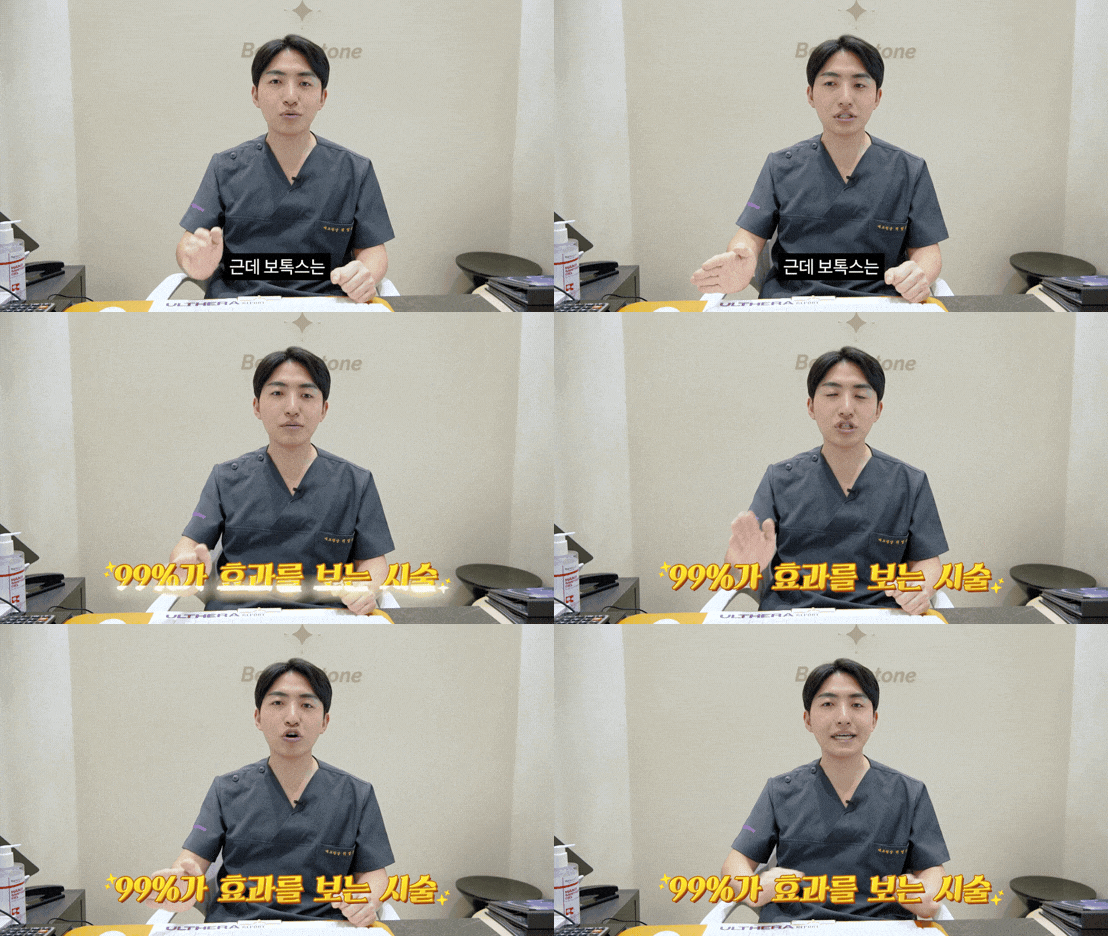
Botox is
a medically long-used
and safety-verified procedure.
Because it works by temporarily reducing muscle movement
through a nerve transmission-blocking mechanism,
if it is injected accurately into the proper area,
the likelihood of problems is low.
However,
if the injection site is incorrect
or the procedure is performed without understanding muscle anatomy,
if it affects the swallowing muscles,
temporary difficulty swallowing may occur,
or if it acts excessively on facial expression muscles,
an unnatural expression may appear.
So what matters is
not Botox itself,
but the exact injection site and dosage design.
- How far can Botox be used for treatment areas?
Botox can be used in most areas
as long as there is muscle.
Representative areas include
✔ Square jaw muscles
✔ Forehead wrinkle muscles
✔ Eye-area wrinkle muscles
✔ Chin muscles
✔ Trapezius muscles
✔ Calf muscles
In addition,
it is also applied to areas with many sebaceous glands
and areas with many sweat glands.
That is why
skin Botox
underarm hyperhidrosis
palm sweating treatment
are also performed
with Botox.
- Can I drink alcohol after Botox treatment?
Complete abstinence is not absolutely required,
but it is best to avoid drinking on the day of treatment.
Drinking alcohol can cause vasodilation,
spreading around the injection site, and increased swelling,
and in some cases
it may also weaken the effect.
So it is best to avoid alcohol on the day of the procedure,
and if possible, reduce drinking for about 2–3 days.
- Why should facial heat be avoided after Botox?
Botox
is made of a protein structure,
so it is sensitive to heat.
If you are exposed immediately after the procedure to
saunas, jjimjilbang, hot massages,
or high-temperature lasers,
the medication may spread
or its effect may decrease.
So on the day of treatment,
it is better to avoid
strong hot heat exposure.
- Why do pores get smaller with skin Botox?
Around pores,
there are sebaceous glands.
As sebum production increases,
pores become wider,
and as sebum production decreases,
pores appear tighter.
Skin Botox reduces sebaceous gland activity,
which leads to reduced sebum production, less skin shine,
and a pore-reducing effect.
This is especially why it is often performed for
summer pore concerns, oily skin,
and makeup breakdown.
- Does it also work on eye-area wrinkles?
Wrinkles around the eyes are dynamic wrinkles
caused by repeated use of facial muscles.
Botox reduces this muscle movement,
helping improve smile lines and fine wrinkles at the outer corners of the eyes.
If done naturally, it is possible to soften wrinkles
while maintaining facial expression.
- What is the principle behind square jaw Botox?
A square jaw is often not caused by the jawbone,
but by enlarged chewing muscles,
which make the face look wider.
These muscles are continuously used for chewing,
bruxism,
and habits of clenching the jaw,
so they gradually become larger.
When Botox is injected,
reduced muscle use, muscle atrophy,
and a decrease in volume occur,
which softens the jawline
and creates the effect of a smaller-looking face.
- Can people in their 20s and 30s get Botox?
Yes, they can.
Botox is not based on age,
but on the condition of muscle use.
✔ Developed square jaw
✔ Bruxism
✔ Beginning of expression wrinkles
✔ Enlarged jaw muscles
If these apply, people in their 20s can absolutely undergo the procedure.
In fact, for disease treatment purposes,
it is also used at even younger ages.
- What should I do if Botox resistance develops?
If resistance develops,
it is better to leave a sufficient gap between procedures.
Usually, after taking about a 1-year break,
when the procedure is performed again,
the effect often recovers.
It can also be addressed by adjusting the dosage,
changing products,
or changing the treatment interval.
- Why does resistance develop if Botox is done too often?
Botox is
structured as botulinum toxin + complex proteins.
If repeated procedures are performed at short intervals,
antibodies may form against these complex proteins,
which can reduce the effect and lead to resistance.
So what matters is
✔ Avoiding excessive dosage
✔ Avoiding intervals that are too short
✔ Treating only the necessary areas
These three things.
Botox is a safe procedure,
but accurate placement and dosage design are important.
It can be applied to various areas,
including the square jaw, wrinkles, pores, and sweating.
After treatment, it is best to avoid alcohol and heat exposure on the same day.
If repeated too frequently at very short intervals,
resistance may develop.
Design tailored to each person’s muscle condition
is the most important factor.
If you are considering Botox,
it is best to first check a treatment plan that matches
your current muscle condition and purpose.
Thank you for reading this long post.
This was Weeyoungjin.