
Hello.
I’m Beauty’s Doctor, Wie Youngjin.
Unlike simple fillers,
Sculptra is not a treatment that “fills up right away”
but one that creates changes over time.
In other words, rather than the change immediately after the procedure,
the key is the response that develops inside the skin.
That is why, even during consultations at the Yeonsinnae dermatology clinic,
patients tend to have different kinds of questions.
“Why doesn’t it fill up right away?”
“How many sessions do I need?”
“What’s the difference from filler?”
The reason these questions keep coming up
is because Sculptra’s structure itself is different.
So today,
based on the questions most often asked
in the Yeonsinnae dermatology clinic exam room,
I’ll organize the key points in an easy-to-understand way.
- Can one bottle of Sculptra be used on just one area?
To start with the conclusion:
it is possible, but it is not the recommended approach.
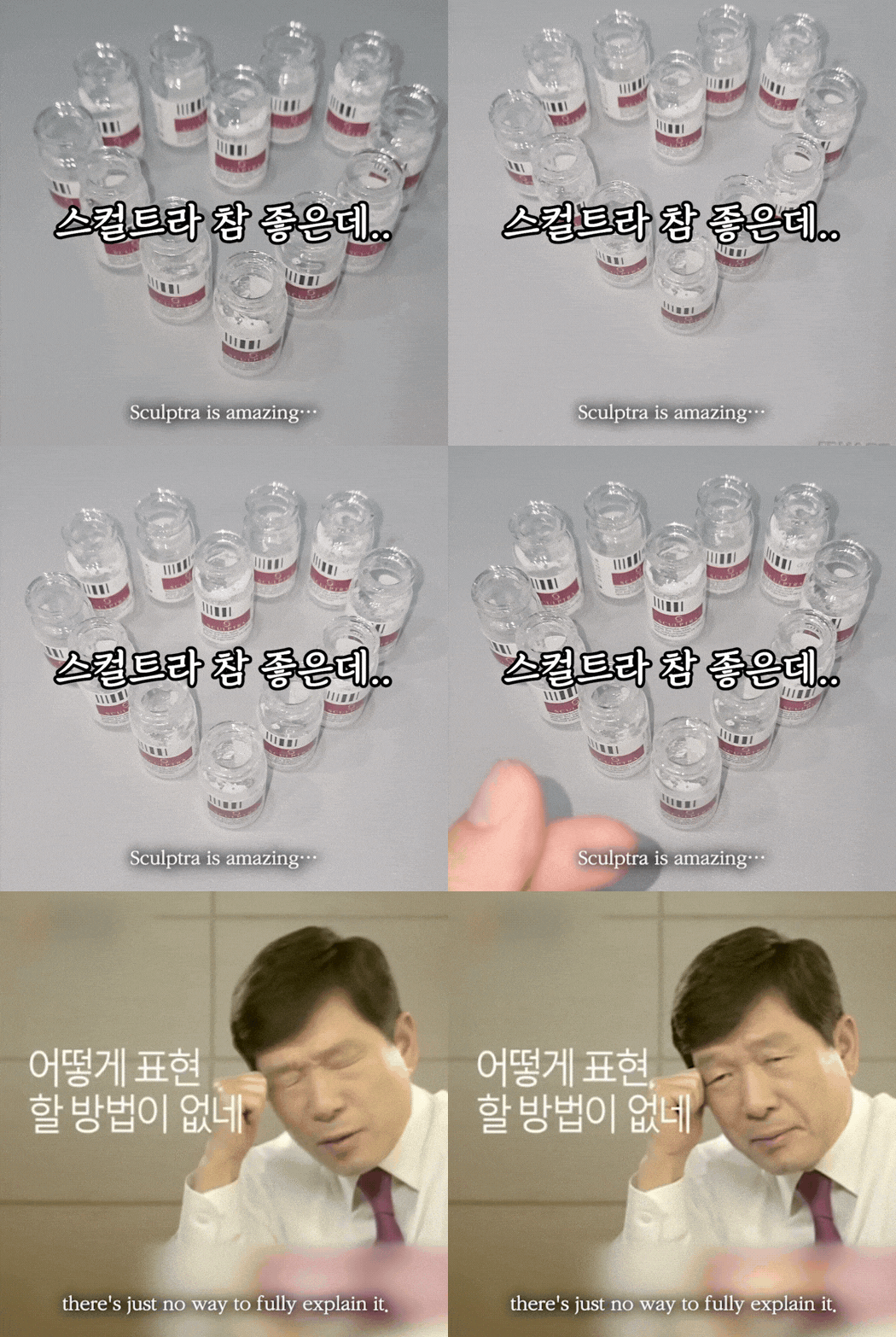
When one bottle of Sculptra is diluted,
it creates about 8–10 cc of volume.
If this amount is used all in one area,
it may create temporary volume,
but the distribution can become unbalanced,
which may reduce the naturalness of the result.
So in actual clinical practice,
rather than concentrating it in one area,
it is often distributed across multiple points
or divided into half-bottle portions
and planned as two treatment sessions.
This approach
more evenly induces collagen production
and ultimately creates a more natural sense of volume.
2. How many bottles are needed for the whole face?
Sculptra varies greatly from person to person,
but for the whole face,
2–3 bottles is usually considered the basic range.
This standard is not simply about quantity,
but is closer to the “minimum unit needed to create a foundation for collagen production.”
In particular, usage tends to increase in the following cases:
when there is overall hollowing in the cheeks
when there is little facial fat and the face is naturally thin
when overall skin elasticity has declined
In other words, it is not simply age,
but rather the combination of “facial structure + degree of volume loss” that matters most.
That is why an accurate diagnosis during the Yeonsinnae dermatology clinic consultation stage is so important.
3. Can it really improve lifting, volume, and elasticity all together?
To put it simply,
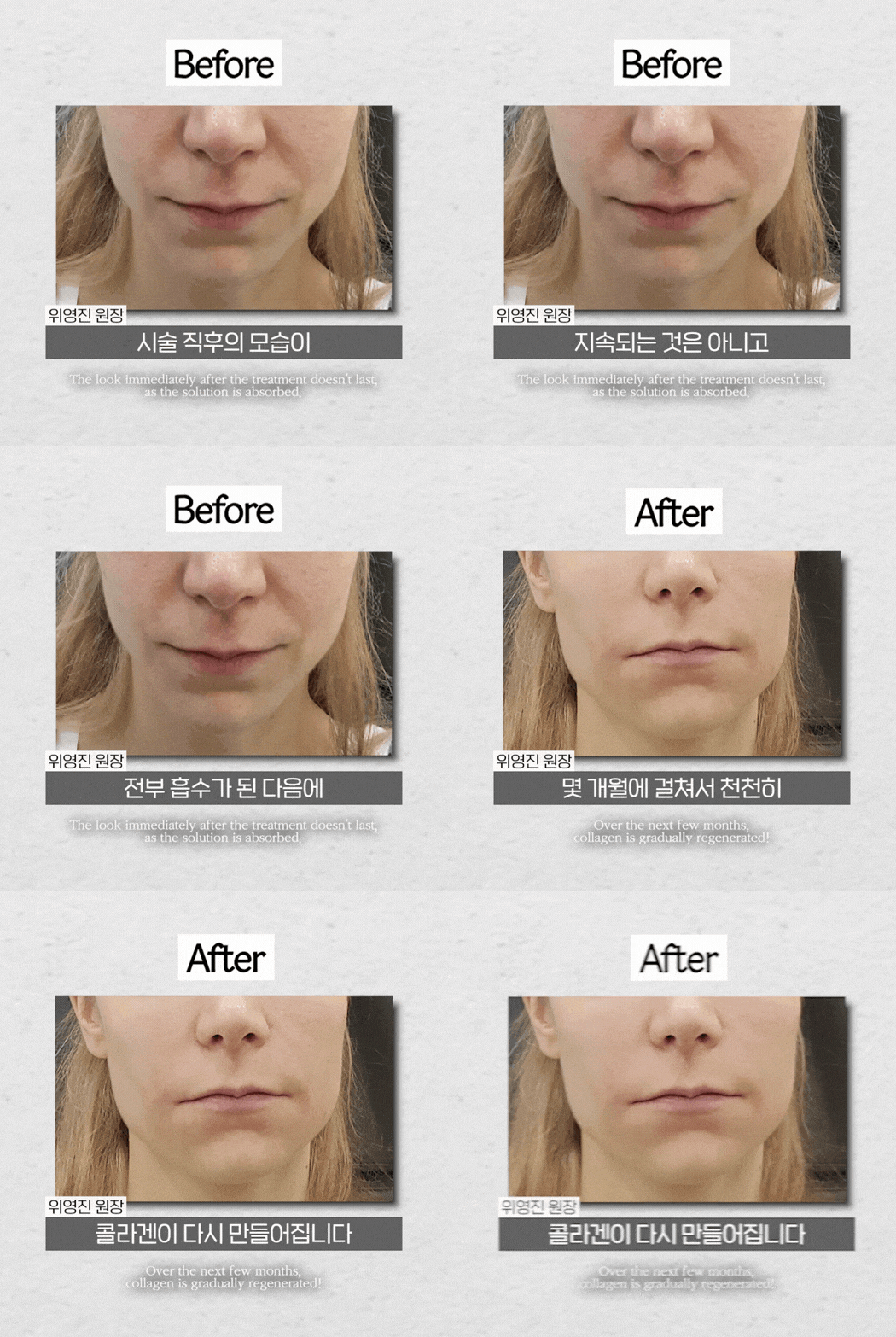
improvements in volume and elasticity can definitely be expected.
Sculptra’s PLLA ingredient
induces collagen production within the skin.
In other words, it is not simple filling,
but a method in which “your own skin fills itself back up.”
Because collagen serves as the skin’s framework,
when its production increases, you naturally see
volume improvement
increased elasticity
higher skin density
all together.
However, the lifting effect is not a direct pull,
but rather an “indirect lifting” effect
where the structure appears lifted as volume gradually returns.
So instead of a dramatic change,
it is closer to a naturally refined look.
4. Can it be performed on the neck or the back of the hands?
Sculptra can be applied not only to the face
but also to the neck and the backs of the hands.
In particular, for the neck,
it can often help improve fine wrinkles caused by collagen loss.
However, the approach differs by area.
The skin on the backs of the hands is thin and moves a lot,
so in some cases another treatment may be more suitable than Sculptra.
For example,
if immediate volume and a uniform result are needed,
another collagen stimulator such as Radiesse
may be a better choice.
In other words, rather than “whether it can be done,”
what matters is “which product is more appropriate.”
5. Do you really have to get all 3 sessions?

Three sessions is not always the only correct answer.
However, in general,
a 2–3 session protocol is used most often.
The reason is simple.
Sculptra is not a treatment that ends in one session;
it is a structure in which collagen builds up gradually.
It is usually performed at 4–6 week intervals,
and the response stabilizes with repetition.
In other words, 1 session is the “start,”
2 sessions is “formation,”
and 3 sessions is close to “completion.”
6. Is it okay to do it together with lifting treatments?
Sculptra is good on its own,
but it has strong synergy when combined with lifting treatments.
Each treatment plays a completely different role.
ultrasound lifting: immediate tightening
thread lifting: structural lifting
Botox: easing muscle movement
filler: immediate volume replenishment
Sculptra: collagen regeneration-based volume
In other words, Sculptra is
“a treatment that builds the foundation over time.”
That is why, at the Yeonsinnae dermatology clinic,
it is often combined with other treatments
to design the overall facial balance more stably.
7. Why is there such a big price difference?
Sculptra is not just the cost of the product itself,
but the result of treatment planning.
Even with the same product,
dilution ratio
injection depth
distribution method
facial analysis ability
these factors can make the result completely different.
In particular, with PLLA,
where and how it spreads
has a major impact on whether nodules form and how natural the result looks,
so a high level of skill is very important.
In other words, price differences
are often more about “differences in technique” than “differences in the product.”
8. Why the duration is long
Sculptra is not like a simple filler
that physically remains in place.
As the PLLA ingredient breaks down,
it stimulates collagen production in the process,
and as a result,
your skin creates a new structure.
That is why the duration is long,
and cases lasting more than 2 years are common.
In other words, it is not a treatment that simply “remains,”
but something closer to “a newly created result.”
9. Why massage is necessary
Massage after Sculptra treatment
is an important step that affects the outcome.
The core purpose is simple.
It is to distribute the particles evenly
so they do not clump together in one area.
So the 5-5-5 rule is usually recommended.
For 5 days
5 times a day
massage for 5 minutes each time
Through this process,
it helps reduce the risk of nodules
and create a more natural result.
10. Why do nodules occur?
Simply put, nodules are a reaction
that occurs when collagen concentrates in one area.
In other words, it is similar to seeds not being spread evenly
and gathering in one place.
In the past, particle stability was lower,
so this problem was more common,
but recently,
with improved formulations + advances in injection techniques,
the frequency of occurrence has decreased significantly.
In the end, the key is one thing:
how evenly it is distributed.
That is the factor that determines the result.
Sculptra is not just a volume treatment;
it is a collagen regeneration treatment
that encourages the skin itself to change.
Rather than an immediate change,
it is a structure that becomes more complete over time,
and understanding this difference
is the most important point.
Even during consultations at the Yeonsinnae dermatology clinic,
starting only after fully understanding this point
greatly affects satisfaction with the result.
Thank you for reading this long post.
This was Wie Youngjin.