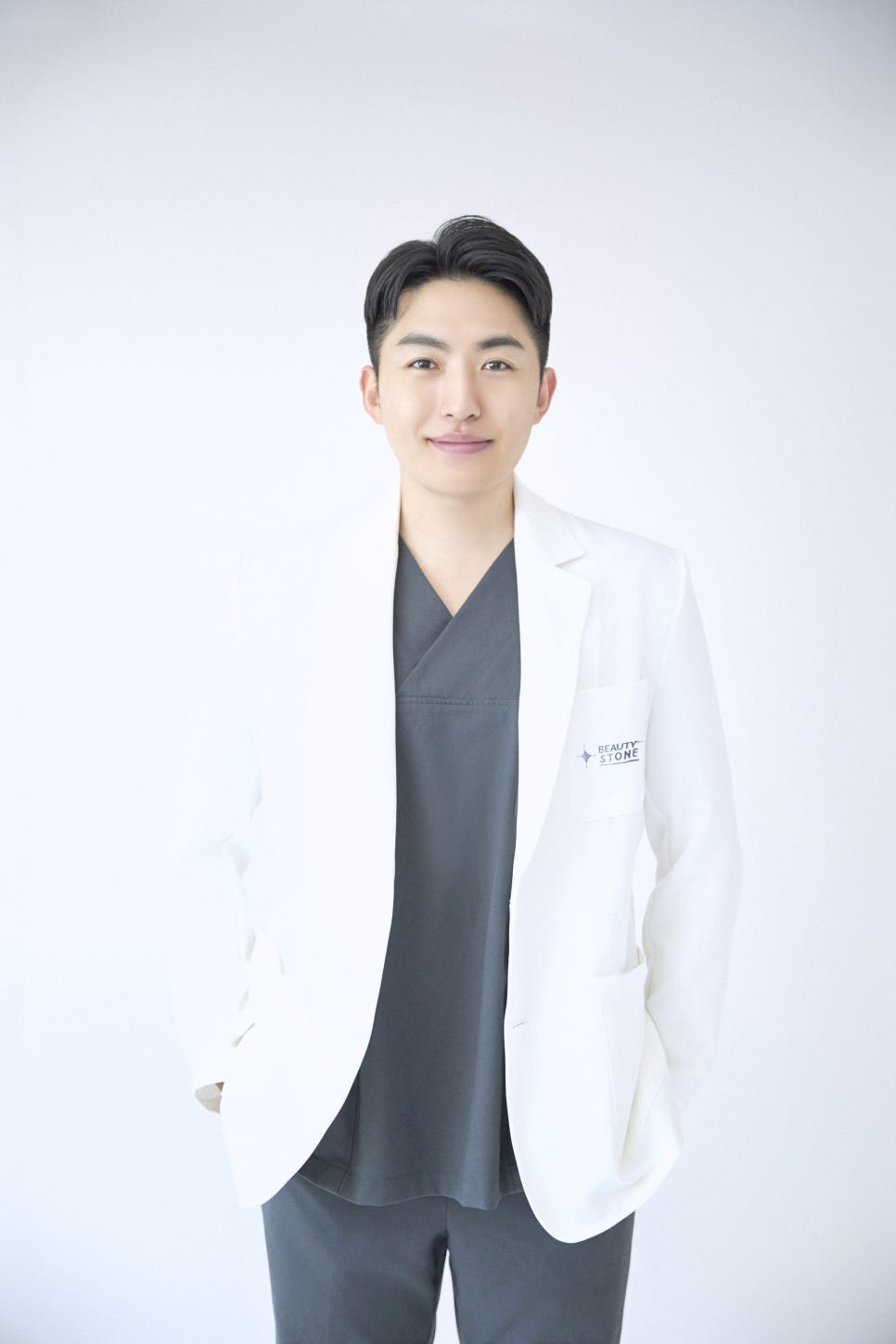
Restylane, Juvederm, Belotero
Were you confused about what’s different?
At our Hapjeong dermatology clinic,
many people ask about the different types of facial fillers,
so I’ve organized them one by one.
"Why are there so many types of fillers?"
"Are expensive fillers better?"
"Do different areas need different fillers?"
I get these questions very often.
Let me go through them one by one.
✅ 1. How many types of fillers are there?
There are far more filler types than you might think.
It depends on the brand,
but a typical company has about 3 types,
while filler-specialty companies like Restylane
have nearly 10.
Juvederm also has a lineup of about 6 products.
The brand names vary by company.
Representative overseas brands include
Galderma’s Restylane,
Merz’s Belotero,
and Allergan (AbbVie)’s Juvederm.
Domestic brands include
Medytox’s Neuramis,
LG Chem’s Yvoire,
and Humedix’s The Chaeum.
Even within the same brand,
they are divided into about five levels
depending on firmness,
which is why there are so many filler types.
Broadly speaking, they are divided into monophasic fillers
and biphasic fillers,
and biphasic fillers are firmer than monophasic ones.
✅ 2. Do the uses differ depending on the filler type?

Very much so.
For treating fine lines in very superficial layers,
soft fillers are used.
Examples include Belotero Revive, Belotero Soft,
and Restylane Vital Light.
On the other hand, for areas like the chin tip or nose,
where the shape needs to be held firmly like an extension of bone,
firm fillers from the biphasic category,
such as Restylane Lyft, are used.
Which filler is used
can completely change the result
at a Hapjeong dermatology clinic.
✅ 3. How are Juvederm, Restylane, and Belotero different?
Each brand has its own lineup.
Juvederm ranges from Skinvive < Volbella < Volift < Voluma < Volux,
from softer to firmer products.
Belotero is organized as Revive, Soft < Balance < Intense < Volume.
Restylane also has area-specific products,
such as Kysse for lips only
and EyeLight for under the eyes.
The important thing is not the brand difference,
but which line is chosen within that brand.
Choosing the right texture for the area
leads to natural-looking, long-lasting results.
✅ 4. Is the main ingredient of fillers hyaluronic acid?

Yes, hyaluronic acid is the main ingredient.
However, when hyaluronic acid is injected into the skin,
it naturally gets absorbed quickly.
So, to make it last longer,
it is cross-linked with a substance called BDDE.
In simple terms,
this binds the hyaluronic acid molecules together
so they are absorbed more slowly.
The degree of cross-linking affects
the filler’s firmness and how long it lasts.
Some products also include lidocaine,
a local anesthetic ingredient,
to reduce pain during the procedure.
✅ 5. Do more expensive fillers work better?

Not necessarily.
However, imported fillers
have been used around the world for a long time,
so they have many clinical studies
and the advantage of long-term safety verification.
Price does not guarantee effectiveness,
but having a lot of verified data
is clearly a strength.
✅ 6. Do you need to use different fillers for different areas?

Yes, you do.
In areas like the nose and chin,
where movement is limited and the shape needs to stay firm,
a firmer filler should be used.
On the other hand, areas like the lips and aegyo-sal
need to move naturally even with facial expressions,
so a softer filler is more suitable.
If a firm filler is used in the lips,
it can feel hard and look unnatural.
Choosing the right texture for the area
is the key to natural results at a Hapjeong dermatology clinic.
✅ 7. How can you check whether a filler is genuine?
You can check the box.
Genuine filler products clearly display
the manufacturer information,
distribution route,
and certification marks.
Getting the procedure done at a trustworthy clinic
like Hapjeong dermatology
is the most reliable way to ensure authenticity.
✅ 8. Does the duration of a filler vary by type?

The difference is greater by treatment area
than by type.
Areas that move a lot, like the lips,
tend to last about 1 year,
while areas with less movement, like the forehead and chin,
may hold up well even after 4 to 5 years.
Even with the same filler,
its duration can vary this much
depending on where it is injected.
✅ 9. For facial fillers,
is it better to do a lot at once or split it up?

It’s better to keep it slightly underfilled.
There’s no need to split it up unnecessarily,
but rather than overfilling,
it’s much wiser to leave a little 부족하게 하고
and do a touch-up later.
If there isn’t enough, it can be corrected with a touch-up,
but if too much is injected,
it has to be dissolved,
and it’s difficult to control the amount precisely.
Starting from an exact amount or slightly underfilled
is the safest approach.
✅ 10. What is the standard for a good facial filler result?
It looks natural, as if nothing has been done.
These days, people generally do not prefer
overdone procedures that make it obvious
"they got filler."
Ten years ago, looking obvious was trendy,
but now it’s completely different.
The best filler result at a Hapjeong dermatology clinic
is one where the patient is satisfied,
but people around them only think,
"They just look pretty."
That’s the standard.
✅ 11. What causes the price differences between fillers?
It is mainly due to brand differences.
There can also be price differences depending on the material properties,
but the difference is not large.
Imported brands are often more expensive than domestic ones,
and within the same brand,
the firmer the product, the slightly higher the price tends to be.
There are many types of fillers and the choices can be complicated,
but in the end, the key is one thing.
Which area,
what kind of filler texture,
and how much to inject.
Accurately deciding these three things
creates natural-looking, long-lasting results.
If you have any questions, please feel free to ask through the Hapjeong dermatology comments! 😊
Thank you for reading this long post.
This was Woo Young-jin.