
Hello.
I’m Kim Ha-won from Beauty's Doctor.
Today,
I’d like to talk about tattoo removal,
which many people worry about,
but feel anxious about as soon as they try to start.
Tattoo removal is not a procedure that ends
just by firing a laser a few times.
That’s because the goal is to break down only the pigment selectively
while minimizing skin damage as much as possible.
So in practice,
the process of removing a tattoo
is often more delicate and more difficult
than getting one.
In particular, the treatment approach can change
depending on the tattoo’s depth,
amount of pigment, and whether it has been layered repeatedly.
Principle of Laser Tattoo Removal
Tattoo pigment particles are relatively large
for our body to absorb naturally.
So the key to laser treatment
is to break the pigment down into very small particles.
Recently,
pico laser methods are often used.
This method delivers strong energy for a very short time
to finely break apart the pigment.
Simply put,
it is similar to crushing a large rock into small pieces
and turning it into sand.
As the particles become smaller,
it becomes easier for the body’s immune cells
to remove the pigment.
In addition, because heat damage is relatively low,
it may also help reduce the burden of recovery.
Can a Tattoo Be Completely Removed?

This is one of the most common questions.
To answer first,
the result varies greatly depending on the tattoo’s depth and amount of pigment.
A tattoo that has been layered many times
or one that is deeply embedded
may leave some faint traces behind.
On the other hand,
relatively shallow and simple tattoos,
such as lettering tattoos or eyebrow tattoos,
can sometimes be removed cleanly.
So it is not enough to look only at the color;
you also need to check the depth and pigment density together.
That is because the expected number of sessions and recovery process
can differ depending on the type of tattoo.
Difference Between Black Tattoos and Color Tattoos

Black tattoos tend to absorb laser energy relatively well.
So among tattoo colors,
they are one of the types that respond well to removal.
On the other hand,
with color tattoos,
the more varied the colors used,
the more difficult the treatment can become.
That is because different colors respond to different laser wavelengths.
In particular, red, blue,
and green tones
may require multiple treatment sessions.
The more colors mixed into a tattoo,
the more likely it is that the treatment period will be longer,
and that should be taken into account.
How Many Sessions Are Usually Needed?
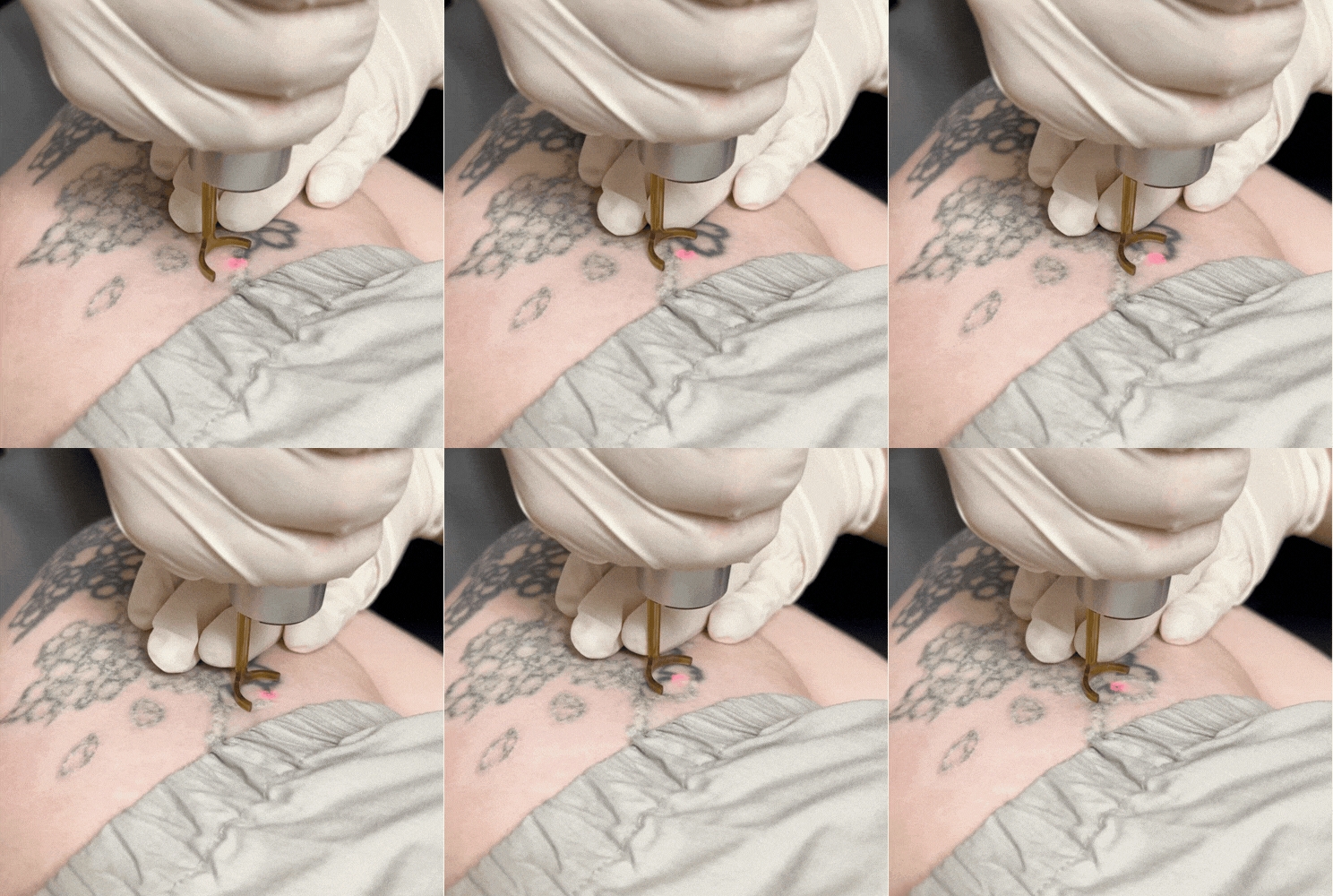
Usually, even after just one session,
many people feel that the color has lightened.
Especially in the first few sessions,
because there is a large amount of pigment,
changes are relatively easy to see.
However, as treatment is repeated,
the remaining pigment decreases,
so the rate of change may feel slower.
This does not mean the treatment is going wrong;
it is a natural part of the tattoo removal process.
That is why,
closer to the later stages,
a more precise approach and sufficient recovery time become important.
Tattoo Removal Process

Tattoo removal is usually performed
at intervals of 4 to 8 weeks.
This is because enough time must be secured
for the skin to recover.
Immediately after treatment,
a frosting reaction may appear
on the area hit by the laser,
making it look white.
This is one of the temporary normal reactions
that occurs as the pigment breaks down.
Then, for the next 1 to 2 weeks,
redness, itching, and tiny scabs may appear.
During this period,
the body’s immune cells gradually clear away
the broken-down pigment.
As time passes,
you can observe the tattoo color slowly becoming lighter.
Aftercare Following Tattoo Removal

Tattoo removal is not just about removing pigment;
it is a procedure that also requires considering skin recovery.
That is why aftercare has a major effect on the result.
✔ Protect from UV rays
✔ Apply a regeneration cream
✔ Do not pick off scabs by force
✔ Do not pop blisters on your own
✔ Avoid saunas and drinking alcohol
If you follow these basic care steps well,
they can help with the recovery process.
In particular, if you neglect UV protection,
the risk of pigmentation may increase,
so it is important to be careful about sunscreen when going out.
Possible Reactions

If the laser intensity is too strong,
even normal melanin cells can be affected,
and hypopigmentation may occur,
making the skin appear whiter.
Blisters may also appear temporarily.
In that case,
it is important not to touch them forcefully
and to manage them hygienically.
If you neglect UV protection after the procedure,
pigmentation may remain,
so sun protection must be taken seriously.
Points to Check Before Tattoo Removal

✔ Whether the device can handle various colors
✔ Whether there is a system to reduce skin damage
✔ Whether skin recovery is also taken into account
✔ Whether the intensity can be adjusted based on experience
It is a good idea to check these points together.
Tattoo removal is not a simple procedure that ends quickly;
it is closer to a process of gradually clearing it up
while observing the skin’s condition.
Rather than rushing unnecessarily,
proceeding slowly in line with the skin’s recovery flow
may also help with satisfaction.
It is important to accurately check the current tattoo condition
and then establish an appropriate treatment plan.
Thank you for reading.
This was Kim Ha-won from Beauty's Doctor.