
Hello.
This is Beauty's Doctor, Woo Young-jin.
Sculptra is
a procedure that is a little different from filler,
which simply fills in sunken areas.
Rather than creating volume immediately,
it induces the skin to produce collagen on its own,
so it is closer to a collagen booster
that creates gradual, natural changes over time.
That is why, instead of an overly swollen look,
many people seek it out when they want their original face to look
healthier and more three-dimensional.
Recently,
it has been increasingly used not only for improving facial hollowness,
such as the forehead, temples, and nasolabial folds,
but also for areas where volume balance matters,
such as hip dips and body contours.
Today,
let’s take a closer look at how Sculptra creates change,
and also talk in a bit more detail about the maintenance period, cost,
and key points of the procedure that many people wonder about.
Why does Sculptra feel natural?
The biggest characteristic of Sculptra is that
it does not feel like it is “filled right away.”
Instead, it gradually builds up over time.
This is a bit different from fillers,
which show a large, immediate volume change right after the procedure.
The main ingredient, PLLA,
works slowly inside the skin
and induces collagen production.
Through this process,
the skin’s internal structure gradually becomes firmer.
In general,
people often begin to notice improvements in elasticity or volume
about 6 to 8 weeks after the procedure.
And as time passes,
previously sunken areas naturally fill out,
and the overall facial impression
becomes softer and more three-dimensional.
Rather than a sudden change,
this is also why people naturally hear,
“You look better these days.”
The reason the maintenance period is long

Sculptra is not a method that temporarily fills volume;
it is a procedure that induces new collagen production
within your own skin.
So while the newly created collagen structure is maintained,
you can expect relatively long-lasting results.
Although it varies from person to person,
it often lasts about 1 to 2 years.
In particular, when skin elasticity declines
and the central volume of the face appears hollow,
satisfaction often increases over time.
However, the maintenance period can vary
depending on lifestyle habits, skin condition,
and the injection area.
How is the price of Sculptra determined?
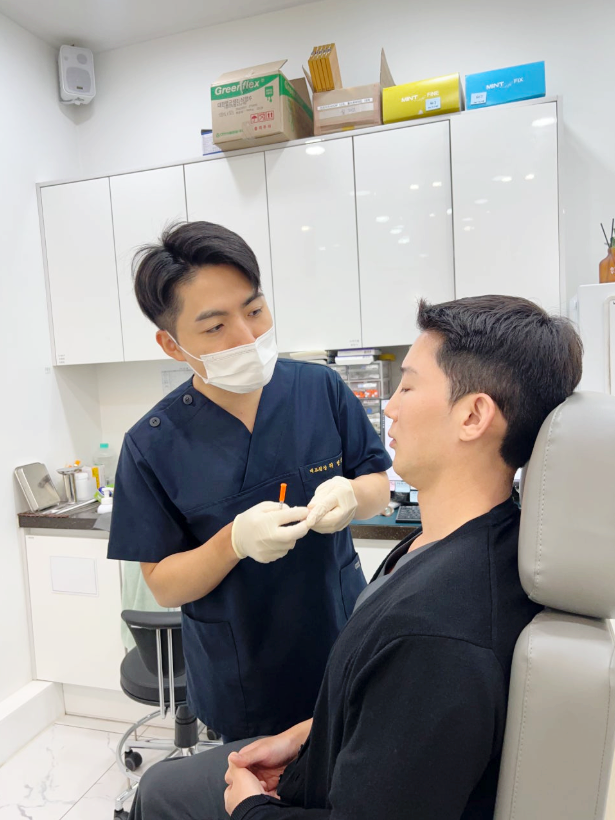
Sculptra is usually priced
by the vial.
The number of vials needed can vary
depending on the degree of hollowness
and the direction of the desired change.
For example,
if you want to improve multiple areas in a balanced way,
such as the temples, forehead, nasolabial folds, and chin,
the distribution method becomes very important.
Simply using more does not necessarily produce better results.
Rather, dividing and injecting appropriately while considering
facial proportions and the location of hollowness
plays a more important role in achieving natural results.
So in practice,
rather than “how many vials are used,”
“how the structure is designed”
can be the key factor that creates differences in the outcome.
Why is volume important in the face?

A face that looks youthful
or smaller
is not simply about facial size.
When volume is balanced and present,
three-dimensionality is created,
and the overall impression looks much more refined.
On the other hand,
when volume around the temples, the front of the cheeks,
or the nasolabial area is lost,
the face can look wider than it actually is
or give a tired impression.
Especially as we age,
fat loss and collagen decline occur together,
so the center of the face often appears to sag downward.
In these cases,
it is important not to simply fill one area,
but to take a three-dimensional approach
while considering the overall balance.
Sculptra is a procedure where planning matters

With Sculptra,
where and how much is injected
has a very important effect on the outcome.
Even with the same amount,
the mood can change completely
depending on the injection site, depth,
and distribution method.
In particular, areas that affect facial impression,
such as the temples, forehead, and chin,
require a process that naturally connects them
while considering the overall proportions.
Recently,
it has also been widely used for body volume improvement,
such as hip dips.
Many people are interested in it
when they want to soften the body line
without implants.
Because it is a method in which the body produces collagen itself,
the texture feels relatively natural,
and there is less concern about an awkward feeling during movement,
which is one of its advantages.
What changes happen inside the skin?

After Sculptra enters the skin,
the PLLA ingredient slowly breaks down
and stimulates fibroblasts.
Through this process,
the collagen production response is activated,
and over time,
the density and elasticity within the skin
gradually improve.
In other words,
rather than leaving a foreign substance behind,
it is closer to gradually changing the skin environment itself.
That is why the results are relatively natural,
and there is less of a sudden hollowing effect over time.
People like these often consider it
✔ When the face feels like it has naturally lost volume
✔ When the look of excessive filler feels burdensome
✔ When you prefer a style that changes slowly over time
✔ When you want to naturally improve the face and body line
✔ When you want long-lasting volume
Sculptra is less about creating a dramatic change quickly
and more about helping the skin create change on its own over time,
so it is closer to a collagen booster.
That is why, above all else,
careful planning that considers the individual’s facial structure
and volume balance is most important.
Rather than simply filling more,
when you also consider where and how to connect areas,
it can lead to more natural and satisfying results.
Since the appropriate plan can vary
depending on your current facial condition and the degree of hollowness,
it is important to approach it with a customized plan
through 충분한 상담.
Thank you for reading.
This was Beauty's Doctor, Woo Young-jin.