Hello.
I’m Youngjin Wi from 뷰티스닥터.
Repeatedly shaving every morning can make the jawline, philtrum, and sideburn areas feel rough and may lead to cumulative redness and irritation after shaving.
That is why many people consider facial hair removal.
However, facial hair is somewhat different from hair on the arms or legs.
The roots are deep,
the hair is thick and dark,
and factors such as skin tone and shaving irritation also need to be considered.
So rather than focusing on the idea that “it will be finished after a certain number of sessions,”
it is better to first understand the characteristics of facial hair as an area.
How Facial Hair Differs from Other Hair-Removal Areas
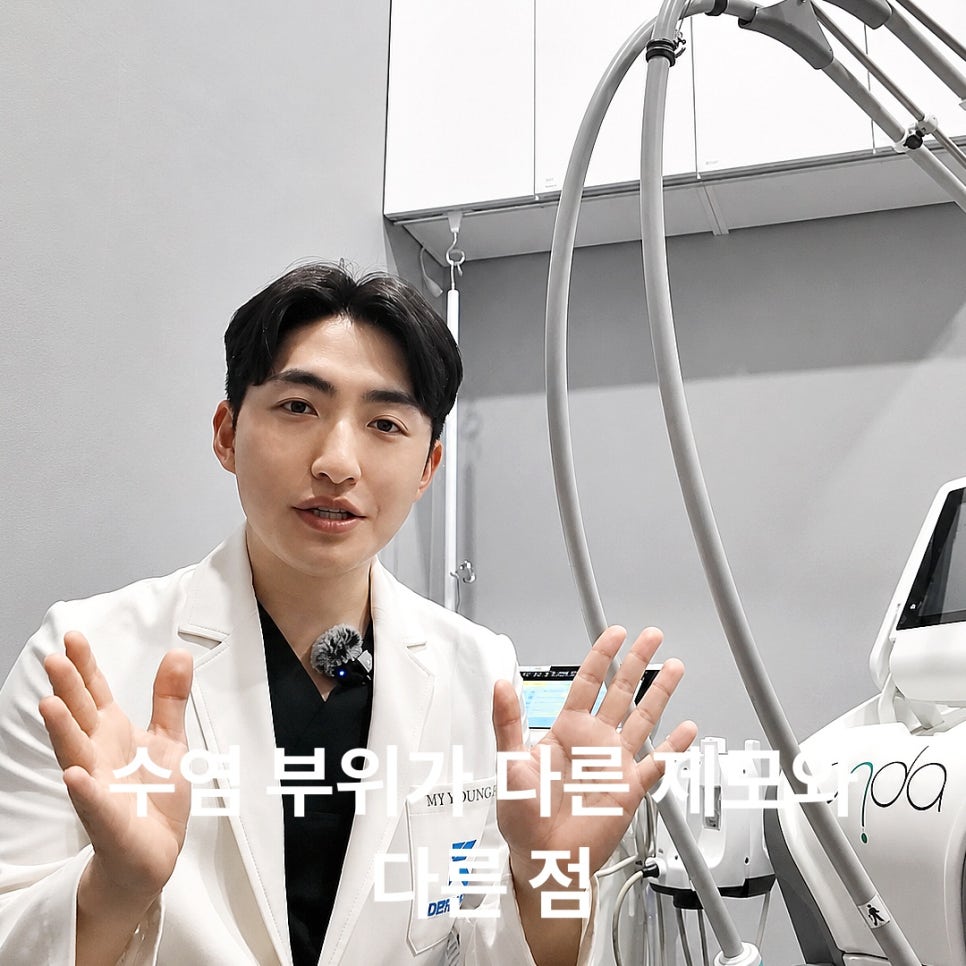
Facial hair differs in three main ways.
First, the roots are deep.
Facial hair often sits deep beneath the skin,
so an approach that only affects the superficial layer
may not reach it sufficiently.
Second, the hair is thick and dark.
Because it contains a high amount of melanin pigment,
it tends to absorb laser energy well,
but it can also interact with pigment in the superficial layers of the skin.
If your skin tans easily
or you have a relatively deep skin tone,
this needs to be assessed more carefully during the consultation.
Third, shaving irritation is also involved.
Irritation caused by daily shaving,
ingrown hairs, and traces of folliculitis
often remain together.
An ingrown hair
is a condition in which the hair cannot emerge through the skin
and instead grows embedded beneath it.
The Approach Used at Our Clinic

At 뷰티스닥터스, we use the GentleMax Pro Plus when treating the facial hair area.
This device
combines two wavelengths:
755 nm Alexandrite and
1064 nm Nd:YAG.
The 755 nm Alexandrite wavelength
has strong melanin absorption
and is used when treating thick, dark hair.
The 1064 nm Nd:YAG wavelength
reaches deeper layers
and is considered when assessing deep facial-hair roots
along with variations in skin tone.
Facial hair involves both deep roots and skin-tone variables,
so the two wavelengths need to be considered separately according to the individual’s condition.
The device also has DCD cooling,
which helps reduce the burden on the superficial skin layer during the procedure.
Devices in the 800–810 nm diode range
are also used for hair removal,
but they are not currently used at 뷰티스닥터스.
What We Assess First During the Consultation

The first thing we assess during a facial hair removal consultation is
“what is the current condition of your facial hair and skin?”
We consider skin tone, the thickness and distribution of the facial hair,
whether folliculitis or ingrown hairs are present,
and shaving habits together.
It is also necessary to check your history of recent laser treatments, peeling, or other skin procedures,
as well as whether you are taking antibiotics or photosensitizing medication.
Only after reviewing these factors can we determine
which wavelength to use on which areas
and at what intervals.
Factors That Vary from Person to Person
Facial hair removal is strongly influenced by the hair growth cycle.
Not all hairs are in the same stage at the same time,
and lasers primarily respond to hair roots in the growth phase.
Therefore, it is difficult for all hairs to respond
in the same way during a single session.
The number of sessions and intervals required may also vary depending on the amount of facial hair, its growth rate, changes in skin tone,
sun exposure, and how much reduction is desired.
Some people only want to reduce the burden of shaving,
while others want the area to be as cleanly groomed as possible.
There are also cases in which treatment is first focused on areas prone to problems,
such as the jawline or neck,
rather than the entire facial hair area.
Determine Whether Treatment Is Needed After a Consultation Rather Than Proceeding Automatically

Facial hair removal
is not a procedure that is completed in a single session;
it is an area that is assessed over multiple sessions according to the hair growth cycle.
That is why, during the consultation before starting,
it is important to assess the depth and thickness of the facial hair, skin tone, shaving irritation, and whether any problems are present.
At 뷰티스닥터스, we first assess the current condition of your facial hair and skin through a consultation,
then explain which wavelength will be used on which areas
and at what intervals.
Because skin condition and facial-hair characteristics differ from person to person,
a particular treatment is not necessary for everyone.
If you are considering facial hair removal,
it is best to first check the depth of your facial hair and the condition of your skin,
then decide on the appropriate approach.
Frequently Asked Questions
Q. How many sessions of laser facial hair removal are needed?
Because of the hair growth cycle,
it is difficult to view it as something completed in a single session.
Since the treatment primarily responds to hair roots in the growth phase,
it is generally carried out over multiple sessions.
Q. Can I receive treatment if my skin tans easily?
If your skin tans easily in the sun
or you have had significant sun exposure recently,
the condition of the superficial pigmentation is assessed first during the consultation.
It is best to determine the treatment approach after considering factors related to skin tone.
Q. Can my facial hair be reduced naturally without removing it all?
Yes.
There is an approach aimed at reducing the entire area,
as well as an approach that thins the hair enough to reduce the burden of shaving.
Treatment may also first focus on areas prone to problems,
such as the jawline, philtrum, or neck.
Thank you for reading this lengthy post.
This was Youngjin Wi.