Hello.
I’m Ha-won Kim, Beauty’s Doctor.
When looking into skin boosters,
many people compare
Rejuran and Juvelook together.
Both products are often mentioned in connection with skin texture, hydration,
and fine lines,
but they belong to different ingredient categories.
So rather than asking, “Which one is better?”
it is important to first determine
what kind of approach your skin needs right now.
The Two Products Belong to Different Ingredient Categories
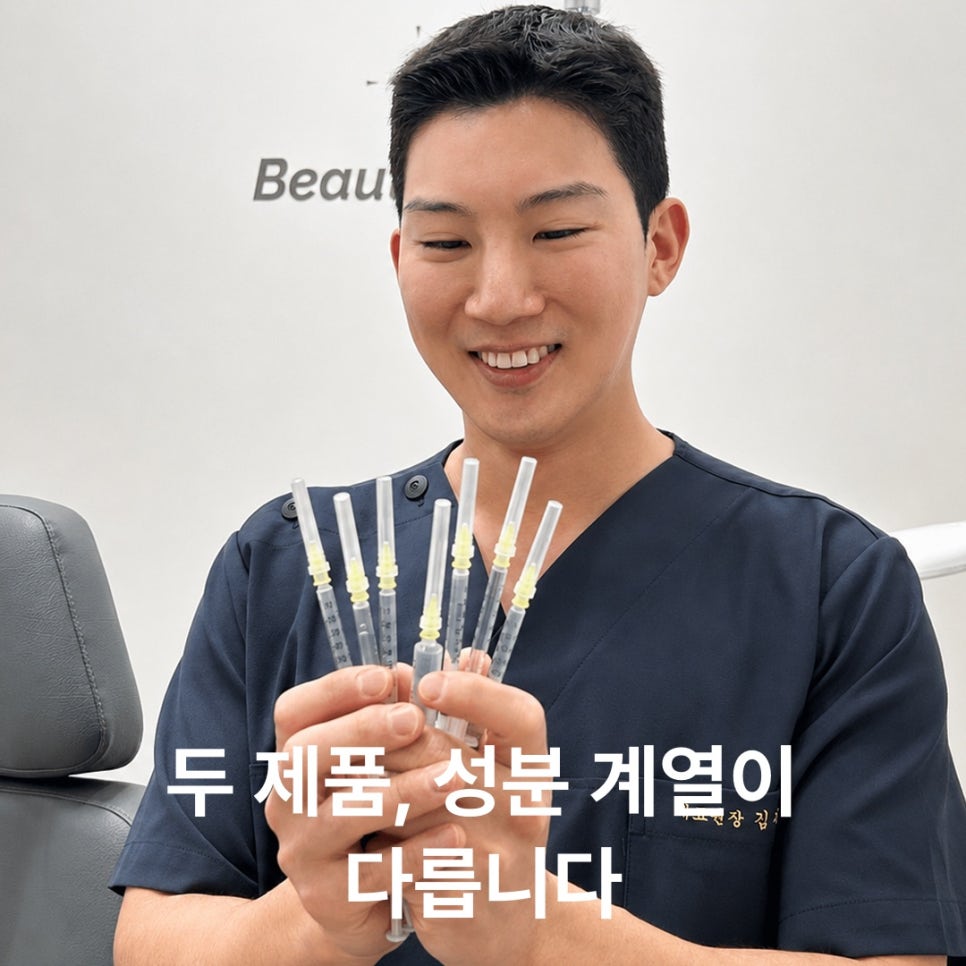
Rejuran is
a PN, or polynucleotide-based,
skin booster.
It is known as a treatment that addresses the skin environment
by microinjecting salmon-derived PN ingredients
into the dermal layer of the skin.
It is often mentioned in connection with skin texture, hydration,
and concerns about fine lines.
Rather than immediately filling volume like a filler,
it is closer to an approach that observes
skin condition and texture over time.
Juvelook
is a combination product containing
PDLLA, poly-D,L-lactic acid,
and HA, hyaluronic acid.
PDLLA is known as an ingredient that induces
a collagen-production response,
while HA is an ingredient that also addresses hydration.
In other words, Rejuran is based on PN,
while Juvelook is a PDLLA–HA combination,
so they start from different points.
Although both are categorized as skin boosters,
it is best to distinguish between
their ingredients and approaches.
How Are Rejuran and Juvelook Different?

Rejuran is often compared
when concerns about skin texture, fine lines,
and dryness are experienced together.
It is frequently mentioned during consultations
when the skin appears thin
or the surface texture feels rougher than before.
Juvelook is often compared
when concerns about texture, pores, hydration,
and reduced skin elasticity occur together.
However, with both products,
rather than determining the outcome after just one treatment,
the approach is to proceed while observing the skin’s condition and response.
The direction depends on whether the current concern is texture, hydration,
fine lines, or pores,
rather than one product simply being better than the other.
What Is Checked First During a Consultation

When comparing Rejuran and Juvelook,
the skin’s condition should be considered before the product name.
It is important to check whether the skin texture has become rough,
whether fine lines are noticeable,
and whether dryness is significant.
It is also necessary to examine whether pores, reduced elasticity, redness,
and loss of volume are present as well.
The treatment interval and approach may also vary
depending on any previous skin boosters,
fillers, lasers, or chemical peels.
Items requiring advance confirmation, such as allergies to salmon or seafood
and pregnancy or breastfeeding,
should also be reviewed during the consultation.
Why Results Vary from Person to Person
With skin boosters,
the changes you experience may differ
depending on your skin condition and recovery response.
Skin thickness, degree of dryness,
ultraviolet exposure, lifestyle habits,
and previous treatment history all have an effect.
Depending on the injection site,
reactions such as redness, raised bumps,
and bruising may temporarily occur.
Also, rather than being completed in a single session,
treatment is often considered over several sessions,
depending on the condition of the skin.
That is why it is difficult to give a fixed answer
such as “How many Rejuran sessions?”
or “How many Juvelook sessions?”
After assessing the skin’s condition and the desired direction,
it is first necessary to determine
the appropriate product and treatment interval.
Juvelook and Juvelook Volume Are Different
One point that can easily cause confusion
is that regular Juvelook and Juvelook Volume
are not the same product.
Regular Juvelook
is a skin booster category often mentioned
for concerns about skin texture, hydration, and pores.
Juvelook Volume, on the other hand,
is more focused on addressing volume or contours
in areas that appear sunken.
Although their names are similar,
their purposes and application approaches differ,
so they should be distinguished during a consultation.
Decide After a Consultation Rather Than Automatically Choosing a Treatment

“Is Rejuran better, or is Juvelook better?”
is a question that often comes up
during skin booster consultations.
However, because the two products differ
in their ingredient categories and approaches,
it is difficult to simply rank them.
The important thing
is to first determine
what your skin needs right now.
The choice depends on whether the focus should be skin texture,
hydration and fine lines,
or pores and reduced elasticity as well.
Because each person’s skin condition is different,
no particular treatment is necessary for everyone.
Before choosing a product,
it is important to confirm your current skin condition
and the changes you want through a consultation.
Frequently Asked Questions
Q. Which is better, Rejuran or Juvelook?
A. It is difficult to definitively say
that one is better than the other.
Rejuran belongs to the PN category,
while Juvelook is a PDLLA–HA combination,
so their ingredients and approaches differ.
The direction of the choice may vary
depending on your current concerns,
such as skin texture, hydration, fine lines, or pores.
Q. Can I receive both products together?
A. Depending on the skin condition and treatment area,
a combination may sometimes be considered.
However, the product combination, order, and interval
vary depending on the individual’s condition,
so it is best to decide after a consultation.
Q. Are Juvelook and Juvelook Volume the same?
A. Although their names are similar,
they are products with different purposes.
Regular Juvelook
is often mentioned for concerns about skin texture,
hydration, and pores.
Juvelook Volume
is more focused on addressing volume or contours
in areas that appear sunken.
Thank you for reading this lengthy post.
This was Ha-won Kim.