Hello.
I’m Youngjin Wi from Beauty’s Doctor.
As summer approaches,
people start becoming more conscious of hair
on exposed areas such as the underarms, arms, and legs.
When you search for Hongdae hair removal,
you often come across wavelength names such as
Alexandrite and Nd:YAG.
The names may seem difficult at first,
but the key points are simpler than you might think.
Laser hair removal does not remove all the hair at once
like an eraser.
Instead, it is performed in stages according to the hair growth cycle.
That is why, before a Hongdae hair removal consultation,
it is better to first check which wavelength suits
your skin and hair condition
rather than focusing on how many sessions it will take.
Even on the same area, the criteria considered during a consultation
may vary depending on hair thickness,
skin tone, and follicle depth.
Why Can’t It Be Finished in One Session?

Laser hair removal works by having
the melanin pigment around the hair follicle absorb laser energy,
with the resulting heat acting on the follicle.
However, not all hair
is always growing in the same phase.
Hair cycles through the anagen, catagen, and telogen phases,
and the phase that generally responds best to laser treatment
is the anagen phase.
Even if you receive treatment today,
hair that is still dormant
may grow again during the next cycle.
For this reason, it is difficult for all the hair
to respond simultaneously in a single session.
Therefore, when looking into Hongdae hair removal,
it is important to consider the intervals and number of sessions
for each area rather than expecting it to be completed at once.
The number of sessions is often adjusted
based on how the hair grows back
and how it responded previously,
rather than according to a fixed number.
Differences Between Alexandrite and Nd:YAG
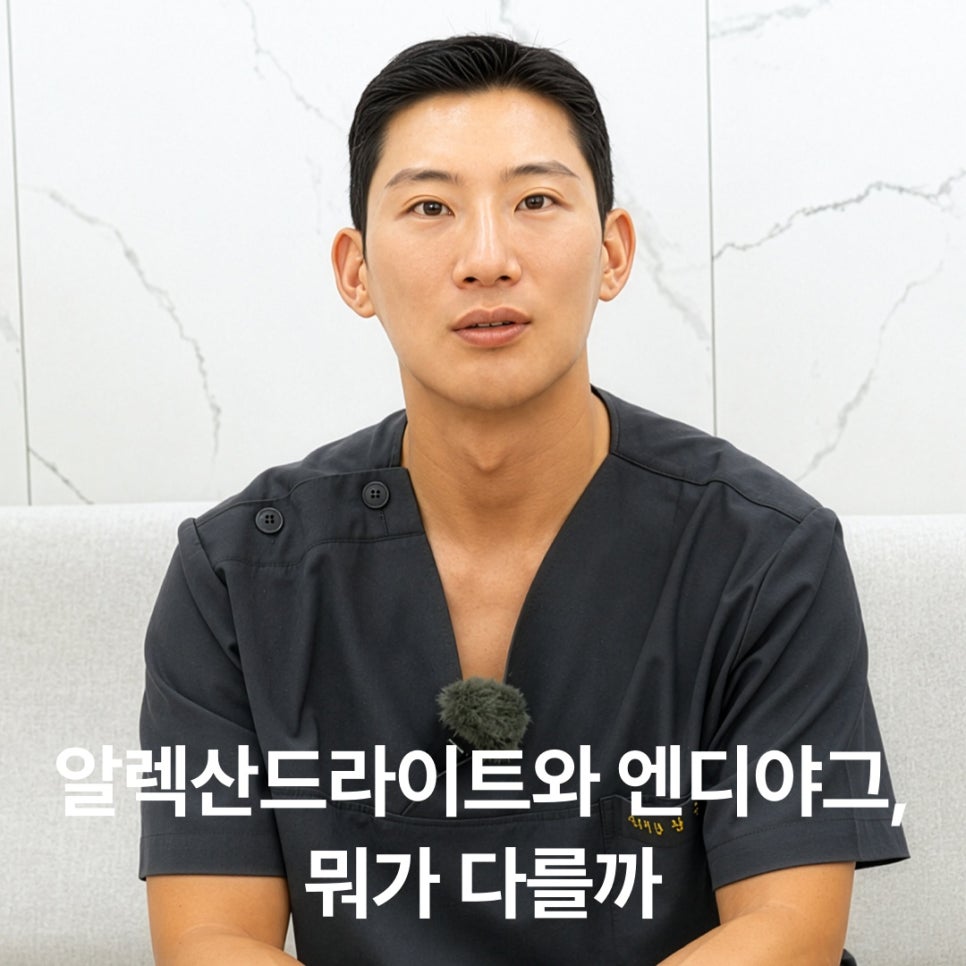
The wavelengths frequently discussed during hair removal consultations
are 755 nm Alexandrite
and 1064 nm Nd:YAG.
Both wavelengths are used for hair removal,
but they differ somewhat in how deeply they penetrate the skin
and how strongly they respond to melanin.
Because 755 nm Alexandrite tends to respond well to melanin,
it is often used for thick, dark hair.
It is frequently considered during consultations
for areas such as the underarms, arms, and legs,
where the hair is relatively dark and thick.
1064 nm Nd:YAG has properties that allow it to penetrate relatively deeply,
so it may be used when the follicles are deep
or when skin tone requires careful consideration.
For areas with deep, thick hair,
such as the beard, sideburns, and bikini line,
these characteristics are considered together.
In other words, what matters in a Hongdae hair removal consultation
is not simply the name of the device,
but the process of determining which wavelength suits your area.
Rather than assuming that one wavelength is always better,
it is more useful to understand that the choice depends
on skin tone and hair condition.
Factors That Vary from Person to Person

Even when the same device is used,
people can respond differently to laser hair removal.
The thicker and darker the hair,
the more melanin it contains,
so it generally tends to respond relatively well to the laser.
In contrast, fine hair, white hair, and blonde hair
contain less melanin and may respond weakly,
or treatment may be limited for these types of hair.
For areas that are heavily tanned
or have hyperpigmentation,
power settings and wavelength need to be considered more carefully.
Because the skin surface can also receive energy,
the consultation may focus on reducing epidermal irritation
or heat sensation.
Immediately after removing hair with waxing or tweezers,
there may not be enough of the follicle for the laser to target,
so it is better to have a consultation after allowing some time to pass.
Hormonal changes or medications can also
alter the pattern of hair growth,
so it is best to mention them in advance during the consultation.
In particular, if hair has suddenly become more abundant
or has repeatedly become darker only in a specific area,
it is better to assess the condition as a whole
rather than considering only the number of hair removal sessions.
What to Check During Your Consultation
Before a Hongdae hair removal consultation,
it is helpful to ask which wavelength suits
your skin tone and hair thickness.
It is also useful to check the interval required between sessions for each area
and whether a recent history of waxing or tanning could be an issue.
Before and after treatment,
it is also a good idea to learn in advance about care methods
such as sun protection, moisturizing, and when to shave.
You should also check for each area
whether shaving is necessary the day before treatment
and whether saunas or strenuous exercise should be avoided afterward.
Laser hair removal is not a treatment
that is applied in exactly the same way to every area.
Considering skin tone, hair thickness, follicle depth,
and the hair growth cycle together
can make it easier to create a plan for each area.
If you are preparing for Hongdae hair removal,
it is better to consider the wavelength and your skin condition together
rather than looking only at the price or number of sessions.
Frequently Asked Questions
Q. Is it possible to receive treatment during my first visit?
A. This may vary from clinic to clinic.
Usually, the process begins by checking the condition of the skin and hair,
after which the area, wavelength, and interval are determined.
If your skin is sensitive
or you have recently tanned or waxed,
the timing of treatment may be adjusted.
Q. Can I receive laser hair removal after waxing?
A. Yes, you can.
However, immediately after waxing, there may not be enough of the follicle,
so the laser response may be weaker.
It is better to wait until the hair has grown back for a certain period
and then have its condition checked during a consultation.
The required period may vary somewhat
depending on the area and the rate of hair growth.
Q. Does the treatment hurt a lot?
A. It varies depending on the area, power setting, hair thickness, and individual sensitivity.
People often describe it as a stinging sensation
or the feeling of being snapped with a rubber band.
Devices that use a cooling system may help reduce epidermal irritation,
but the sensation varies from person to person.
If you are concerned about pain,
it is a good idea to ask in advance during the consultation
about how each area may feel and how to care for it.
Thank you for reading this long post.
This was Youngjin Wi.