Hello.
I’m Youngjin Wi from 뷰티스닥터.
A mark may remain on the skin
after a cut has healed.
After surgery as well,
a faint suture line may remain,
or it may become more noticeable over time.
If it continues to bother you even after several months,
you may naturally find yourself searching for
“scar laser treatment.”
However, not all scars remain in the same form.
Some leave discoloration,
some develop an uneven surface,
and some may look raised or indented.
That is why, before a consultation,
it is important first to determine what condition the scar is currently in,
rather than simply thinking about getting rid of it.
Why do scars remain?
When the skin is injured,
it goes through a process of filling in the damaged area.
As collagen and connective tissue are produced,
the wound closes
and the skin reconnects.
However, the tissue formed during this process
does not have exactly the same arrangement as the original skin.
As a result, its color, thickness, and texture
may feel different from the surrounding skin,
and this mark is called a scar.
A scar is
a mark formed as the skin heals after an injury or surgery
and settles into tissue that differs from the original skin.
A certain amount of scarring
is a natural part of the healing process.
However, how noticeable it becomes
may vary depending on the depth of the wound, its location, individual characteristics,
and how the wound was managed.
Wounds and surgical scars come in several forms
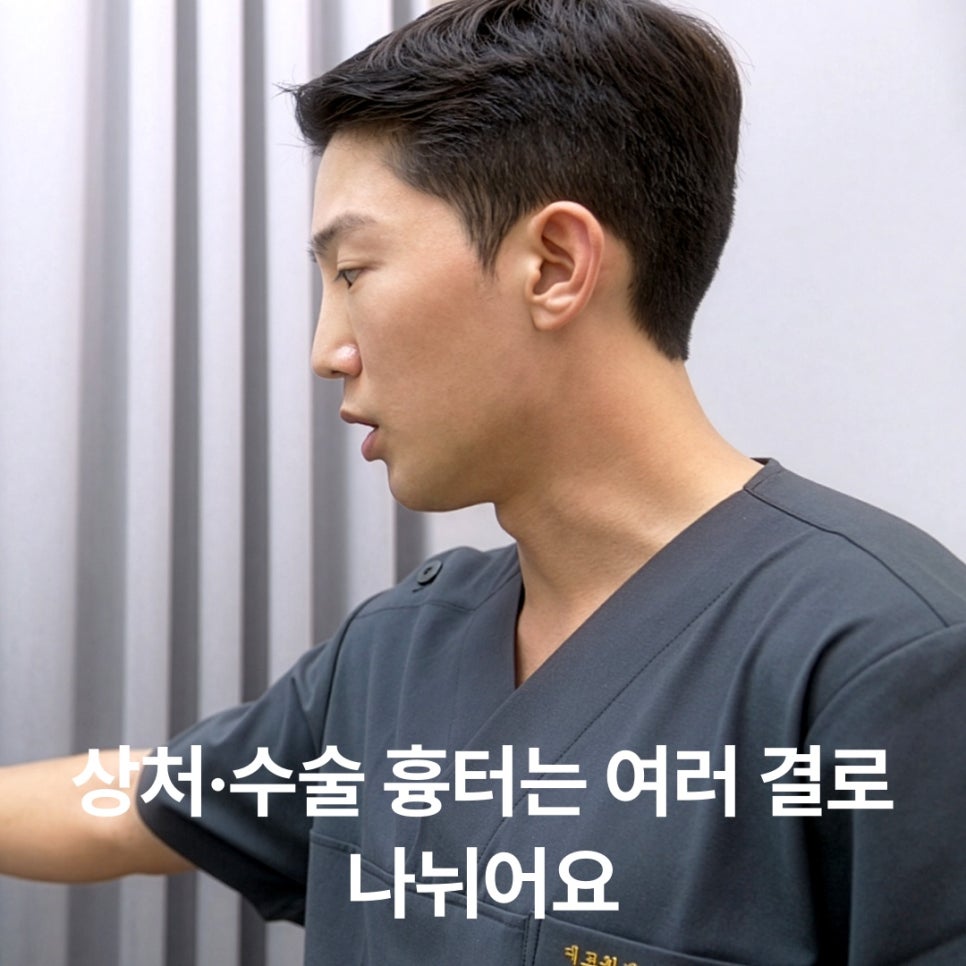
Not all scars
are evaluated in the same way.
During a consultation, the first step is
to determine which type the current mark most closely resembles.
A flat scar
is a mark that is about the same height as the surrounding skin
but remains different in color or texture.
It may appear red,
retain brown pigmentation,
or look pale and white.
A hypertrophic scar
is a condition in which the scar looks thick and raised
within the original boundaries of the wound.
A surgical line or wound area
that feels raised to the touch may fall into this category.
An indented scar
is a form in which the skin appears sunken inward
because the tissue has not filled in sufficiently.
It may appear partially
in an old wound or along part of a suture line.
A keloid
is a condition in which scar tissue grows beyond
the original boundaries of the wound.
It is known to occur relatively often
on the front of the chest, shoulders, ears, and jawline,
and individual characteristics and family history are also considered.
As you can see, depending on the form of the scar,
the criteria considered during a consultation
and the treatment approach may differ.
Scars also change over time

A scar does not remain permanently fixed
in the same state as immediately after the wound heals.
It may initially feel red and firm,
then gradually become lighter in color over time,
while its thickness and texture may also change little by little.
This process is generally described as
scar maturation.
After the wound has healed,
its color, thickness, and texture change over time
as the scar gradually settles.
Changes usually continue over several months,
and in some cases may continue for more than a year.
Therefore, a newly healed scar
and a scar that has been present for several years
may be evaluated according to different criteria during a consultation.
Taking a strong approach too early
is not always best,
while a scar that has been left untreated for a long time
may require a different approach.
This is why it is important during a consultation
to determine what stage the scar is currently in.
What aspects of a scar does laser treatment address?
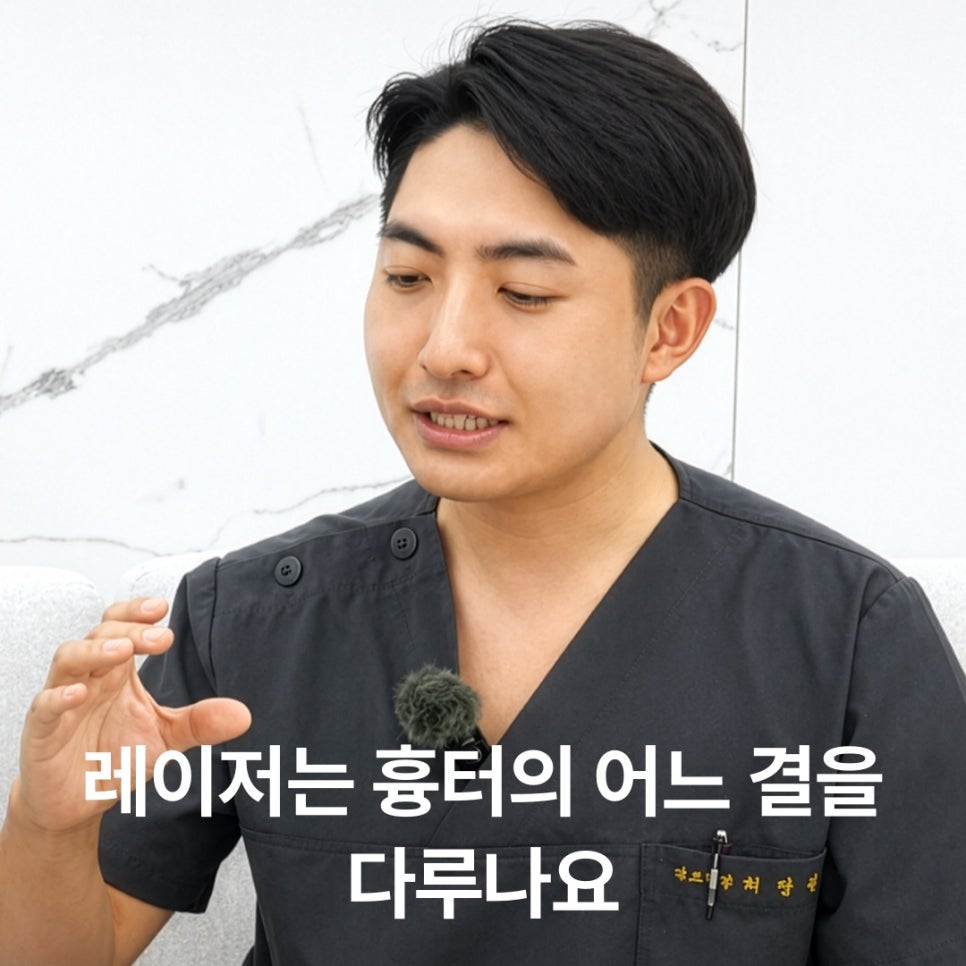
Although people commonly refer to it as “scar laser treatment,”
it is not performed using just one method.
The approach may differ depending on whether
the most noticeable aspect of the scar is its color, redness, surface irregularity,
or thickness.
For scars with pronounced redness,
the focus may be on vascular response or changes in color.
For marks that remain brown,
the extent of the pigmentation change is also assessed.
When the surface is uneven
or its texture differs from the surrounding skin,
the approach may focus on the surface texture and irregularities.
For thick, raised marks such as hypertrophic scars,
other treatment approaches may be considered alongside laser treatment,
rather than using laser treatment alone.
When there is a tendency toward keloid formation,
it is difficult to evaluate the situation simply as a matter of smoothing the surface.
Individual characteristics, the location, and previous responses must be assessed first.
Many scars also involve multiple factors.
There may be residual discoloration,
a different surface texture,
and areas that are raised at the same time.
In such cases, rather than trying to finish everything at once,
a consultation is needed to consider several approaches according to the condition.
What is checked during a consultation?
During a consultation, the first steps are
to identify the cause of the scar and when it formed.
The consultation approach may differ
depending on whether it resulted from an injury,
a surgical suture line,
or a mark left after a burn or inflammation.
The scar’s color, height, and firmness,
whether there is itching or pain,
and whether it is gradually enlarging are also assessed.
A history of keloids or hypertrophic scars,
family history, and whether there are areas where scars form easily
are also important factors to check.
Because a scar is tissue that has already settled,
it is difficult to describe the goal as restoring it
so that it becomes exactly the same as the original skin.
During a consultation, the most noticeable aspects of the scar are identified,
and the options for reducing their appearance are considered separately.
A specific laser or procedure
is not equally necessary for every scar.
After assessing the current condition,
it is best to distinguish between the areas that may be addressed
and those that do not necessarily need treatment.
Frequently asked questions
Q. When is it best to start laser treatment for a scar?
A. Scars go through a process in which
their color, thickness, and texture change over time.
Therefore, the consultation criteria may differ
depending on whether the wound has just healed,
several months have passed,
or the scar is old.
It is best to determine the appropriate timing
by assessing the current condition of the scar.
Q. Can a scar be removed completely?
A. Because a scar is tissue that has already settled,
it is difficult to describe the goal as restoring it
so that it becomes exactly the same as the original skin.
During a consultation, the noticeable aspects of the scar,
such as its color, height, and texture, are assessed,
and ways to reduce their appearance are considered.
Q. Is laser treatment possible for people prone to keloids?
A. A keloid is a scar that grows beyond
the original boundaries of the wound,
so its treatment approach may differ from that for an ordinary scar.
If you have a tendency toward keloid formation,
it is best to first assess the location, individual characteristics, family history,
and previous treatment responses before discussing possible approaches during a consultation.
Thank you for reading this lengthy post.
This was Youngjin Wi.