
Hello.
I’m Kim Ha-won from Beauty’s Doctor.
Whenever you look in the mirror,
if melasma or dark spots catch your eye,
you may wonder how to manage them
rather than simply covering them with makeup.
However, treating pigmentation
does not end with simply lightening the marks that are visible.
The cause and depth of the pigmentation,
as well as the degree of skin irritation,
should all be considered together.
3-Line Summary
- In pigmentation treatment, it is important to first distinguish
the type and depth of the pigmentation.
- Although melasma, dark spots, and post-inflammatory pigmentation
may look similar, the approach to each can differ.
- Sun protection, moisturizing, and reducing friction
should continue alongside treatment.
Why Does Pigmentation Occur?
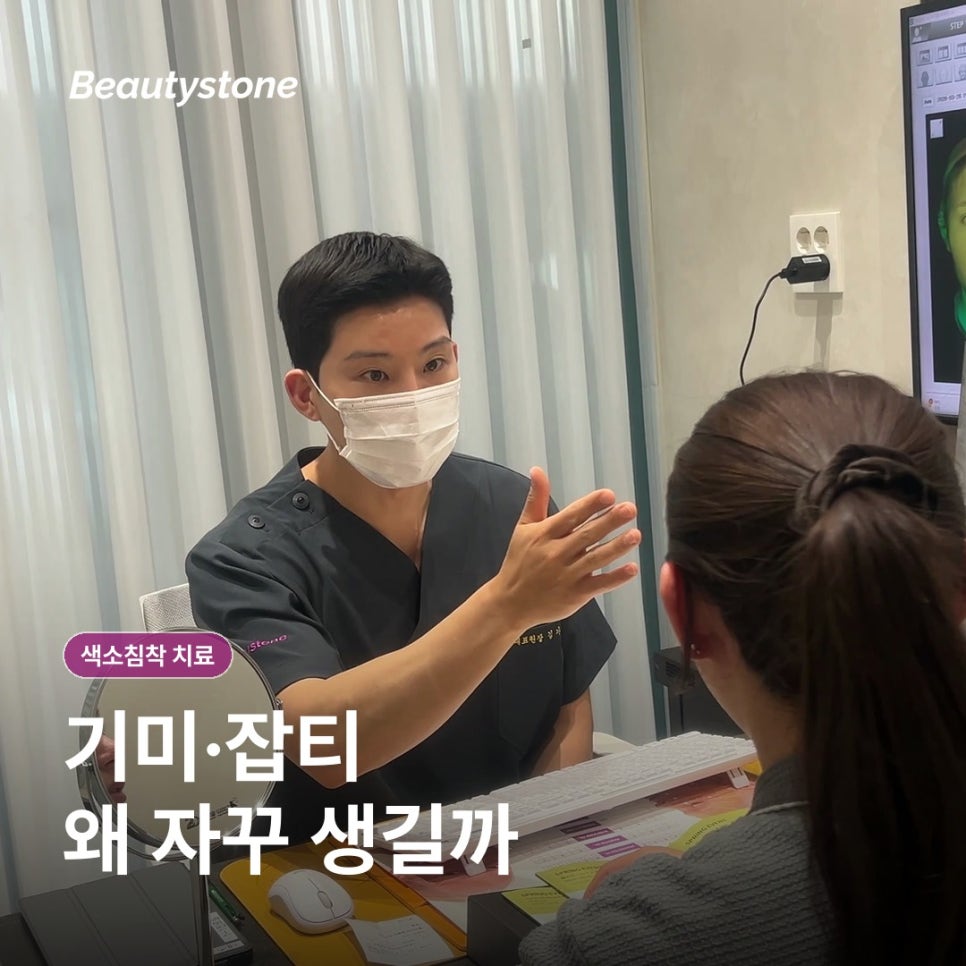
One of the main factors affecting pigmentation
is ultraviolet exposure.
When the skin is exposed to ultraviolet rays,
it produces melanin to protect itself.
If this stimulation is repeated,
the pigmentation may remain without fading sufficiently.
Pregnancy or hormonal changes during certain periods
may also have an effect.
Brown marks may remain where acne, wounds, or dermatitis
have previously occurred.
Repeatedly rubbing the skin
or aggressively removing dead skin cells
can also irritate the skin and make pigmentation more noticeable.
In many cases, several factors overlap
rather than just one cause being involved.
Are Melasma and Dark Spots the Same Type of Pigmentation?
Melasma often appears diffusely
on both cheeks or the forehead,
with indistinct borders.
Dark spots may appear as relatively small,
well-defined dots.
Post-inflammatory pigmentation often remains like a mark
where acne or a wound previously occurred.
However, even if they look similar to the naked eye,
the depth at which the pigmentation is located may differ.
Melasma, dark spots,
and post-inflammatory pigmentation may also occur together
on the same face.
Therefore, it is difficult to determine the type of pigmentation
based only on photographs or a mirror.
How Is Pigmentation Treatment Approached?

During a consultation, the appearance and distribution
of the pigmentation are examined first.
It is also checked whether the pigmentation is close to the epidermis
or extends into deeper layers.
It is important to consider whether the skin is thin or sensitive to irritation,
as well as whether you have recently undergone another procedure.
If several types of pigmentation are mixed in the same area,
it may be difficult to treat them using only one approach.
Depending on the condition, energy-based devices,
topical medication, or oral medication may be considered.
However, a particular method
cannot be applied in exactly the same way to every type of pigmentation.
Rather than applying strong stimulation all at once,
treatment may proceed gradually while monitoring the skin’s response.
It Is Better to Monitor the Progress Than to Try to Erase It All at Once
Pigmentation can continue to form
and change within the skin.
Therefore, even after managing it once,
it may be difficult to consider the process completely finished.
The speed at which changes are noticed
depends on the type and depth of the pigmentation.
It may also be affected by the condition of the skin,
ultraviolet exposure, and lifestyle habits.
Rather than using someone else’s number of treatments as a standard,
it is important to monitor how your current skin responds.
Increasing the intensity too hastily
may instead leave redness or changes in pigmentation.
Sun Protection and Daily Care Are Also Important

Even after pigmentation treatment,
repeated ultraviolet exposure can cause the color to darken again.
Apply sunscreen before going outside,
and reapply it if you will be outdoors for an extended period.
Using a hat or parasol
to reduce direct sunlight can also help.
Please avoid rubbing the skin vigorously
or scrubbing frequently.
Dry skin may respond more sensitively
to external irritation.
It is advisable to use a gentle moisturizer
and care for the skin so that its barrier remains comfortable and stable.
What Changes Should Be Checked by a Medical Professional?
If a new mole or spot that was not previously present
suddenly appears or grows quickly, it should be checked.
The same applies if its shape becomes asymmetrical
or its borders and color change.
If it bleeds or repeatedly develops a scab,
or if itching and pain continue,
it is better to seek medical attention
rather than assuming it is simply a dark spot and waiting.
If blisters, intense heat, or changes in skin color
continue for a long time after a procedure,
do not make your own judgment;
please contact the medical institution where you received the procedure.
What Should You Tell the Provider
During a Consultation?

Please mention when you first noticed the pigmentation
and whether there was a recent event that made it darker.
Pregnancy and childbirth, medications you are currently taking,
and whether you have recently tanned may also be checked.
Any laser treatments or peels you have previously received,
as well as the cosmetics you currently use,
may also provide useful information.
After examining the nature of the current pigmentation
and the condition of your skin,
it is important to determine an appropriate management approach.
Frequently Asked Questions
Q. Are melasma and dark spots managed in the same way?
Although they may look similar on the surface,
their causes and depths may differ.
It is best to first identify the type of pigmentation
and then determine an approach suited to its condition.
Q. Will pigmentation fade if I only apply sunscreen?
Sun protection is a basic form of care
that reduces the stimulation that can make pigmentation darker.
For pigmentation that is already present,
sun protection alone may not be sufficient.
Q. How long does it take to see a difference from pigmentation treatment?
The point at which changes become noticeable
depends on the type of pigmentation and the condition of the skin.
Rather than stating a fixed period,
it is better to monitor the progress while checking the skin’s response.
Thank you for reading today.
This has been Kim Ha-won from Beauty’s Doctor.