
Hello.
I’m Ha-won Kim from Beauty's Doctor.
If you shave every day,
your chin or upper lip may easily become red,
or small bumps may appear.
Many people are also bothered
when beard shadow becomes dark again
not long after shaving.
Because of these inconveniences,
many people look into men's beard hair removal,
but when they are about to get started,
they may wonder what principle it uses
and how painful it is.
It can also be difficult to determine
how many sessions are needed
and how the intervals between treatments are set.
Today, I’ll summarize the principles, pain,
intervals, and care methods
that are helpful to know before starting
men's beard hair removal.
Three-line summary
1 Men's beard hair removal
uses the laser principle of responding to
melanin pigment in the hair follicles.
2 Pain may feel different depending on
the thickness and density of the hair,
the treatment area, and skin sensitivity.
3 The number of sessions and intervals
are not fixed. It is important to adjust them
for each individual by considering the hair-growth cycle
and the skin's recovery status.
- What is the principle behind men's beard hair removal?

Men's beard hair removal
works on the principle that laser energy
at a specific wavelength responds to
melanin pigment in the hair follicles.
The laser energy is converted into heat,
which affects the structures
where the hair grows.
However, not all beard hair
grows in the same state at the same time.

Hair grows through repeated cycles of
the growth phase, regression phase, and resting phase.
Among these, hair in the growth phase
tends to respond relatively well to lasers,
so treatment is performed over multiple sessions.

Men's beard hair
is often thicker and denser
than hair on other parts of the body.
The thickness and growth direction of the hair
also vary depending on the area,
such as the upper lip, chin, and beneath the chin.
Therefore, rather than using
a single set of conditions,
it is necessary to consider the skin and hair condition together.
It is also helpful to know before starting
that the laser response and the number of sessions needed
may vary depending on skin tone,
beard thickness, and density.
- How painful is beard hair removal?
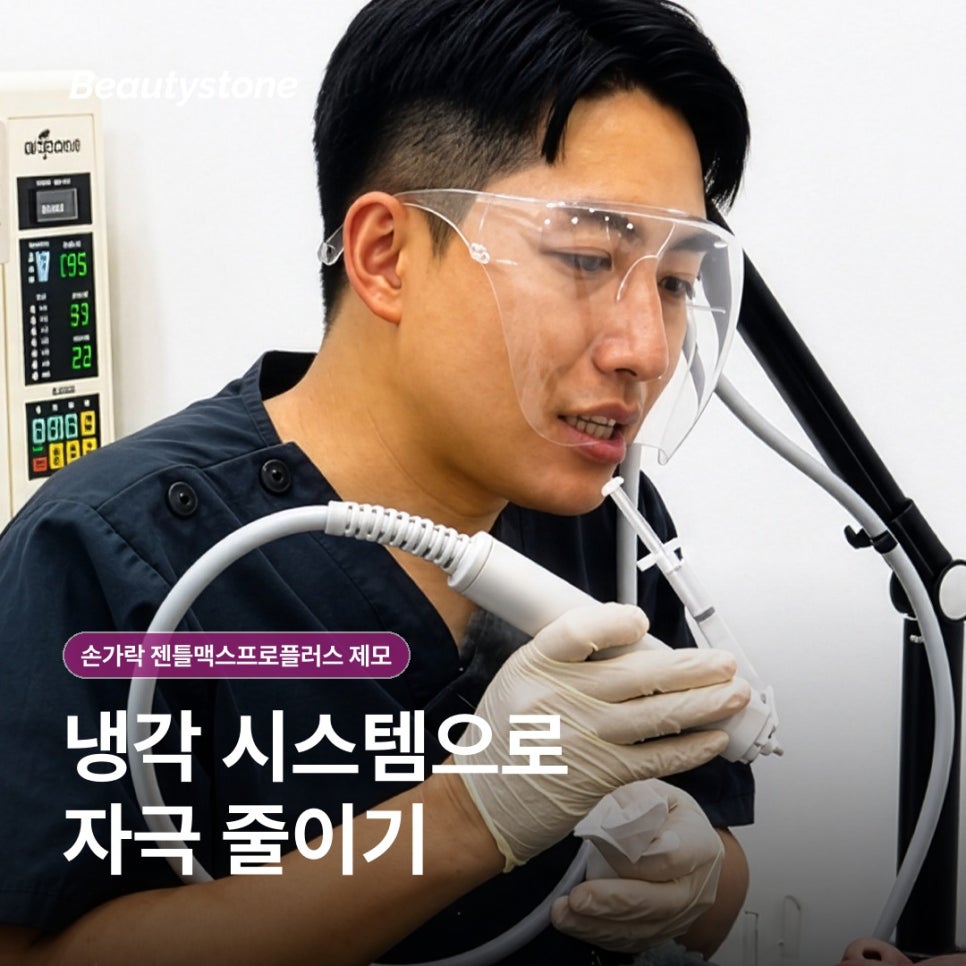
The pain of beard hair removal is often described as
a brief stinging sensation, like a short snap from a rubber band,
or a momentary feeling of heat.
However, the intensity felt
varies from person to person.
Areas with thicker, denser beard hair
may feel somewhat more intense.
In particular, areas where hair is concentrated
or the skin is sensitive, such as the upper lip and chin tip,
may feel more stinging
than other areas.
Even for the same person, the pain response may vary
depending on the treatment session, skin condition,

and how they are feeling that day.
Immediately after treatment,
the skin may become red,
small bumps may appear
around the hair follicles,
and mild burning may occur.
These symptoms usually gradually settle over time,
but recovery speed is not the same for everyone.
If the pain worsens over time,
or large blisters and discharge,
expanding redness, or heat are observed,
rather than waiting based on your own judgment,
it is best to contact the medical institution
where you received the treatment.
- How should treatment intervals and care be determined?

The intervals for men's beard hair removal
are basically determined by considering
the rate of hair growth and the skin's recovery status.
Setting the intervals unconditionally shorter
does not necessarily make them more appropriate.
If skin irritation remains
or there is not yet enough hair in the growth phase
that can respond to the laser,
the schedule may be adjusted after checking the condition.
The number of sessions needed
is also not the same for everyone.
It varies depending on beard thickness and density
and the desired treatment range.
The plan may also differ between
treating the entire mustache and beard
and simply tidying stray hairs
on the neck or jawline.
Rather than deciding on the total number of sessions from the beginning,
rather than setting the total number of sessions in advance,
it may be possible to make a more natural plan
by checking the skin's response after the initial treatment
and the amount and thickness of the remaining beard hair,
then adjusting the timing of the next treatment.
Before treatment, do not pluck the hair
or remove the roots through waxing.
Prepare by shaving according to the instructions you receive.
If you have recently tanned
or been exposed to strong sunlight,
it is best to mention this during your consultation.
After treatment, temporarily reduce activities that increase heat,
such as washing with hot water for a long time,
using a sauna, or engaging in strenuous exercise.
Wash your face gently with lukewarm water,
and use a low-irritation moisturizer
and sunscreen to give your skin time to calm down.
When redness or stinging remains,
also avoid repeatedly rubbing the skin with a razor
or using scrub products.
Wrapping up

Men's beard hair removal
may seem simple in principle
when viewed only as a laser responding to pigment in the hair follicles.
However, in the actual treatment process,
beard thickness and density,
skin tone and sensitivity,
and the hair-growth cycle
all need to be considered together.
Pain and redness,
as well as the number of sessions and treatment intervals,
may also vary from person to person.
Rather than applying someone else's
number of sessions or intervals as-is,
check whether your skin currently has inflammation,
which areas you want treated,
and how much irritation you usually experience
after shaving.
After receiving a thorough explanation,
making a plan suited to your skin and beard condition
is an important standard
when starting men's beard hair removal.
Frequently asked questions
Q. About how many sessions of men's beard hair removal are needed?
It varies depending on beard thickness and density,
skin condition, and the desired treatment range.
Rather than deciding on the number of sessions from the beginning,
it is better to make adjustments after several treatments
by checking how the beard grows
and how the skin responds.
Q. Can I shave immediately after treatment?
If the skin is red or feels hot immediately after treatment,
it is best not to repeatedly irritate it
with a razor.
Once the skin has calmed down, shave gently,
but determine the specific timing based on
the post-treatment instructions and your current skin condition.
Q. Can I receive beard hair removal if I have acne?
The approach may differ between
mild blemishes and severe inflammation.
If you have painful inflammatory lesions
or lesions with discharge,
it may be necessary to avoid the affected area
or adjust the schedule.
Therefore, it is best to show the medical staff
the condition of your skin before treatment.
Thank you for reading this lengthy post today.
This has been Ha-won Kim from Beauty's Doctor.