Hello.
I’m Ha-won Kim, MD, from Beauty’s Doctor.
When you decide to have a tattoo removed,
the first question that comes to mind is probably,
“How many sessions will I need?”
Online, you can find both stories of tattoos becoming significantly lighter after just a few sessions and accounts of treatment lasting a long time,
so it can be difficult to know what to expect.
The number of PicoWay tattoo removal sessions
is not determined by the device name alone.
The tattoo’s color and depth, the amount of ink,
the treatment area, and the skin’s response
all need to be considered together.
Today, I’ll calmly go over why the number of sessions can vary,
the intervals between treatments, and what to check during the recovery process.

3-Line Summary
- Tattoo removal is a process of gradually lightening the pigment over multiple sessions,
rather than eliminating it all at once.
- The number of PicoWay tattoo removal sessions can vary depending on the color and depth,
the amount of ink, and the condition of the skin.
- It is also important to maintain appropriate recovery intervals
and monitor for unusual reactions such as blisters or severe pain.
- How does PicoWay work on tattoo pigment?

PicoWay delivers laser energy to tattoo pigment
over an extremely short period of time,
breaking the pigment particles into smaller pieces.
The fragmented particles do not disappear immediately.
They are gradually cleared over time
through the action of immune cells.
During treatment, you may feel a stinging sensation like a rubber band snapping
or a brief sensation of heat.
The stimulation may feel more pronounced in areas with dense pigment or thin skin,
or in areas close to bone.
Repeatedly applying high energy in a single session
does not necessarily make the tattoo fade faster.
Treatment should proceed within the range the skin can tolerate,
and time is needed for the fragmented pigment to be cleared.
- What determines the number of PicoWay tattoo removal sessions?

Black and darker colors
are generally easier to observe a response to.
On the other hand, tattoos containing multiple colors
or lighter pigments may require a longer process
due to differences in response between colors.
The number of sessions may also vary depending on whether the tattoo was applied deeply and densely by a professional,
or whether it was placed relatively shallowly.
The time since the tattoo was created, the amount of ink,
whether it is a cover-up tattoo, and the treatment area
also need to be considered.
Even with the same tattoo, individual differences may occur
in the skin’s recovery speed and the way the pigment fades.
Therefore, rather than fixing a number by saying,
“It will be finished in a certain number of sessions,”
at the initial consultation,
the response after the early treatments should be assessed.
The tattoo may fade faster than expected,
while some pigments may remain
for a relatively long time.
In practice, it is better to adjust the number and intervals of sessions
while checking the skin’s condition at each visit.
- What should be checked before treatment?
During the consultation, please share, as far as you know,
when you received the tattoo,
which colors were used, and whether it is a cover-up tattoo.
You should also check in advance whether you have recently received laser treatment on the same area,
as well as any medications you are taking, allergies, dermatitis, or open wounds.
Do not stop medications that may affect bleeding or bruising on your own.
Consult the healthcare professional who prescribed them first.
Light-colored or skin-tone inks
may appear different than expected after laser treatment.

If necessary, a small area may be treated first
to observe how the pigment and skin respond.
During the consultation, it is also helpful to discuss your removal goal specifically.
This is because the treatment plan and expected duration may vary depending on whether you want the tattoo to become almost invisible
or simply want it lightened to cover it with another tattoo.
- How should you care for the area after treatment?

Immediately after treatment, the tattooed area may look white,
or redness, swelling, small blisters, and scabs may develop.
At this time, do not remove scabs with your hands
or pop blisters yourself.
Protect the area according to the instructions you received.
During the early recovery period, avoid saunas, heated baths,
and washing for a long time with hot water.
Please also take a break from strenuous exercise, alcohol, and strong massages
until the warmth and swelling have subsided.
Avoid scrubs and products that cause strong friction,
and use a gentle moisturizer to prevent the skin from becoming dry.
If the area is exposed, be sure to pay attention to sun protection as well.

However, if redness and pain worsen over time,
or if large blisters, drainage, or an expanding sensation of heat develop,
contact the medical institution where you received treatment.
Rushing into the next treatment before the skin has recovered sufficiently
may place additional strain on it.
Rather than following fixed dates alone,
determine the interval before the next treatment
after checking the recovery status.
Wrapping up
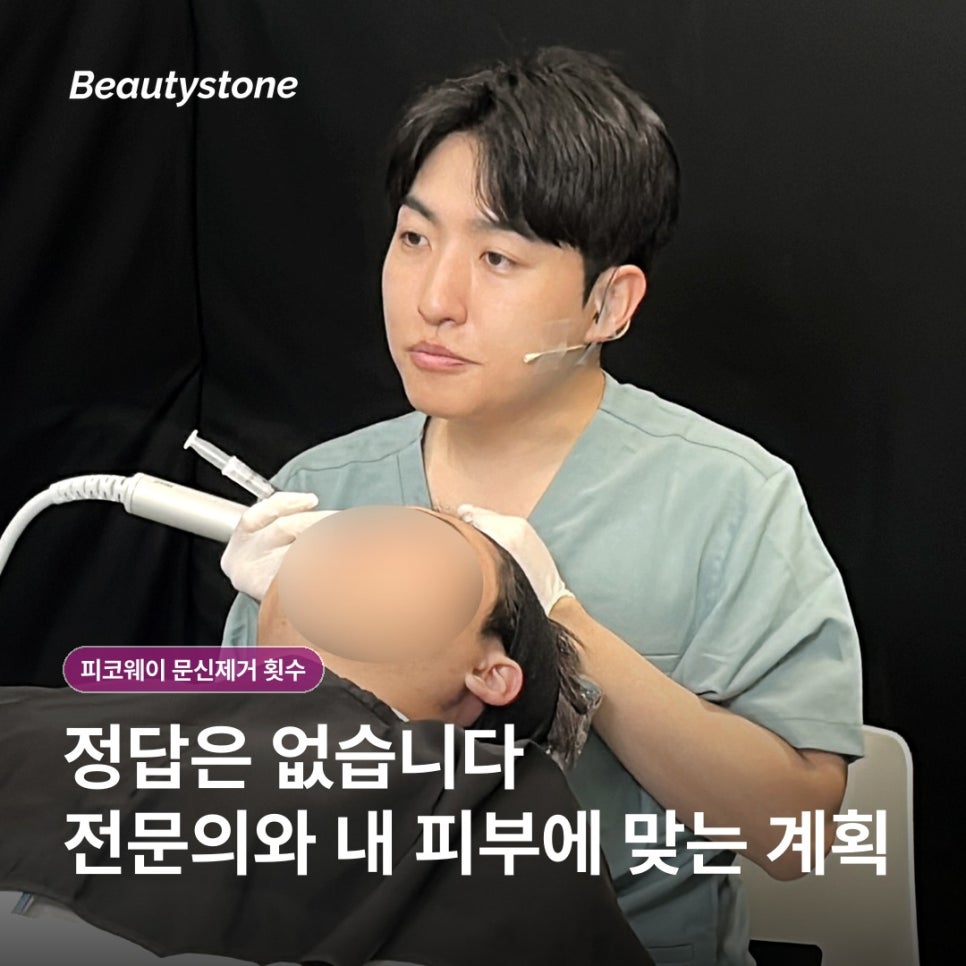
There is no single correct answer
that applies to everyone when it comes to the number of PicoWay tattoo removal sessions.
Even tattoos of the same size can fade at different rates
depending on their color and depth,
the amount of ink, and the skin’s response.
Rather than trying to finish everything in one session,
think of the process as one in which the plan is adjusted
while monitoring the pigment’s response and the skin’s recovery at each visit.
At the initial consultation, it is important to thoroughly assess the tattoo’s condition
and learn about the expected range and limitations,
as well as aftercare methods.
Frequently Asked Questions
Q1. How many PicoWay tattoo removal sessions are usually needed?
There is no fixed number of sessions.
The plan should be adjusted while checking the tattoo’s color and depth,
whether it is a cover-up tattoo,
and the skin’s response.
Q2. Why is it necessary to leave intervals between treatments?
The fragmented pigment needs time to be cleared from the body,
and the skin needs time to recover.
Shortening the intervals does not make the removal process
faster in proportion.
Q3. Are older tattoos easier to remove?
Some pigment in older tattoos may have already faded,
so the response may be different.
However, color and depth, as well as the ink’s composition, also have an effect,
so it is difficult to determine the number of sessions based only on when the tattoo was created.
Q4. What symptoms indicate that I should contact a medical institution?
If the pain becomes progressively worse,
or if you experience large blisters and drainage,
or expanding redness and warmth,
please contact the medical institution where you received treatment.
Thank you for reading this lengthy post today.
This has been Ha-won Kim, MD, from Beauty’s Doctor.