Hello, this is E-Comfortable World Dental Clinic.
Many patients seem to feel startled when they come to the dental clinic
because that is often when they first learn they have wisdom teeth.
Wisdom teeth are widely known as teeth that need to be extracted,
so many people worry about having them removed.
In particular, if a wisdom tooth is impacted
or its shape is unusually curved,
many people feel anxious ahead of extraction.
So we are often asked this question:
“They said the root of my wisdom tooth is curved.
Can it be extracted?”
Wisdom teeth themselves are not easy to extract,
so if the roots are curved, the concern naturally grows.
Today, we will explain why wisdom tooth roots become curved
a long with whether extraction is possible.
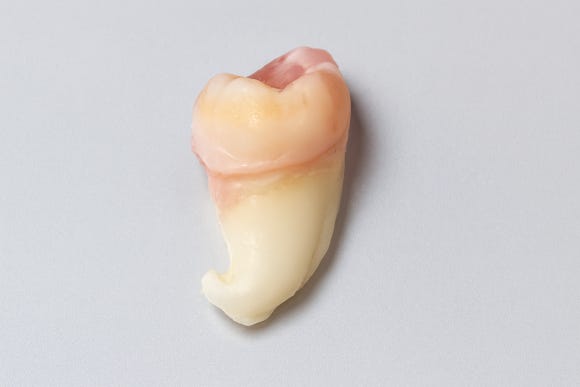
Why do wisdom tooth roots become curved?
Let’s briefly look at what kind of tooth a wisdom tooth is.
A wisdom tooth is the tooth that takes its place at the very back of the molars,
and it usually refers to a permanent tooth that grows
in the late teens to the early-to-mid 20s.
Because it erupts later than other permanent teeth,
it often grows abnormally due to lack of space, impaction, abnormal direction,
and root deformation.
So why do wisdom tooth roots
become curved?
Root shape varies from person to person.
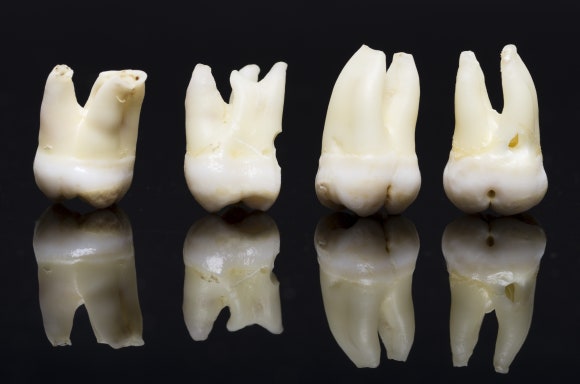
In particular, wisdom tooth roots are often not straight
and may curve or split.
The reasons are as follows.
| First, lack of space |
Because there is not enough space due to the teeth already positioned in front,
such as the molars,
the root may not extend properly and become curved.
| Second, unstable wisdom tooth development |
During the growth process of the wisdom tooth,
if it is blocked in the back and cannot grow,
the root may remain curved as it is.
| Third, the structure and growth of the jawbone |
If the density of the jawbone is high or the space in the back is narrow,
the root may grow in a twisted shape.

Can a curved wisdom tooth root be extracted?
If a wisdom tooth root becomes curved due to the situations above,
is extraction possible?
To give the conclusion first,
a wisdom tooth can still be extracted even if its root is curved.
(This may vary from person to person.)
However, the method and difficulty of extraction may differ.
If the root is only slightly curved,
the tooth may be removed by loosening it.
But if the curvature is severe
or if it is close to a nerve,
the extraction is performed after checking the proximity.
In general, if the root has a gentle curve,
extraction is possible without much difficulty,
but if the root tip is bent like a hook
and caught in the bone, or
if the root is bent twice,
the extraction difficulty may increase.
Do not wait too long to have your wisdom tooth removed
Many people worry about extraction
and put it off as long as possible before visiting the dental clinic.
Wisdom teeth also have an appropriate time for extraction.
In general, extraction is recommended before the wisdom tooth root
has fully developed.
The reason is that the root tip is not yet fully hardened,
so it is not firmly fixed to the jawbone
and comes out more easily during extraction.
Also, before the root is fully developed,
the distance from the nerve is relatively greater,
so the risk of nerve damage during extraction is lower.
In addition, once the root has fully developed
and a long time has passed,
it becomes more firmly integrated with the bone,
which increases the difficulty of extraction.
Therefore, rather than leaving a wisdom tooth untreated for too long,
we recommend having it extracted at the appropriate time.
This has been E-Comfortable World Dental Clinic.
Thank you.