Hello.
This is E-Pyeonhan Sesang Dental Clinic.
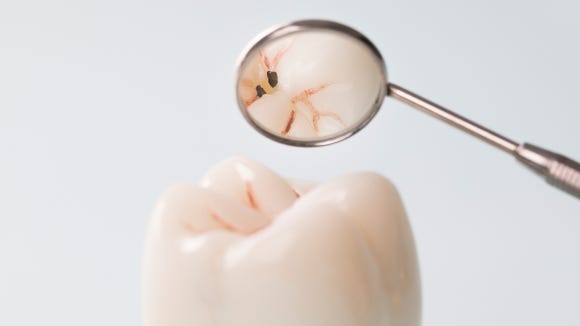
Before cavity treatment,
the question patients ask most often is,
What is the difference between resin and inlay?
Many people think it is just a difference in materials,
but in reality, there are quite a few differences in the situations they are used for,
the treatment methods,
and even the prognosis.
So today,
I’d like to briefly explain
the difference between resin and inlay. ^^
Why are there so many different ways to treat cavities?
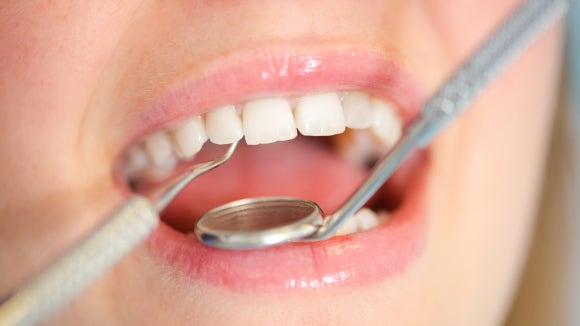
It is easy to misunderstand cavity treatment as a simple process of removing the decayed part of a tooth
and filling it in,
but in fact, the treatment method changes depending on the depth,
extent,
and location of the cavity.
Early cavities may sometimes be slowed or stopped with simple care or prevention alone,
but if the decay has already progressed into the inside of the tooth,
removal and restoration are necessary.
The criteria for deciding which material to use at this point
are not whether one material is good or bad,
but which material is most suitable for the current condition of the tooth.
In other words, it is more accurate to understand resin and inlay not as competing options,
but as different treatment methods chosen for different situations.
What is resin treatment?
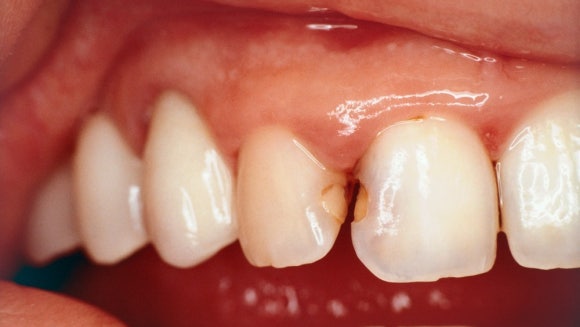
Resin uses a tooth-colored composite resin material
to directly fill the area where the cavity was removed.
Because the decayed area is removed and resin is filled in immediately,
then hardened with a special light,
the treatment is usually completed on the same day.
This short treatment time
and the ability to minimize tooth removal are major advantages.
Also, because the color is similar to natural teeth,
it can be an aesthetically favorable option for front teeth or areas that are easily visible.
That is why it is mainly used for relatively small cavities
or cases where the tooth damage is not extensive.
In what cases is inlay treatment needed?
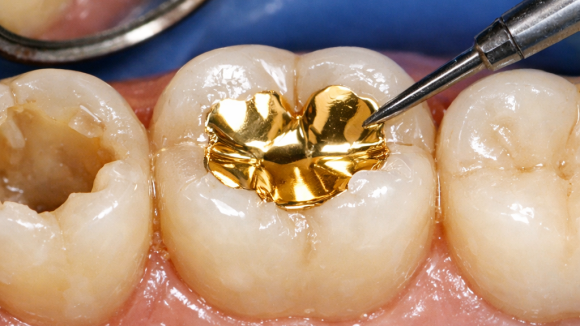
Inlay is a treatment method chosen when the cavity is somewhat more extensive.
Unlike resin, it involves making a custom prosthetic that fits inside the tooth and placing it there.
Because an impression of the tooth is taken to make the prosthetic,
and then the decayed area is removed before the prosthetic is bonded in place,
more than one visit is required.
This process may feel inconvenient,
but it can provide a more precise and durable result.
In particular, in areas that receive a lot of chewing force, such as molars,
inlay is often more advantageous than resin.
Inlay also comes in a variety of materials, such as ceramic and gold,
and each has different strengths in terms of durability and aesthetics.
Differences in longevity and maintenance after treatment
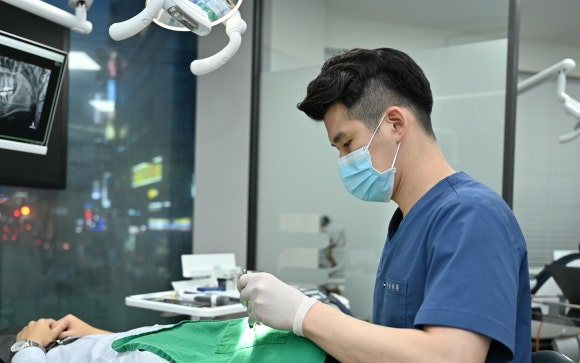
Neither resin nor inlay is a permanent treatment.
Over time, they can wear down or come off,
and their lifespan can vary greatly depending on how well they are maintained.
Since resin is a relatively simple treatment,
areas that are repeatedly exposed to strong force are more likely to experience wear or fracture.
Special caution is especially needed if you grind your teeth or clench them tightly.
Inlay generally has higher strength and less deformation,
so it tends to offer better long-term stability.
However, if a problem occurs with the bonding area,
secondary cavities can develop,
so maintenance is especially important.

Many people focus on choosing the material,
but what is actually more important is
how accurately the decayed area is removed
and how tightly the restoration is fitted.
No matter how good the material is,
if the basic treatment process is not carried out properly,
the prognosis may not be good.
Conversely, if the treatment is done well with the appropriate method for the situation,
you can expect good results from either resin or inlay. ^^
Many people say there are too many types of cavity treatment,
or that they do not know the difference between resin and inlay and cannot tell what to choose.
In fact, rather than deciding on your own,
it is best to make the decision together with the medical team after diagnosing the current condition of the tooth.
I hope today’s explanation was even a little helpful for those who are preparing for cavity treatment.
This has been E-Pyeonhan Sesang Dental Clinic.
Thank you for reading today.