Hello, this is 이편한세상치과.
Recently, as interest in teeth whitening has grown, a wide range of whitening products can be easily found at pharmacies, drugstores, and online.
There are many different types, including whitening toothpaste, patches, pens, and strips. Some people also ask whether it is okay to whiten their teeth at home or whether it is necessary to visit a dental clinic.
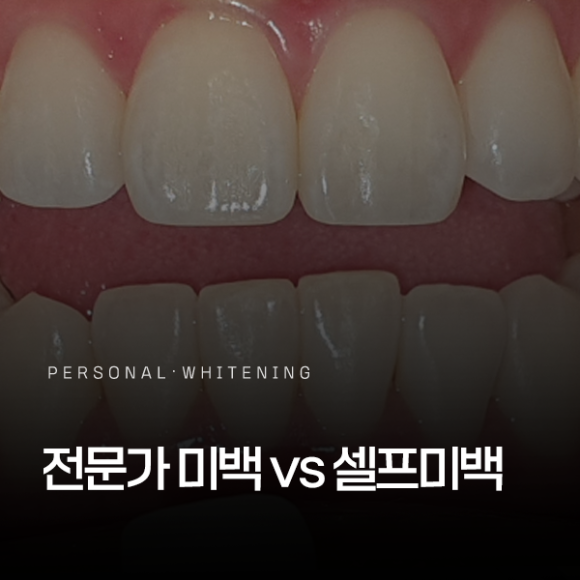
Today, to answer these questions, we will discuss the differences between self-whitening and professional whitening, as well as why whitening is performed at a dental clinic.
|
|---|
| Before whitening, the cause of discoloration should be identified before focusing on the color. |
| 2. The key to professional whitening lies in 'diagnosis,' not concentration. |
| 3. Self-whitening is for 'maintenance,' not a 'substitute.' |
| 4. Not all teeth show the same results. |
- Before whitening, the cause of discoloration should be identified before focusing on the color.
Many people think that if their teeth look yellow, it is simply due to staining.
However, the structure of the teeth itself often affects their color.
Teeth consist of enamel, the outermost layer, and dentin beneath it.
Because enamel is translucent, the color of the underlying dentin may show through.
In other words, even with the same type of teeth, the color that naturally appears can differ from person to person.
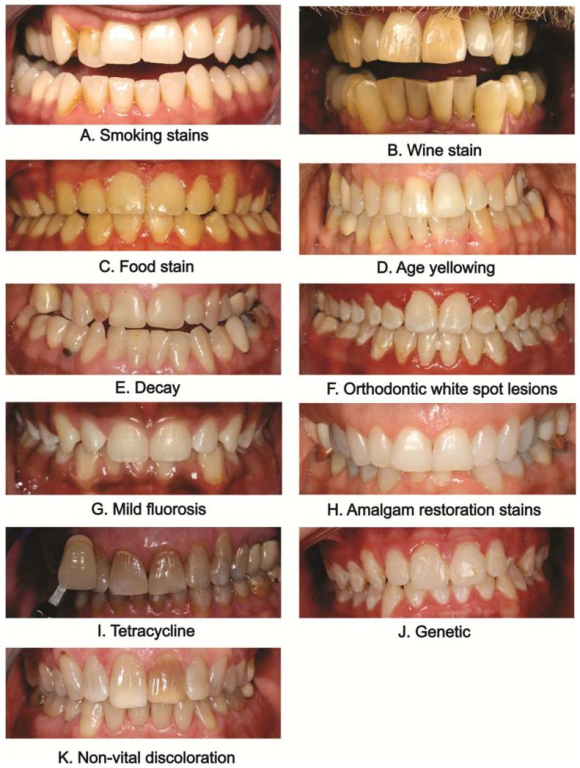
Various causes of tooth discoloration
[Source]
Carey CM. Tooth Whitening: What We Now Know. J Evid Based Dent Pract. 2014.
In addition to extrinsic staining caused by coffee, tea, wine, and smoking, intrinsic discoloration can also occur due to aging, medication, trauma, and other factors.
Therefore, when planning teeth whitening, it is important not only to consider how yellow the teeth are, but also to first determine why they appear yellow.
- The key to professional whitening lies in 'diagnosis,' not concentration.
Compared with self-whitening that can be performed at home, professional whitening uses a whitening agent with a higher concentration.

Here is a brief summary of the differences between self-whitening and professional whitening.
The concentration of the whitening agent is important, but the process of checking the current condition of the teeth is also considered important.
For example,
these conditions may need to be checked before whitening.
The reason is that even when the same whitening agent is used, the response and care methods may differ depending on the current condition of the teeth.
Therefore, professional whitening does not simply mean using a high concentration. It also includes evaluating the current condition of the teeth and creating an appropriate treatment plan. ^^
- Self-whitening is for 'maintenance,' not a 'substitute.'
feat. Take-home whitening
Then, does self-whitening have no effect at all?
That is not necessarily the case.
Self-whitening is often used to manage light staining or for maintenance after professional whitening. In particular, the availability of various home-care products in recent years has made at-home care more accessible.

However, not all discoloration can be improved through self-whitening alone.
The expected range of improvement may vary depending on the cause of discoloration, and differences may also occur from person to person.
There is also a method known as dentist-prescribed take-home whitening.
This involves using a tray made to fit the individual's teeth along with a whitening agent, followed by care at home for a set period. Although the process is slower than professional whitening, it can provide relatively gradual color improvement.
In particular, if you want more thorough care or wish to extend the duration of the whitening effect, combining take-home whitening with professional whitening at a dental clinic may also be helpful. ^^
We will discuss take-home whitening in more detail another time.
Not all teeth show the same whitening results.
Even when the same whitening agent is used, the results and responses may differ from tooth to tooth.
In particular,
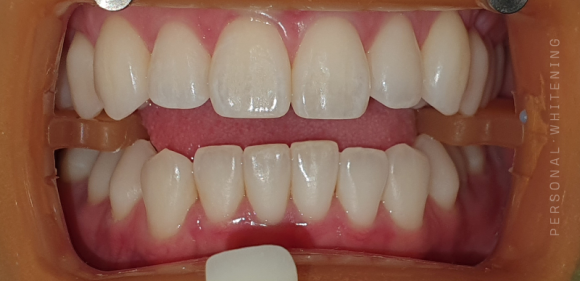
This is a reference image to help explain teeth whitening.
-
when the discoloration has been present for a long time
-
when the tooth has undergone root canal treatment
-
when congenital discoloration has occurred
-
when the discoloration is caused by a specific medication
these cases may present differently from ordinary staining.
Therefore, before whitening, it is important for a dental clinic to first evaluate the current condition of the teeth and explain the range of results that may reasonably be expected.
Rather than trying to make the teeth unconditionally white, setting an appropriate direction based on their current condition may lead to better results.
Before teeth whitening, instead of aiming only for the brightest possible shade, having a diagnosis tailored to the condition of your teeth first and then proceeding may help you achieve more satisfactory results.
We hope that the information provided today will help you take the right first step toward teeth whitening. ^^
We will continue to share a variety of information about teeth whitening.
| If you are curious about before-and-after teeth whitening cases, please visit the cafe below and take a look. |

Thank you. ^^