Osstem Implant Grades
Is More Expensive Really Better? Differences Between SA, CA, BA, and SOI by Grade
Hello.
This is E-Pyeonhan Sesang Dental Clinic.
When you receive an implant consultation,
you may notice some words that stand out.
That is, dental implants also have different grades.
Since the price varies depending on the grade,
many people wonder whether more expensive materials are necessarily better.
Today, we have prepared this post to explain
why implants are divided into different grades
and what the differences are between them. ^^
Implant Grades Refer to Differences in Surface Treatment Methods
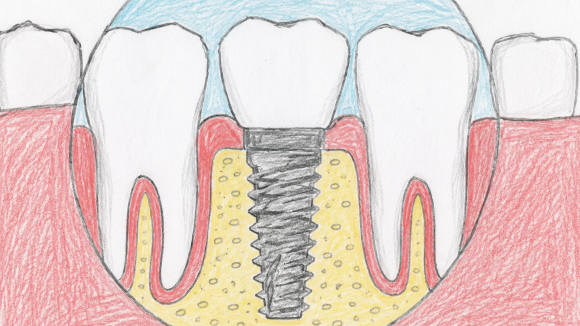
Many people think that the letters
SA, CA, BA, and SOI attached to the end of an Osstem implant
represent its grade.
Strictly speaking, however, they refer to a slightly different concept.
These names indicate differences in the technology used to treat the implant surface,
rather than quality grades of the implant itself.
Implants are made of titanium,
but even with the highest-quality titanium,
how quickly and how stably it bonds with the bone
is a very important factor.
The bonding of the bone and the implant screw
is called osseointegration. When osseointegration proceeds smoothly,
the implant can be firmly fixed
and used stably over the long term.
For this reason, manufacturers have researched various ways to treat implant surfaces
so that bone cells can attach more effectively.
As surface treatment methods have advanced,
technologies designed to improve initial stability and the speed of osseointegration
have been developed successively.
These technologies led to names such as
SA, CA, BA, and SOI.
The SA Surface: The Most Basic Surface Treatment
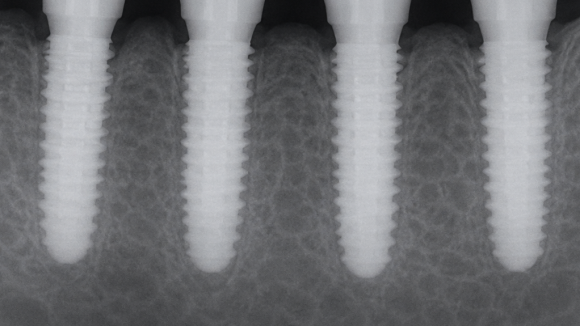
The first one we will look at is SA.
It is one of the most widely used
surface treatment methods worldwide,
with the advantage of having accumulated clinical data over many years.
SA stands for Sandblasted with Acid Etching.
As the name suggests, the surface is roughened using large aluminum oxide particles,
after which it is further treated with acid
to create fine irregularities.
This rough surface
increases the area available for bone cells to attach,
allowing osseointegration to occur more stably.
It may help to think of it as similar to how glue adheres better to a rough wall
than to smooth glass. ^^
If the bone is relatively healthy,
SA can generally be expected to provide satisfactory results.
What Is Different About the CA Surface?
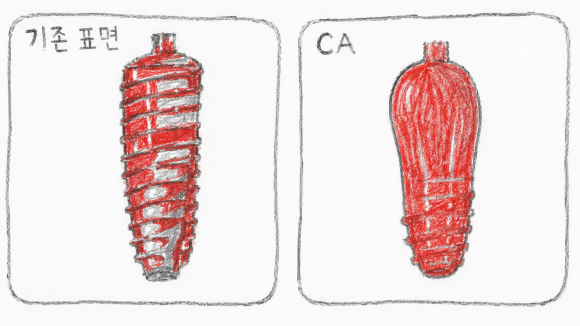
Surface differences after blood contact
CA is a technology that further develops the SA surface.
Over time, carbon components in the air can become adsorbed onto an SA surface,
which may somewhat reduce its hydrophilicity.
Hydrophilicity refers to the degree to which blood or bodily fluids
spread across the implant surface.
Immediately after surgery, blood first comes into contact with the area around the implant,
and blood contains various cells that help with bone formation.
Therefore, when the surface readily accepts blood—that is, when it has high hydrophilicity—it can create a more favorable environment during the early healing process.
To address this limitation of SA,
CA uses calcium ions to treat the surface and increase its hydrophilicity.
This type of surface may be helpful for patients with low bone density
or those who may heal more slowly.
What Kind of Technology Is the BA Surface?
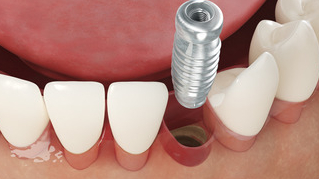
BA is also a surface treatment technology developed
to improve the early osseointegration environment. ^^
Many of the implant materials currently used in dental clinics
also feature a BA surface.
The key concept is to increase surface activity,
improve its reaction with blood,
and support early healing.
While SA is a basic technology that has been validated over many years,
BA can be understood as a technology incorporating research findings
aimed at further enhancing biocompatibility.
However, from a general patient’s perspective,
it is difficult to compare SA, BA, and CA and say,
“This one is the best!”
This is because many factors come into play,
including the patient’s bone condition, the implant placement site,
the condition of the gums,
and the presence or absence of systemic disease.
Is the SOI Surface the Highest Grade?
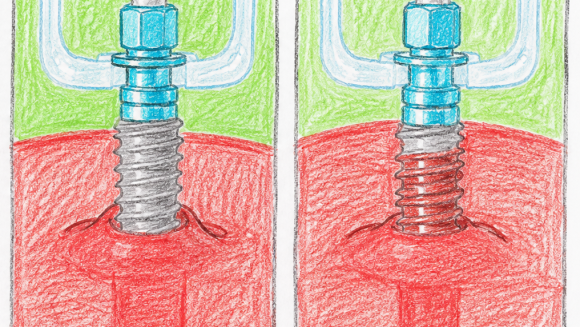
Existing product / SOI
Surface differences after blood contact
During dental consultations,
SOI is often relatively expensive and may appear to be a higher grade,
so many people mistakenly believe that they should choose SOI only.
The greatest feature of SOI
is that the manufacturing and storage processes are managed
so that it maintains very high hydrophilicity.
With standard implants, contact with air
may reduce the hydrophilicity of the surface,
but SOI is designed to minimize this change.
As a result, blood can spread across the implant surface more quickly,
which may greatly help create an early osseointegration environment.
SOI may offer a distinct advantage, especially in situations involving immediate placement,
when initial stability is important,
or for patients with poor bone quality.
However, not every patient needs to use SOI.
Patients with healthy gums and sufficient bone volume
often achieve favorable outcomes even without SOI.
In other words, an expensive product is not always the right answer for every patient. ^^
On the internet, you will often find information claiming that
you must use a particular product “no matter what,”
or that a certain product is “the best.”
However, actual dental treatment is not that simple.
This is because every patient differs in factors such as
how long they have been missing the tooth, their chewing force,
overall health, and bone density.
Even when the same Osstem implant is used,
BA may be suitable for one person,
while SOI may be suitable for another.
Rather than comparing only product names and prices,
patients should ask why the dentist recommends a particular product
and what the current condition of their gums and bone is,
then learn more through a thorough consultation.
The names SA, CA, BA, and SOI used for Osstem implants
refer to surface treatment technologies with different purposes and characteristics.
The success of an implant is not determined solely by its surface treatment method.
An accurate diagnosis by the dental professional, a treatment plan that takes the patient’s bone condition into account,
and consistent follow-up care are the key factors that determine long-term success. ^^
Please remember that implant treatment is not about choosing an expensive product,
but about finding the treatment method that is most suitable for you.
We hope today’s post
has been helpful to those of you considering implants,
and we will bring this post to a close.
Thank you for reading to the end today.
This was E-Pyeonhan Sesang Dental Clinic.