Hwagok Bon-dong Teeth Alignment
My upper teeth cover my lower teeth! (Overbite) Can orthodontic treatment improve it?
Hello.
This is 이편한세상치과 화곡점.
When do you think people typically get orthodontic treatment?
Usually, you may think that orthodontic treatment is needed when someone has crooked teeth or an uneven dental alignment.
However, there are actually many more cases than you might expect in which orthodontic treatment is necessary even when the teeth appear straight.
This is when there is a problem with the bite.
The bite abnormality we frequently encounter during examinations is an overbite.
Today, we will explain what an overbite is, why it occurs, and why orthodontic treatment may be necessary.
What is an overbite?
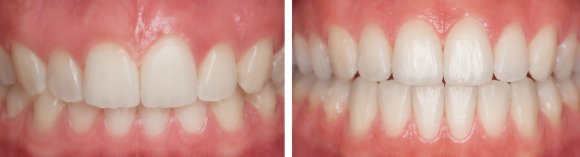
Difference between an overbite and a normal bite
※ This image is provided for reference to aid understanding.
First, with a normal bite, when the mouth is closed, it is generally normal for the upper teeth to cover the lower teeth by approximately 2–3 mm—that is, about 20–30% of the height of the lower teeth.
An overbite, however, is a condition in which the upper teeth cover much more than this.
It is a bite in which the upper teeth excessively cover the lower teeth.
Depending on the case, the bite may be so deep that the lower teeth are barely visible. In severe cases, the lower front teeth may touch or poke the gum behind the upper teeth, causing gum damage.
What causes an overbite?
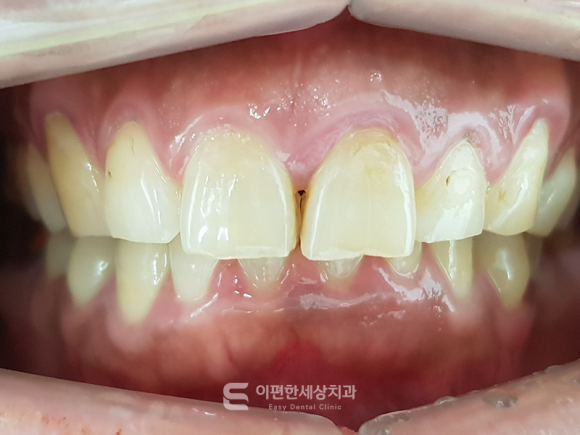
Image of teeth with a prominent overbite
※ This image is provided for reference to aid understanding.
The most common cause of an overbite is an imbalance in the development of the upper and lower jaws during growth.
If the lower jaw does not grow sufficiently or the upper jaw develops relatively more, a bite in which the upper teeth naturally cover the lower teeth extensively may form.
The position of the teeth can also have an effect.
An overbite may occur when the front teeth are tilted significantly inward or when the lower front teeth have moved excessively upward.
In addition, habits such as thumb-sucking during childhood, incorrect tongue positioning, or breathing through the mouth may continue for a long time and affect the direction of jaw growth and the alignment of the teeth.
There are also many cases in which an overbite develops or becomes more pronounced after adulthood.
If the teeth become worn or some teeth are lost and treatment is not received at the appropriate time, the bite height may decrease, causing the overbite to become more severe.
Is it okay to leave an overbite untreated?
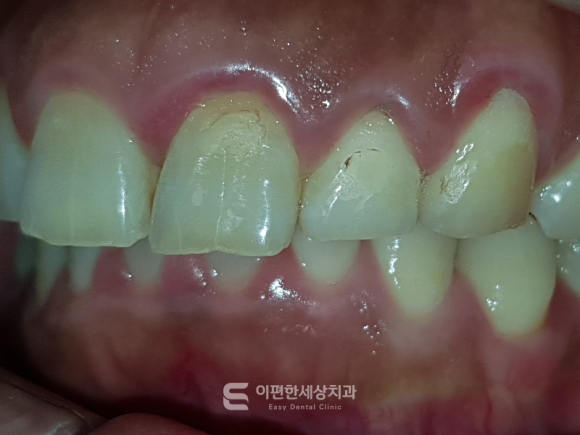
Image of teeth with a prominent overbite
※ This image is provided for reference to aid understanding.
If the overbite is severe or functional problems have already appeared, it is advisable to consider treatment.
The teeth are structures we use repeatedly every day.
Because they come together thousands of times a day and are used to chew food, even a minor bite abnormality can gradually lead to a larger problem over time.
First, if the front teeth meet excessively deeply, discomfort may occur while chewing food, and you may feel that jaw movement is unnatural.
If excessive biting force continues, it may place a burden on the temporomandibular joints and surrounding muscles. The teeth may also gradually wear down more quickly, causing sensitivity.
If the lower front teeth repeatedly irritate the gum behind the upper teeth, gum damage may also occur.
How is an overbite treated with orthodontics?
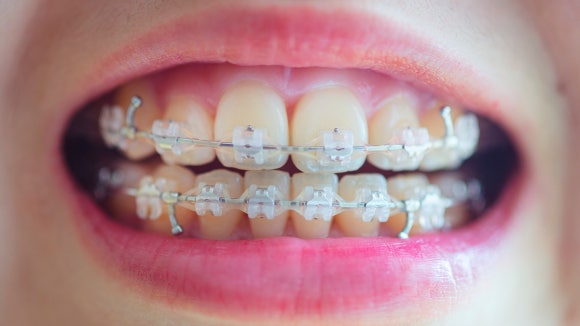
Treatment for an overbite does not consist only of moving the upper teeth backward or the lower teeth forward.
Because the necessary tooth movement differs from patient to patient, several methods are combined during treatment.
If the front teeth have moved excessively downward, treatment to move them to an appropriate position may be considered.
In some cases, the height of the molars is adjusted to balance the overall bite.
If necessary, treatment may also involve rotating the teeth or adjusting their inclination so that the bite fits together naturally.
Because the treatment period and whether extractions are needed differ from person to person, it is difficult to give a definite answer.
Having an overbite does not necessarily mean that tooth extraction is required. If there is sufficient space for the teeth to be aligned, treatment without extraction is also possible.
The orthodontic treatment period is generally expected to be approximately one and a half to two years, but it may be shorter or longer depending on the patient’s cooperation and the rate of tooth movement.
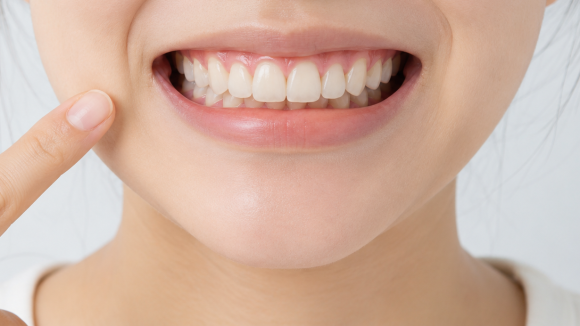
You may think of an overbite simply as a problem in which the upper teeth cover the lower teeth extensively.
In reality, however, it is a bite abnormality that can affect the teeth, gums, temporomandibular joints, and chewing function.
The purpose of orthodontic treatment is not only to make the teeth look attractive. ^^
A more important goal is to create an environment in which the upper and lower teeth fit together harmoniously, food can be chewed comfortably, and the teeth and gums can be maintained in a healthy condition over the long term.
If your lower teeth are barely visible when you smile or your front teeth seem to meet excessively deeply, it may be worthwhile to have your bite checked.
If you live in or around Hwagok-dong or Hwagok Bon-dong, you are also welcome to visit 이편한세상치과 화곡점.
We will always greet you with a smile.
Please feel free to visit us.
This has been 이편한세상치과 화곡점.
Thank you for reading to the end today.