
Hello,
This is 이편한세상치과.
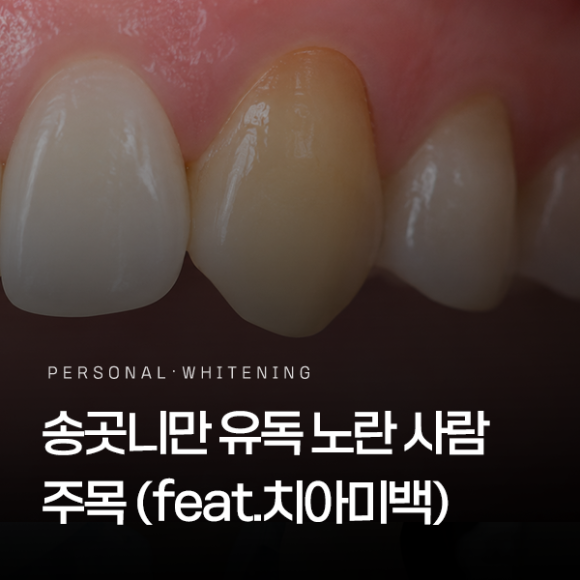
Among those who are concerned about the color of their teeth, some may have a particular area that stands out more than others.
That area is the canines, located on either side of the front teeth.
The front teeth may be relatively bright, while the canines appear slightly more prominent, or the outer edges on both sides may seem to have a yellowish tint when smiling.
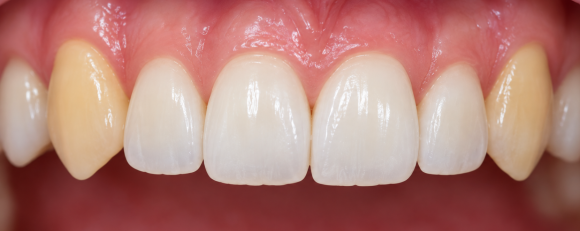
In reality, not every part of a tooth is exactly the same color. Due to their structural characteristics, the yellowish color of the dentin can have a relatively greater influence on the appearance of the canines.
So, can naturally more yellowish canines also be brightened through teeth whitening?
Today, we will take a detailed look at information that may be helpful for those considering canine teeth whitening.
Why Do My Canines Look Especially Yellow?
The enamel, which is the outermost part of a tooth, is semi-transparent.
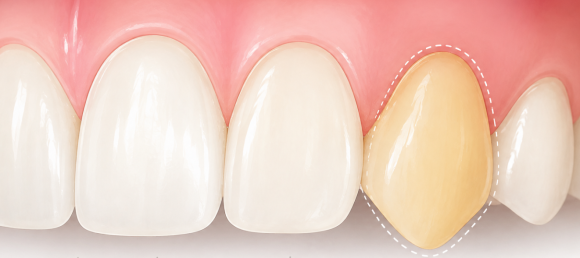
Because of this, the color of the dentin located beneath it also affects the tooth's appearance.
Dentin naturally has a yellowish color,
and because the canines differ from the front teeth in shape and thickness, they may appear relatively darker.
When changes such as staining caused by lifestyle habits—including coffee, tea, and smoking—are added to this, the color difference between the canines and front teeth may become even more noticeable.
| ※ Please regard this image as a reference for understanding the color difference in which the canines may appear relatively darker than the front teeth. |
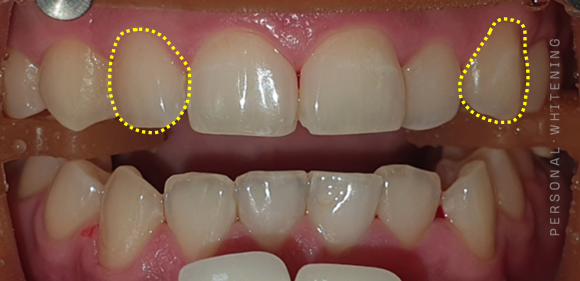
This is a reference image to help explain the color of the canines.
Here is one image to help illustrate this.
Compared with the front teeth, the canines can be seen to have a slightly darker shade.
By comparing the colors of the front teeth and canines as shown in the image above, it is easier to see that each tooth can have subtly different shades.
Can Canines Be Improved with Teeth Whitening?
Like other teeth, the canines can also be expected to undergo a color change through teeth whitening.
However, since each tooth naturally has a different shade and structure, for those whose canines have a particularly noticeable color difference, the areas where the canines appear slightly darker than the front teeth may become brighter after whitening. Nevertheless, we explain that the extent to which they become completely identical to the front teeth may vary from person to person.
Therefore, if you are considering canine teeth whitening, it would be best to understand it as a way to improve the overall brightness of the teeth while reducing the noticeable color difference between the front teeth and canines. ^^
There are several ways to address cosmetic concerns about teeth. In addition to the teeth whitening introduced today, there is also a treatment called laminates.
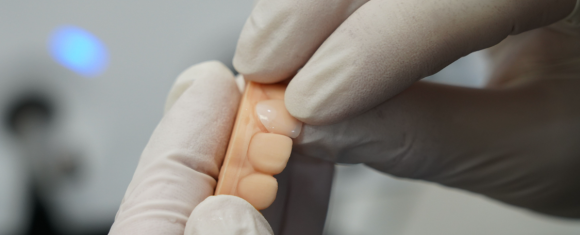
Our dental clinic also performs many laminate treatments.
If the color, shape, size, and alignment of the teeth all need to be improved, laminates may be one option.
On the other hand, if you have no major concerns about the shape of your teeth and the color itself is your primary concern, we recommend considering teeth whitening. ^^
Many people choose teeth whitening because it is a way to improve brightness while preserving their natural teeth completely.
In fact, both laminates and teeth whitening are cosmetic treatments that can help change the overall impression of the teeth. However, there may be differences in the treatment scope, methods, and concerns that each can address.
So, next time, it may be helpful to take a detailed look at the differences, advantages, and disadvantages of laminates and teeth whitening. ^^
If you are concerned because your canines appear particularly yellow, you may expect some degree of brightness improvement through teeth whitening. It would be best to choose the appropriate option after having your exact condition assessed. ^^
Thank you for reading today.
This was 이편한세상치과.