Full-face filler, by area
How much volume is injected?
I checked the literature
Hello.
I’m Kim Jin-hyeon,
Chief Director at You&I Clinic Mokdong Branch.
As interest in full-face filler has increased, it seems that before the procedure,
“how much will be needed in each area” is the biggest concern for many people.
(For reference, full-face filler refers to a procedure in which filler is injected into multiple areas for overall aesthetic improvement of the face. ^^)
So today, while looking at an actual paper,
I’d like to go over the related details,
how I design and decide on full-face filler in the clinic,
and why “how it is injected” is more important than “how much volume is used.”
I’ll honestly explain the reason.
| Table of contents |
|---|
| 1. [Paper] What is the average amount used? 000-centered design is key2. Even the same 4 can be too much for one person and not enough for another3. First, draw the “picture” of the face? |
- [Paper] What is the average amount used?
000-centered design is key
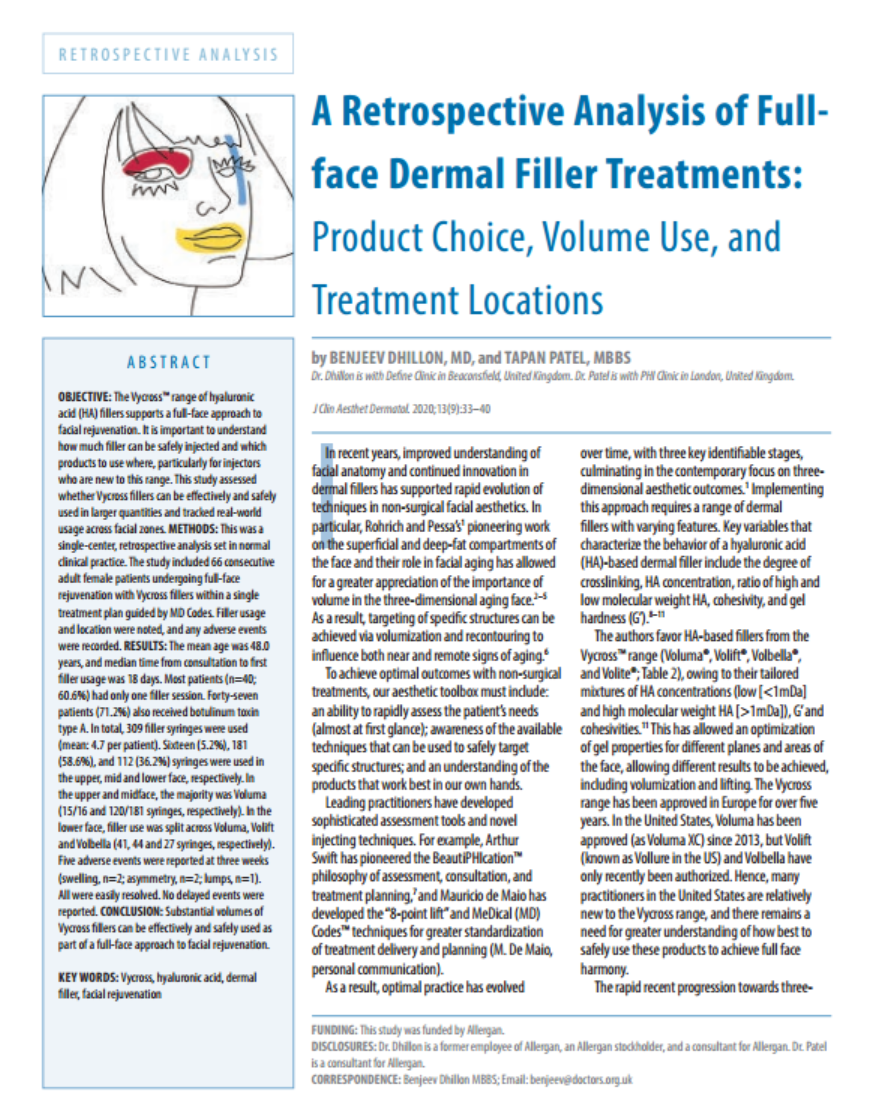
A Retrospective Analysis of Fullface Dermal Filler
Treatments: Product Choice, Volume Use, and
Treatment Locations
Let’s first look at the paper I mentioned earlier.
According to a study analyzing 66 adult female patients,
an average of 4.7 syringes per patient were used,
of which 58.6% were in the midface
(cheekbones, nasolabial folds)
36.2% were in the lower face (chin, around the mouth)
and the upper face accounted for 5.2%, showing a relatively small proportion.
(In Korea, the unit “cc” is commonly used, but in this paper the term “syringe” was used.
It is usually 1 ml per syringe, meaning 1 cc, but it is not exact, so I think it would be best to look only at the proportion of how much was injected in each area. ^^)
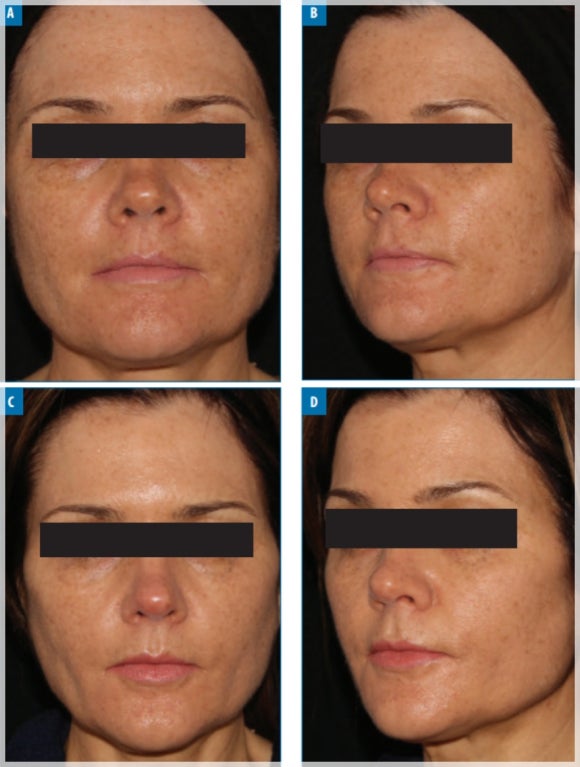
FIGURE 1. Full-face approach in a 55-year-old woman. The patient presented (A, B) complaining that her jawline looked too heavy and that she wanted to
appear less masculine and have better cheek volume. She was treated with the Vycross range of products across
two sessions to achieve facial slimming without
the use of botulinum toxin. The patient received
eight syringes of filler: six of Voluma (3 in the midface; 3 in the lower face), one of Volift (lower face), and one of Volbella (lips). Results at three weeks after the second session are
shown in C and D.
Procedure for a jawline that looked too thick and heavy
(Top) before the procedure, (Bottom) after the procedure
3 syringes in the midface, 4 syringes in the lower face, 1 syringe in the lips
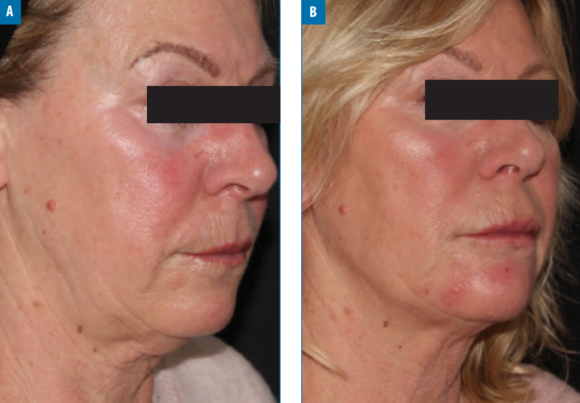
FIGURE 2. Full-face approach in a 64-year-old woman. The patient presented (A) wanting her face to look less saggy and more youthful. She was treated across
two sessions to achieve chin advancement and jawline definition in the lower face and improve submental fullness.
The patient received six syringes of Voluma: three in the midface and three in the chin. Results immediately following
the second session are shown in B. This patient demonstrates the importance of treating
the midface to help impact on the lower face.
Procedure to improve double-chin volume
(Left) before the procedure, (Right) after the procedure
3 syringes in the midface, 3 syringes in the lower face
In other words, in full-face filler, where the emphasis of the procedure lies is important,
and “full face” does not mean the same amount is injected into every area.
In fact, the midface is one of the first areas to lose volume with aging and serves as the central axis supporting the overall contour,
so it is the area I consider most when designing volume.
- Even the same 4 can be too much for one person,
and not enough for another
I hear this often.
“I only want to inject 00cc.”
When I hear that, I explain it like this.
“Even the same amount can be an amount that barely covers a cheekbone on one face,
and for another person, it may be enough for the jawline and around the mouth.”
Unlike a standard filler treatment that simply fills a local area with volume,
full-face filler requires a three-dimensional redesign of the structure.
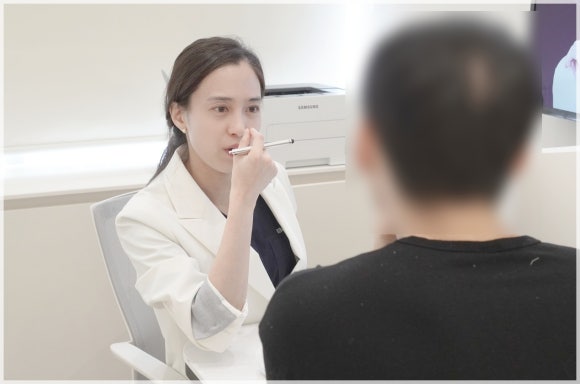
As one example, if you only fill in the sunken areas, the face may actually look heavier and more saggy.
That is why I design it like this.
Check the facial skeleton and fat pad condition
Establish a distribution strategy for the necessary areas
Set priorities to balance budget and effect
- First, draw the “picture” of the face?
Before the procedure, I always start with this question.
“In this face right now, which area would be best to fill first?”
Whether the cheeks have deflated before the forehead
whether the problem is a collapsed volume axis rather than nasolabial folds
whether the corners of the mouth have dropped because of volume loss around the mouth
Judging these things is where design begins.

Thanks to that, after the procedure,
“I can’t tell exactly what changed, but my face looks more balanced.”
“Nothing obvious changed, but my overall impression looks brighter.”
When I hear things like that, I feel genuinely rewarded.
As the chief director, I treat each patient with the mindset that I am “designing” their face.
Even when it is not full-face filler, I try to maintain that same approach in other procedures as well.
This post was not written with the intention of saying you must receive treatment from me,
but because I wanted to emphasize how important customized analysis is,
I think the post ended up being a bit long. ^^;;
I hope this article was at least a little helpful for those preparing for filler treatment,
and I’ll end it here.
Thank you for reading such a long post.
This was Kim Jin-hyeon,
Chief Director at You&I Clinic Mokdong Branch.
< Related posts you may find helpful >
< Directions >