Yangcheon-gu Acne Treatment
Hello.
I’m Kim Jin-hyeon, the lead director at You&I Clinic Mokdong.
"Even though I manage it consistently, my acne keeps coming back.."
Many people diligently care for their skin with thorough cleansing, exfoliation, moisturizing, and even self-extraction, but are disappointed when their acne does not improve.
In fact, to improve it, you first need to know what type of acne it is.
From tiny white bumps that rise on the skin to red, swollen inflammatory acne and severe acne with pus forming inside, the condition inside the skin differs by type, so the treatment approach must also differ.
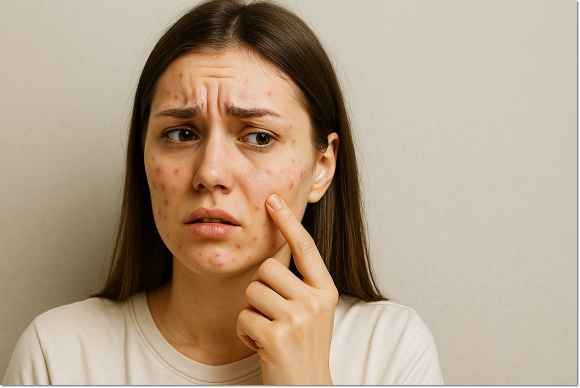
If you manage it with the same products and the same method without distinguishing the type, it can even get worse.
Today, I’ll briefly summarize what types of acne there are and how to approach each type.
Table of Contents
Yangcheon-gu Acne Treatment
Acne Types
Acne appears in various forms as the skin’s sebaceous glands and pores become blocked or inflamed.
Broadly, it can be classified into non-inflammatory acne, inflammatory acne, and suppurative acne.
Each type is distinguished by the degree of change inside the skin, and the treatment method also differs.
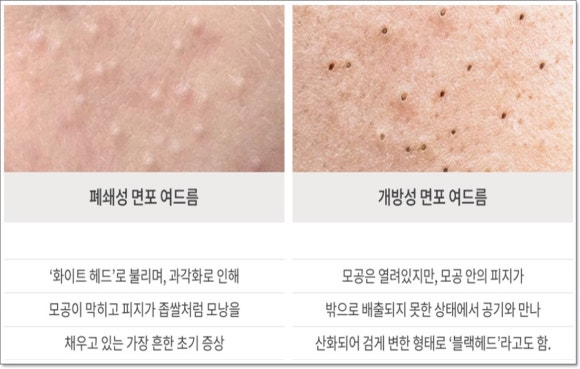
First, non-inflammatory acne appears lightly on the skin’s surface and is divided into closed comedones and open comedones.
Closed comedones are what we commonly call "whiteheads" or small acne bumps, where the pore becomes blocked and rises up as a white bump.
On the other hand, open comedones appear as "blackheads," where the pore is open but sebum cannot be expelled, oxidizes, and turns black.
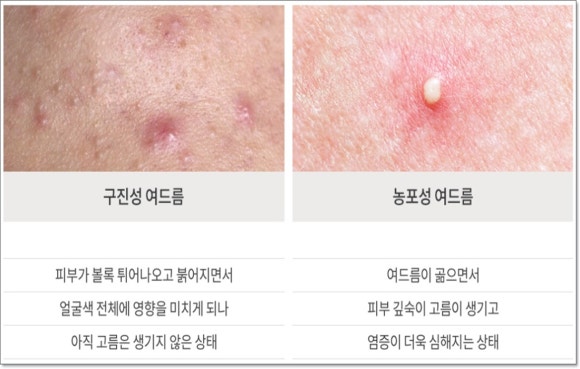
Next is inflammatory acne.
This is a type where the skin becomes red and swollen and is accompanied by pain, and it is divided into papular acne and pustular acne.
Papular acne is red acne without pus yet, while pustular acne has pus formed inside, so yellow or white pus may be visible.
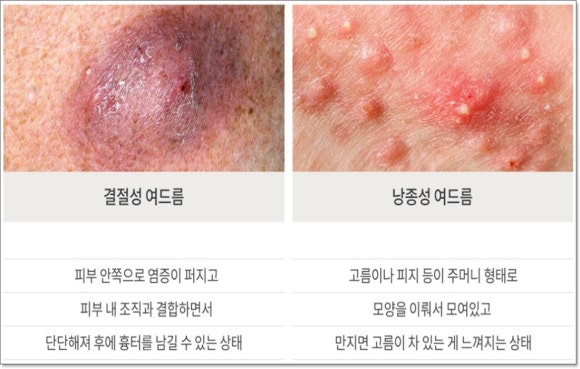
Lastly, suppurative acne is an advanced stage in which inflammation has spread deep into the skin tissue.
Typical examples include nodular acne and cystic acne, which may feel firm to the touch and be very painful, or appear as sac-like lesions filled with pus.
At this stage, the risk of scarring is high, so prompt action is very important.
Yangcheon-gu Acne Treatment
Treatment Methods by Type
Because each type has a different condition inside the skin, the treatment method must also be tailored accordingly.
Using only topical products or cleansers alone can sometimes make it worse, so a step-by-step approach is necessary.
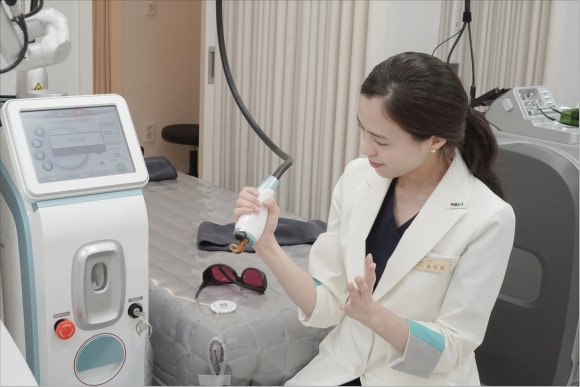 Neobeam
For non-inflammatory acne, it may improve sufficiently with lifestyle care alone.
Neobeam
For non-inflammatory acne, it may improve sufficiently with lifestyle care alone.
In particular, gentle exfoliation that does not irritate the skin and basic skincare that balances oil and moisture are important.
However, if it does not go away over time or seems to be progressing into inflammation, then you should seek help from medical staff.
If necessary, extraction may be performed first, and treatment may be combined with a Neobeam laser that helps reduce sebaceous gland activity to prevent inflammation from progressing.
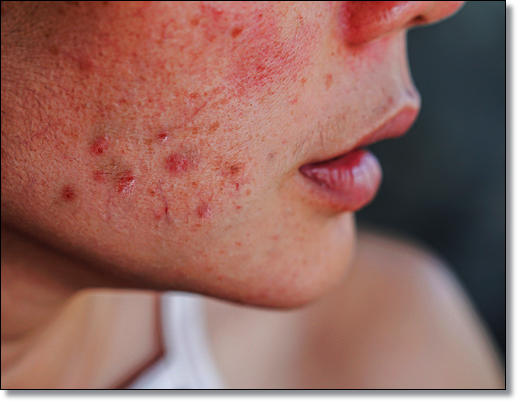
Inflammatory acne is difficult to improve with simple care alone, so device-based treatment should be performed together with medication.
Papular or pustular acne is already in an inflammatory stage, so if it is handled incorrectly, it can easily lead to scarring.
Therefore, in this case, anti-inflammatory treatments should be used, or laser treatment should be used to reduce the inflammatory response inside the skin and regulate sebum secretion.
If necessary, extraction may also be performed to remove pus and support recovery.

Severe forms such as suppurative acne can easily leave damage to the skin tissue, so prompt treatment is key.
If the inflammation is severe, an anti-inflammatory injection should be used to quickly reduce swelling and pain.
After that, it is good to use a radiofrequency device such as Agnes, which directly treats the sebaceous glands deep in the skin, to improve the skin environment itself.
As shown above, the more advanced the acne, the greater the risk of scarring over time, so active treatment intervention is absolutely necessary.
Today, I wrote this post to help those who are looking into Yangcheon-gu acne treatment.
Acne may seem like only an appearance issue, but in fact it is a sign that the balance inside the skin has been disrupted.
Many people visit us after trying various products and folk remedies, saying they had no real effect.
In fact, for acne to improve, you must first accurately identify what condition your skin is currently in and then choose a treatment suitable for that condition.
In the early stages, simple care may be enough to improve it, but if inflammation has begun or pus has started to form, I recommend seeking help from medical staff.
I hope today’s post was a small help to those struggling with acne, and I’ll wrap up here.
This was Kim Jin-hyeon, lead director of You&I Clinic Mokdong.
Thank you.
< Related post you may find helpful >
< Directions >