Omokgyo Dermatology (Department: Dermatology)
Which Lifting Treatment Is Best?
Omokgyo Dermatology
Hello.
I am Kim Jin-hyeon, chief director of the Mok-dong branch of UNI & I Clinic.

"There are so many types of lifting procedures.
Which one is right for my face shape?"
A face line that has lost elasticity and sagged is a common concern for many people.
Even when they try to start caring for it, there are so many different devices and procedures that many people find it difficult to decide which method is the right fit for them.
That is because, just as people look different from one another, skin thickness and the degree of sagging also vary from person to person.
So today, at Omokgyo Dermatology, I would like to talk about the key criteria and principles that must be checked before deciding on a procedure.
Table of Contents
-
The core principles of lifting
-
How are Ulthera and Thermage FLX different?
-
What criteria should you use when choosing?
Omokgyo Dermatology
The core principles of lifting
Facial aging is not simply the skin surface stretching. It is important to understand the structures beneath the skin.
Our face is made up not only of the epidermis, but also the dermis, fat, muscles, and deep structures called the "retaining ligaments" and the "SMAS (superficial musculoaponeurotic system)," which firmly anchor these structures to the bone.
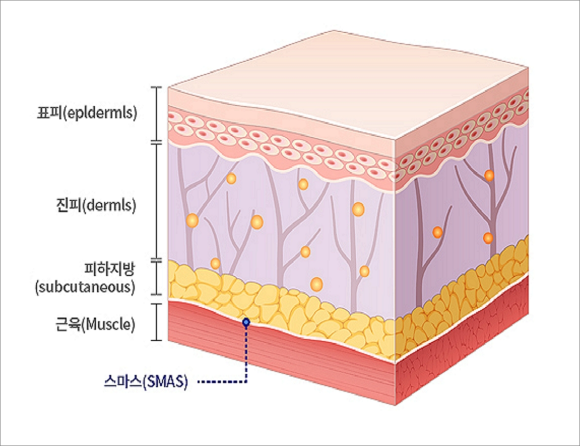
As time passes, the supporting ligaments that act like the pillars of a building weaken, and the collagen that kept the skin firm decreases, causing the tissues to sag downward with gravity.
That is why methods that only temporarily pull the surface taut often fail to produce satisfying changes.
Of course, in the early stages of aging, simple care can be helpful, but when collagen has already collapsed or facial contours need correction, it is necessary to deliver energy from the deep dermis to the SMAS layer to restore fundamental support.
In other words, the core goal of lifting is not simply to pull the skin, but to build structural strength from within.
Omokgyo Dermatology
How are Ulthera and Thermage FLX different?
Among the devices widely used in dermatology for fundamental improvement are Ulthera and Thermage FLX, and these two devices target different layers and work differently.
First, Ulthera Prime uses high-intensity focused ultrasound (HIFU) energy to target the SMAS layer, the deepest part of the skin.
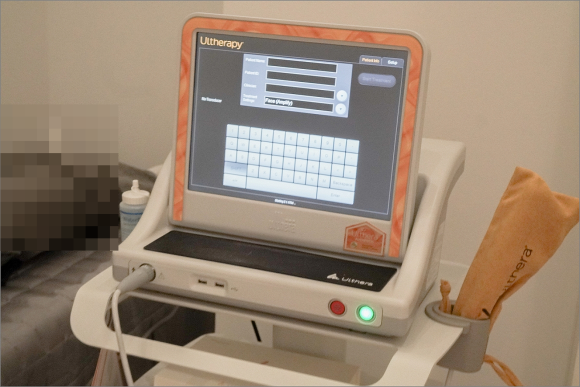
Like concentrating light with a magnifying glass to generate heat, it focuses ultrasound at a single point to create thermal coagulation points and contract sagging tissue.
Because it acts on the same target layer as the lifting plane in a facelift, it can help refine the contour in cases such as a thick double chin or a collapsed jawline.
On the other hand, Thermage FLX uses radiofrequency (RF) energy to deliver gentle, sustained heat throughout the dermis.
It focuses on tightening by inducing collagen regeneration within the skin and firming thin, loose skin.

If Ulthera Prime pulls on deeper layers to define the contour, Thermage is advantageous for increasing the skin’s density itself and improving fine lines, pores, and skin texture.
However, these two devices do not produce the same effect for everyone.
If someone with very thin skin receives a strong ultrasound procedure, or conversely if someone with thick facial fat undergoes only radiofrequency treatment alone, the results may fall short of expectations, so caution is needed.
Omokgyo Dermatology
What criteria should you use when choosing?
"Director, which one would be more effective for me?" Many people ask this.
Ultimately, what I tell them comes down to "the individual's face shape and skin thickness."

If you have a lot of facial volume and thick skin that sags heavily, Ulthera, which strongly lifts the deeper layers, may be suitable.
On the other hand, if you do not have much facial fat, are concerned about hollow cheeks, and your main concerns are fine wrinkles and reduced elasticity, you may want to consider procedures such as Thermage FLX or Juvelook Volume, which help fill out the dermis.
Sometimes, when both concerns are present together, combining Ulthera and Thermage as "Ulthermage" can also be an alternative.
The important point here is that rather than blindly choosing a device that is known to be good, a "customized design" that can compensate for the shortcomings of your own face should come first.

Because everyone has different facial asymmetry, fat distribution, and muscle movement, proceeding with a uniform number of shots or intensity without considering these factors can lead to unwanted results such as the cheeks appearing sunken or burns.
Therefore, before the procedure, it is important to check the condition of each skin layer through precise diagnostic equipment and to adjust the energy intensity in detail after 충분히 consulting with the medical staff.
Today, for those visiting Omokgyo Dermatology, I explained the points you should know before a lifting procedure.

Each lifting device has its own clear strengths, but the appropriate method can vary depending on your current condition and the pace of aging.
Rather than simply comparing them, I recommend first making an accurate diagnosis of your current condition and proceeding after sufficient consultation about the treatment goals.
This has been Kim Jin-hyeon, chief director of the Mok-dong branch of UNI & I Clinic.
Thank you.
< Related article >
< UNI & I Clinic Mok-dong Branch Hours >
Weekdays:
am 10:00 ~ pm 08:30 [Late-night clinic]
Weekends (Sat/Sun) · Holidays:
am 10:00 ~ pm 04:00
*No lunch break
*Open on Saturdays, Sundays, and public holidays
< Directions >