Hello.
This is Yonsei Dagam Dental Clinic near Ogeum Station.
If your gums hurt and bleed,
and you check the area and find that the wisdom tooth site
is swollen,
then after an exam,
if you are told that it is close to a nerve,
making the extraction difficult
and potentially risky,
it is only natural to feel scared.
Today, we will explain
how to safely resolve this.
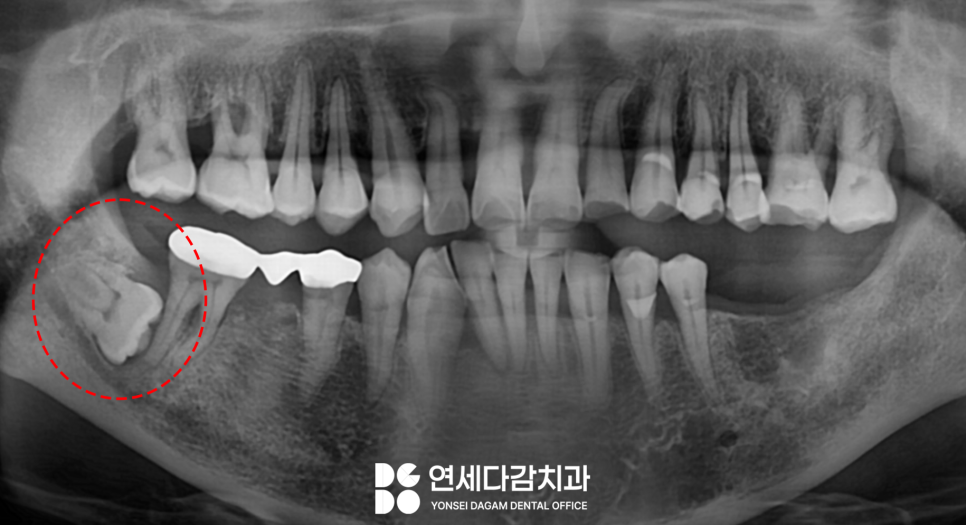
When a wisdom tooth is positioned in such an abnormal
direction,
or
when it has partially erupted,
it becomes a structure where food easily gets stuck.
Moreover, because it is located at the very back,
it is also difficult to brush properly.
As plaque and food debris build up,
the gums may swell and become inflamed,
and an unpleasant odor may develop.
You may think that simply brushing more diligently
will make it better, but
when you chew food while the area is swollen,
it continues to be irritated,
and that irritation causes the gums to swell
more and become painful.
Therefore, to resolve the root cause of the problem,
the tooth needs to be removed.
At the Ogeum Station Dental Clinic,
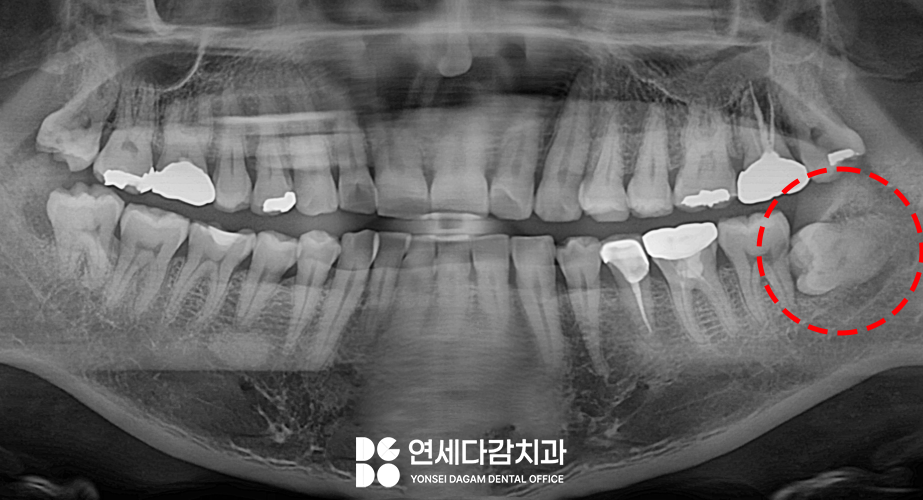
looking at the area marked on the panoramic image,
it was a horizontally impacted tooth.
Before extraction, an accurate diagnosis is made by taking a CT scan
and analyzing the surrounding structures in 3D.
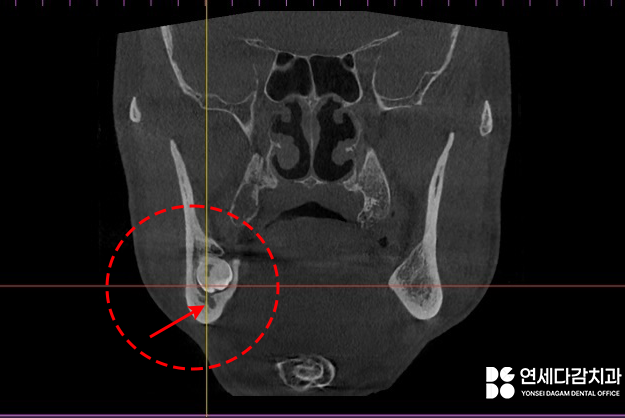
CBCT analysis shows that it is close to the nerve canal.
This structure, which is close to the wisdom tooth,
is the inferior alveolar nerve,
which is responsible for sensation in the lower jaw.
If it is damaged, sensation in the lower jaw may decrease,
abnormal sensations may occur, or there may be permanent loss.
In addition, because there is abundant blood flow in the area,
bleeding after extraction can be severe.
Therefore, as shown in the process at the Ogeum Station Dental Clinic,
we carefully perform extraction after identifying and analyzing
the proximity between the nerve and the tooth root.
However, in this case, there is one more thing
that must be considered.
As bone density becomes stronger with age,
simple extraction becomes more difficult.
The reason is that the lower jaw becomes denser
and loses flexibility.
The younger we are, the softer and more elastic
the bone in our body, especially the jawbone, is,
but as we age, it becomes denser
and less elastic, making it harder.
These changes make the extraction process
more difficult
and lengthen the recovery period.
In fact, when comparing wisdom tooth extractions of the same difficulty
between people in their 20s and those in their 40s and 50s,
the recovery period can differ by 1.5 to 2 times.
For this reason, if possible,
we recommend addressing wisdom tooth problems in your 20s,
when recovery is faster^^.
That way, you will have a less difficult experience.
In cases like the one shown at Yonsei Dagam Dental Clinic,
it is a complex case that is highly likely
to be referred to a university hospital.
For the reasons above,
the risk of complications is high,
so it may need to be removed under general anesthesia.
In situations like this, one alternative to consider is
coronectomy.
This treatment leaves the tooth root
as it is,
and only cuts off the crown portion that causes inflammation.
Considering that it is close to the nerve and that the patient is older,
attempting to remove the root may create risks,
so this method can be a safe alternative.
From the patient’s perspective, leaving part of the tooth behind
instead of removing the whole tooth may not make sense,
so this must be explained thoroughly.
Let me show you what it looks like
when coronectomy is performed at the Ogeum Station Dental Clinic.
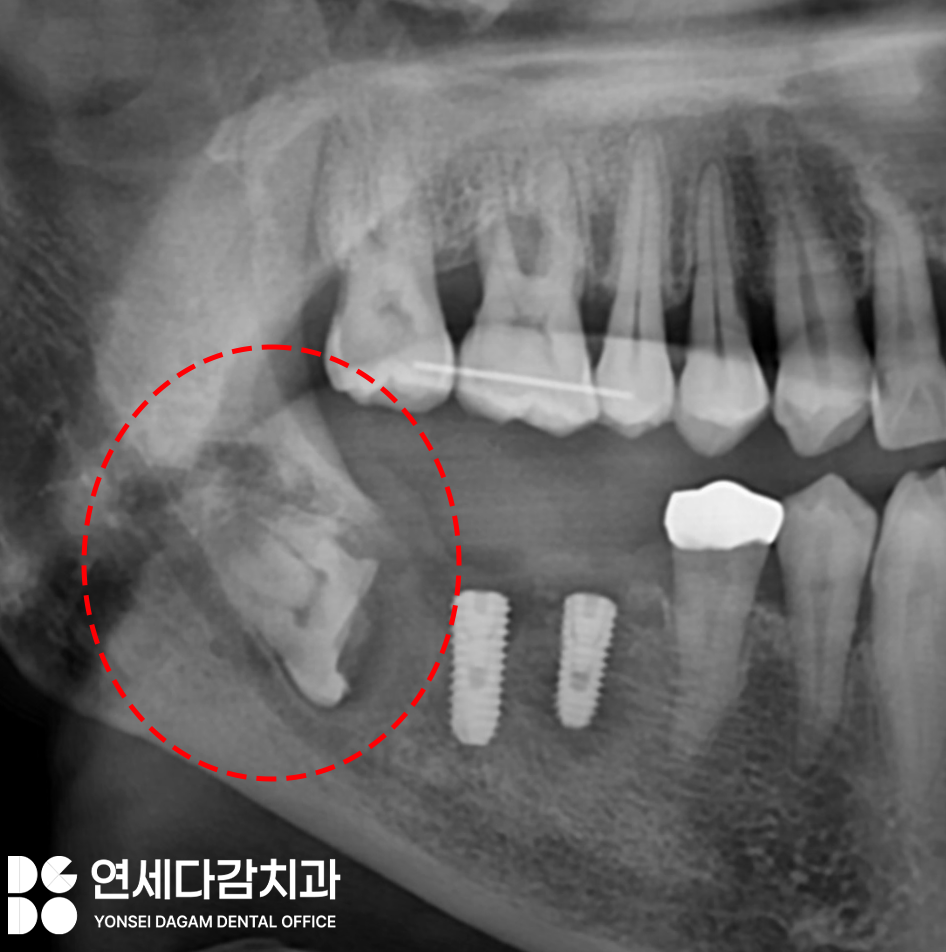
In this way, the crown that causes inflammation is removed,
and the gums are sutured with only the roots left behind.
Through this process, not only is there no need to worry about nerve damage,
but the problem of food trapping is also resolved,
so unpleasant odor and inflammation can also disappear.
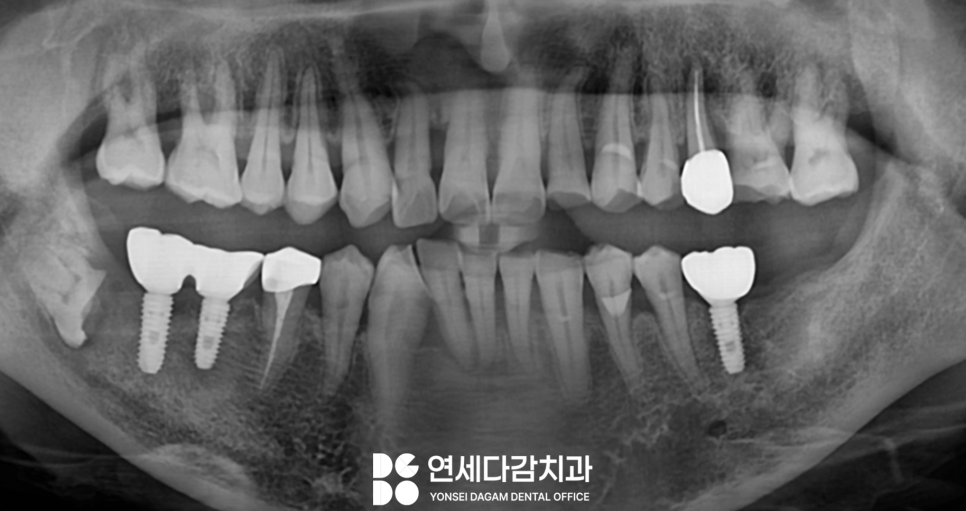
Even while treatment is being completed in another area with an implant,
you can see that a properly treated wisdom tooth
can remain within the alveolar bone without causing problems.
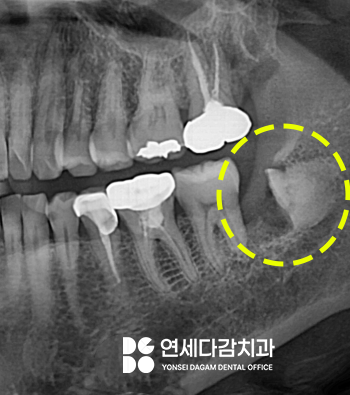
Here is another case.
This case was also in the same situation
as the one shown earlier at the Ogeum Station Dental Clinic.
This area was also horizontally impacted
and partially erupted,
causing gum inflammation and pain.
Under local anesthesia, only this area is incised,
and only the tooth’s head, the crown, is carefully cut away.
Once it is sutured with only the roots left behind
and heals,
it returns to clean, healthy gums.
As the space for bacteria to enter disappears,
the roots are safely left buried in the bone.
Of course, it is best to check periodically through regular examinations.
This way, by matching the overall oral condition and environment,
you can find a safe and appropriate method
and come up with a solution.
If there is a problem, I hope you can receive the treatment that is right for you
through 충분한 상담 with a specialist.
Next time as well, we will help protect your oral health
with useful information.
This has been Yonsei Dagam Dental Clinic near Ogeum Station.
Thank you!.
Treatment period 2022.7.29-2022.8.6
2022.5.3-2022.10.19