Hello.
This is Yonsei Dagam Dental Clinic near Ogeum Station.
Wisdom teeth, also called third molars,
are a source of fear for most people.
As humans evolved,
the size of modern people’s jawbones became smaller,
and there is not enough space for the third molars to grow.
So they do not erupt straight,
and there are many cases where they are tilted, partially erupted, or
impacted.
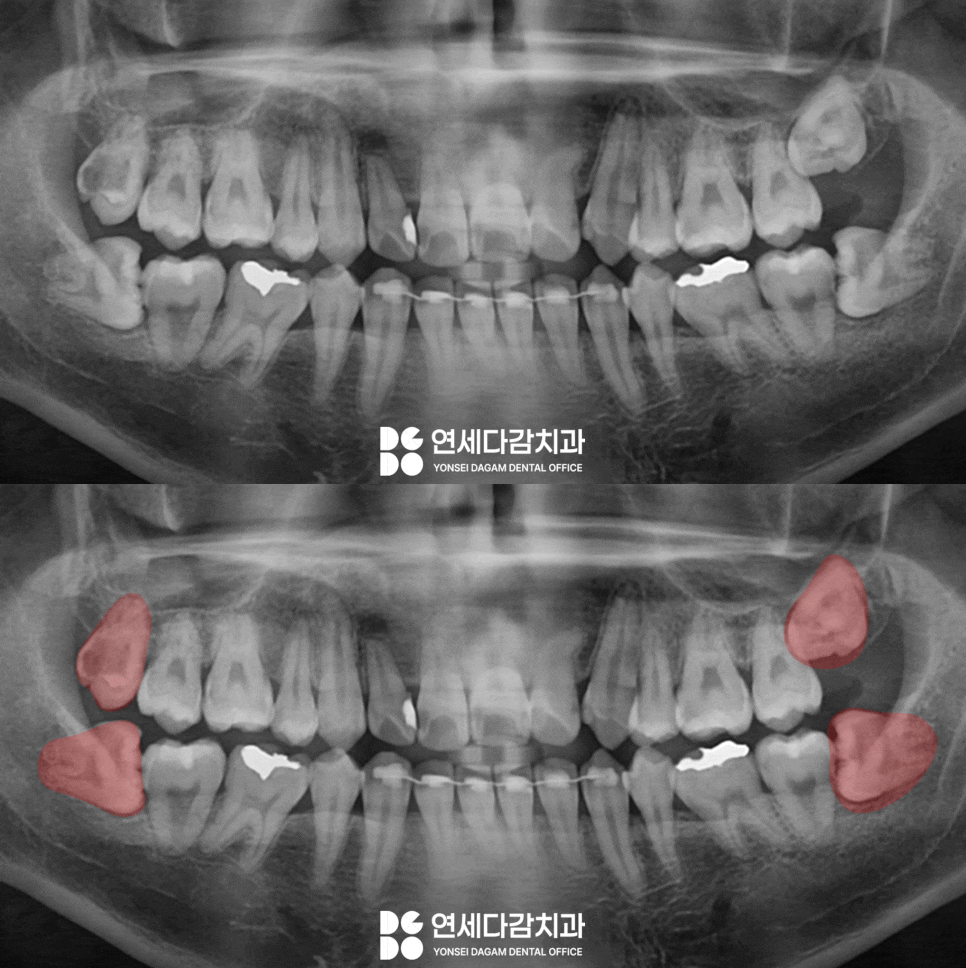
Depending on the person, they may not exist at all,
or some people may have all four, two on the top and two on the bottom.
However, if they exist in an abnormal form,
extraction may have to be recommended.
If we start listing all the reasons,
the list would never end, but
to organize the cases often seen at the Ogeum Station dental clinic,
they are as follows.
✔ When only part of the tooth comes out of the gum
and food gets stuck frequently
✔ When the gums around the tooth swell,
bleed, or become inflamed
✔ When there is no discomfort,
but oral hygiene is not being managed well
✔ When there is tooth decay
✔ When, after being told during an examination that the wisdom tooth remains,
it keeps bothering you and you want to have it removed.
For the reasons above,
there are many cases where the tooth is extracted.
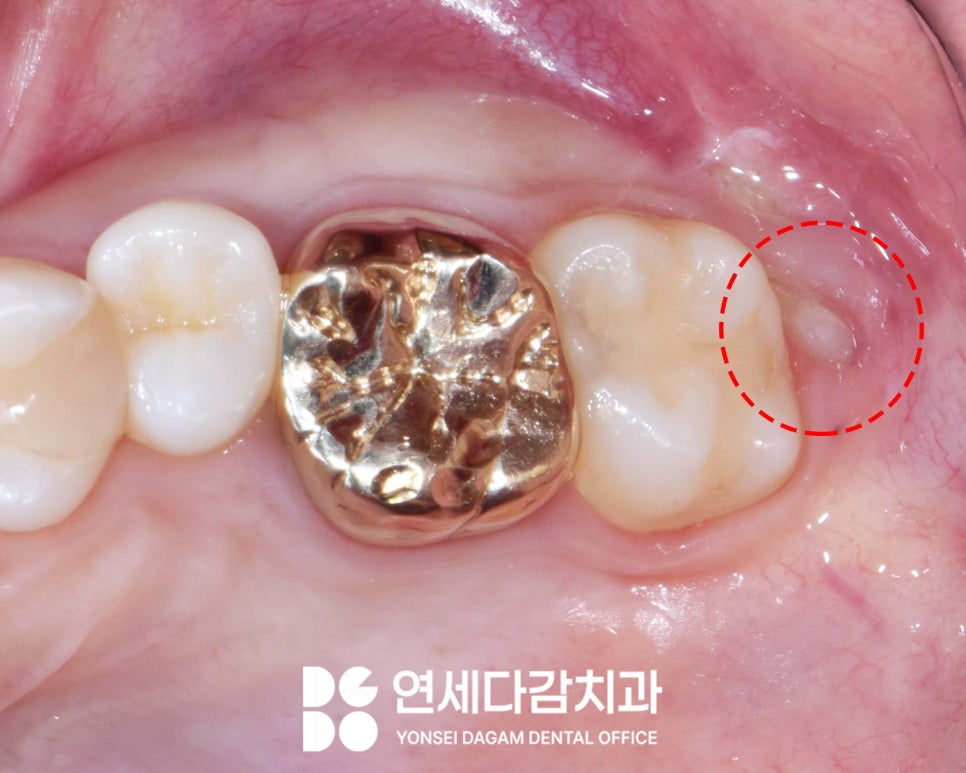
When it is impacted,
it is buried inside the gum, so it is difficult to determine the exact position
with the naked eye.
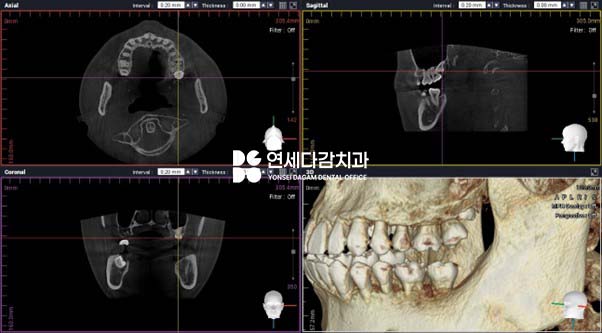
Therefore, CT imaging is essential,
and three-dimensional analysis through it is important.
At the Ogeum Station dental clinic, at this stage,
the exact position and angle of the tooth are identified,
and the relationship with the surrounding structures is examined.
💡
In particular, in the upper jaw,
it may be adjacent to the maxillary sinus,
so it must be examined carefully.
What is the maxillary sinus?
It is an air-filled empty space connected to the nose,
and is surrounded by a thin mucous membrane.
It is located in the cheek area
and is positioned close to the roots of the upper molars.
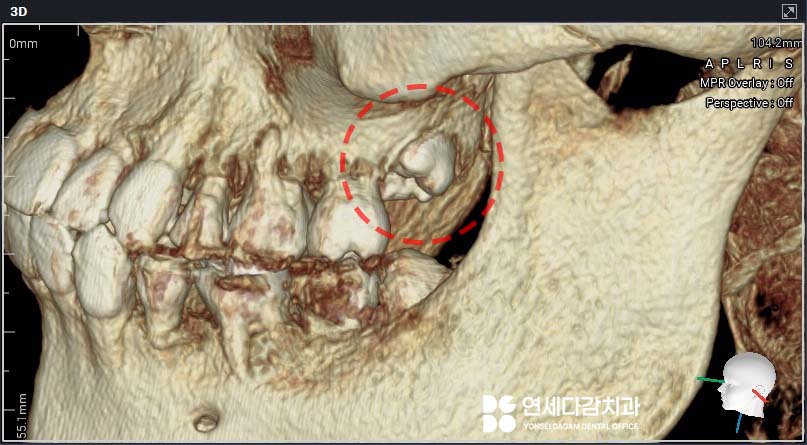
Therefore, during extraction,
the maxillary sinus may be perforated.
What happens then?
At the Ogeum Station dental clinic, we explain that
an abnormal connection is formed between the oral cavity and the maxillary sinus,
and liquid may pass into the nose, or you may feel air leaking.
Also, healing at the extraction site is delayed,
and if infection occurs, maxillary sinusitis may develop.
If perforation occurs during extraction,
a collagen hemostatic agent may be inserted to perform closure.
This hemostatic agent promotes blood clotting and
blocks the perforated area,
helping natural healing.
However, to avoid perforation as much as possible,
careful access is necessary.
In impacted cases, at the Ogeum Station dental clinic,
after making an incision in the gum,
the procedure is usually carried out in two ways.
- If necessary, removing bone first
and extracting the tooth whole.
- Splitting the tooth into pieces and removing it.
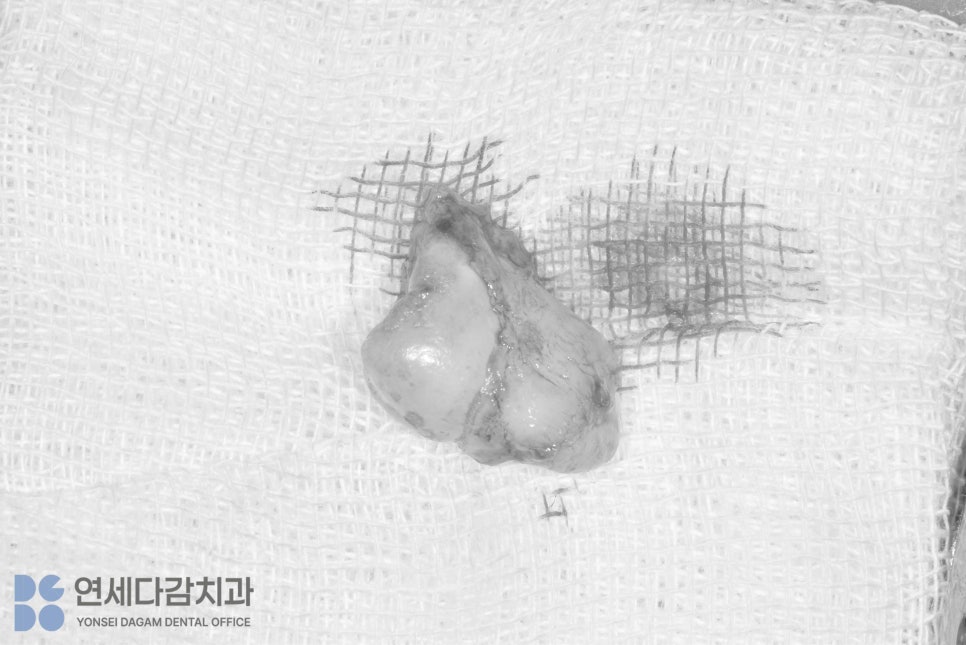
The tooth was successfully removed
using the first method.
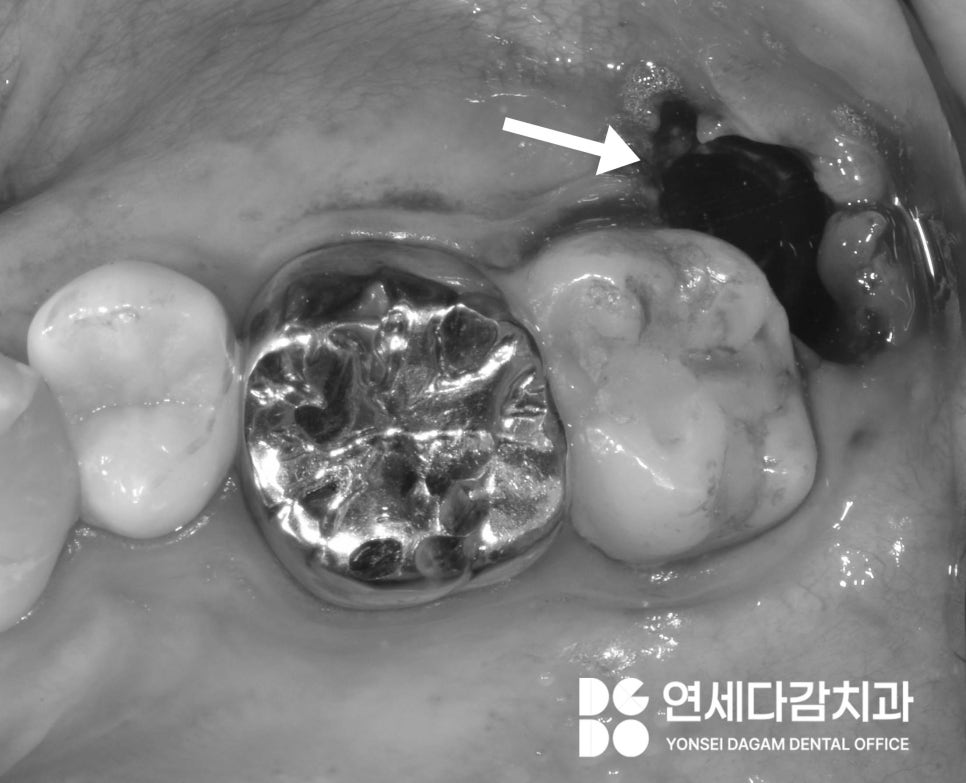
After the tooth is extracted, the area is
stitched closed with sutures to finish.
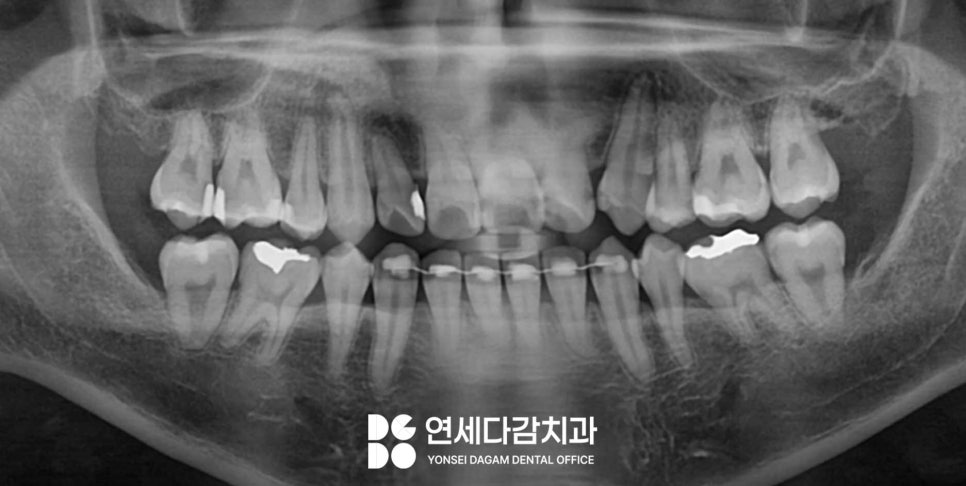
The remaining wisdom teeth were also treated using the same
method,
and in the case of those located in the lower jaw,
the splitting method was used.
After that, it is usually finished by removing the stitches
a week later.
However, during the healing period, it is important to strictly follow the precautions.
Please be sure to refer to the explanations from
the Ogeum Station dental clinic.
✔ On the day of extraction, apply pressure with gauze for more than 2 hours
to stop the bleeding.
At this time, even if blood and saliva make you feel nauseous,
do not spit them out; swallow them,
and do not use a straw.
Spitting and drinking through a straw can create negative pressure in the oral cavity,
which may interfere with hemostasis.
✔ In particular, after upper wisdom tooth extraction,
it is safer not to blow your nose forcefully.
✔ To reduce swelling, apply a cold compress for two days,
and if the swelling does not go down even after a week,
apply a warm compress and
get checked again.
✔ You should eat after the anesthesia wears off.
If you eat while still anesthetized,
you may bite your cheek or tongue without feeling it and cause an injury.
✔ No drinking and no smoking are essential.
✔ For about a week, brush your teeth while avoiding the treatment area.
Let’s also manage it by gargling so that food does not get stuck.
The upper jaw generally heals relatively faster than the lower jaw,
and discomfort after surgery is also less.
Therefore, if there is a problem,
please do not delay,
and I hope you can receive treatment at the appropriate time.
This has been Ogeum Station dental clinic.
Thank you.
2025.05.08~2025.05.15