Hello.
This is Yonsei Dagam Dental Clinic at Songpa Station.
When a front tooth has a partial fracture or an interproximal cavity develops,
many people usually think that crown treatment is needed,
but just because there is a problem with a front tooth
it does not mean that a crown is always necessary.
When something like this happens,
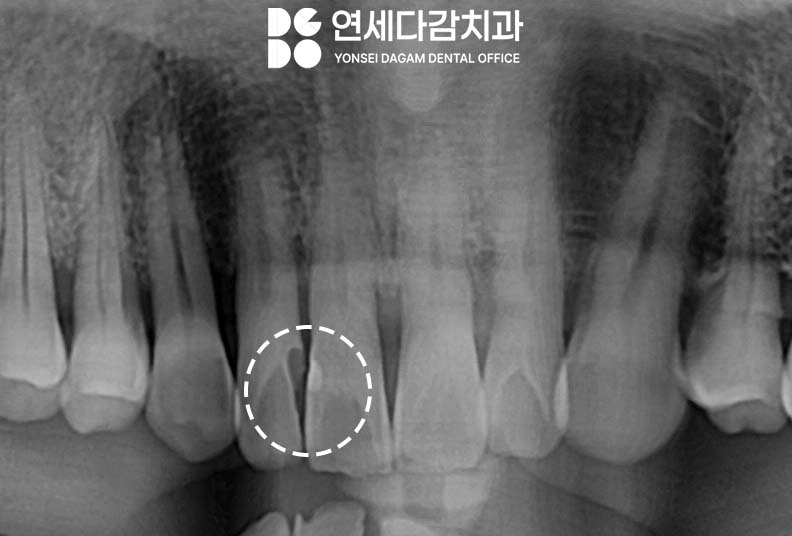
we perform a detailed examination through X-rays.
2025.11.24
We check the extent of damage, whether the nerve has been affected,
and whether there is a lesion at the tip of the tooth root.
If the patient does not feel any discomfort,
we determine that composite resin treatment alone is sufficient.
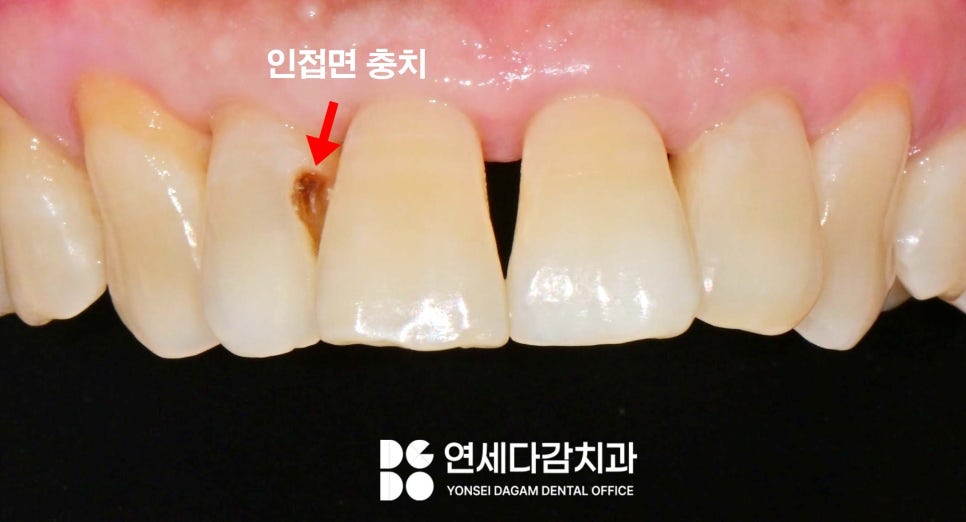
2025.11.24
The cavity is not shallow,
but if enough tooth structure remains
and the root is healthy,
there is no need to cover the entire tooth.
The importance of conservative treatment
Crown treatment reshapes the entire tooth,
so a large amount of healthy tooth structure is removed.
In contrast, composite resin treatment shaves only the minimum necessary area,
then fills the material to restore the tooth’s shape.
This treatment preserves the original tooth structure as much as possible,
and restores only the necessary area without overtreatment.
Although treatment techniques have advanced,
there is nothing that can completely replace a natural tooth,
so it is true that the more natural teeth can be preserved,
the better^^.
Composite resin features
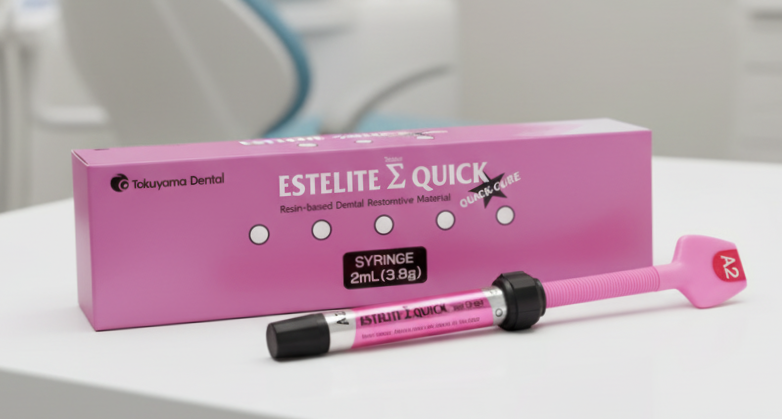
To begin with, regarding the composite resin used at the Songpa Station dental clinic,
treatment composite resin is a plastic-based tooth-colored restorative material.
It comes in various shades, so it can be selected to match the patient’s
natural tooth color, allowing for an aesthetic result.
Resin is applied after lightly etching the tooth surface and then applying a bonding agent,
and because it is bonded to the tooth after this series of pretreatment steps,
its adhesion is quite strong.
Just as glue sticks better to a rough surface,
resin also bonds firmly to the pretreated tooth surface.
One major advantage of resin is that it can restore the shape of a tooth
with only minimal tooth reduction.
It can be treated on the same day, so it is less burdensome,
and compared with crowns, the cost is also more reasonable.
If problems arise later, correction or repair is also relatively easy.
However, resin also has limitations.
Its strength is weaker than ceramic or metal,
so it can break easily in molars that experience heavy impact.
Therefore, resin is mainly used for front tooth treatment.
Because discoloration can occur at the margins of the restoration,
if regular polishing and maintenance are properly performed,
it can last a long time.
At the Songpa Station dental clinic, we consider these characteristics
and select the appropriate material according to the tooth area and the extent of damage.
2025.11.24
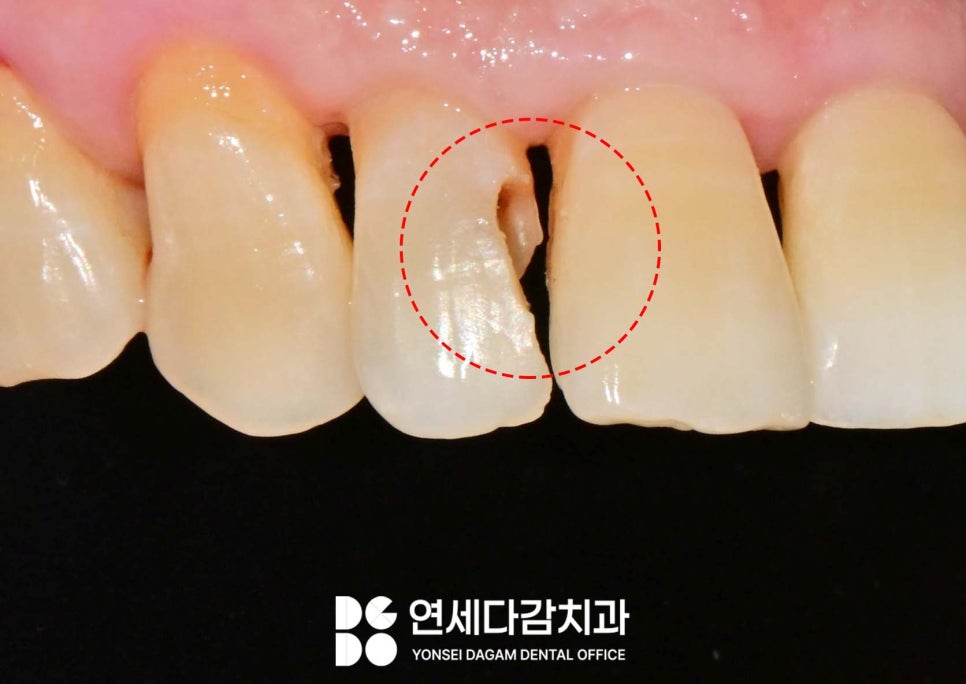
Cavities that occur between teeth like this are called interproximal decay,
and in the case of front teeth,
because they are thinner than other teeth,
as the cavity deepens,
it can pass through the tooth from front to back
and extend to the buccal and lingual surfaces.
Buccal means the cheek side, and lingual means the tongue side,
and if the decay spreads this widely,
the choice of resin material must be made carefully.
A typical resin has a property that allows light to pass through
for a more natural appearance.
Natural teeth also have some translucency, so when light shines on them,
a subtle color appears,
and resin reproduces this characteristic as well.
However, when the buccal and lingual surfaces of a tooth are connected and damaged,
this translucency can become a problem.
The inside of the mouth is dark and the outside is bright,
so if it is treated with regular resin,
the resin area may not match the color of the tooth and may appear dark.
The material used in this case is opaque resin.
Opaque resin
Opaque means not transparent.
It is a resin with lower translucency than regular resin and a property that blocks light.
Compared with a typical material with low opacity and high transmission,
it lets less light pass through,
so the dark shadow inside does not show through,
which can create a more aesthetic result.
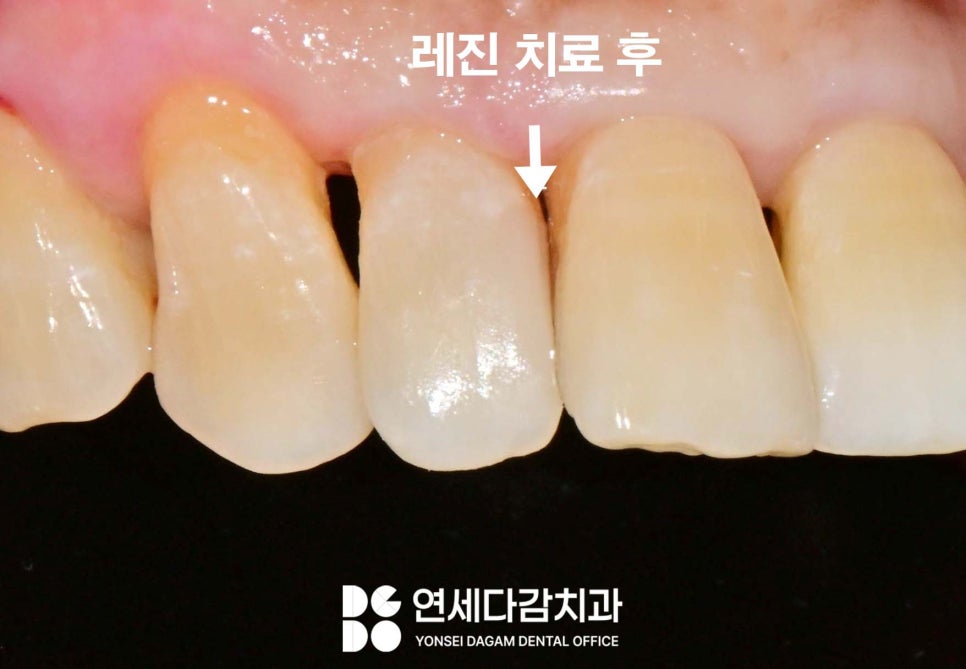
Therefore, at the Songpa Station dental clinic, as shown above,
when there is damage that passes through the buccal and lingual surfaces,
we do not use regular resin with high translucency,
but first fill the area with opaque resin,
which is less transparent and prevents the darkness behind from showing through,
then layer regular resin on the outer surface
to create a more natural color and shape.
2025.11.24
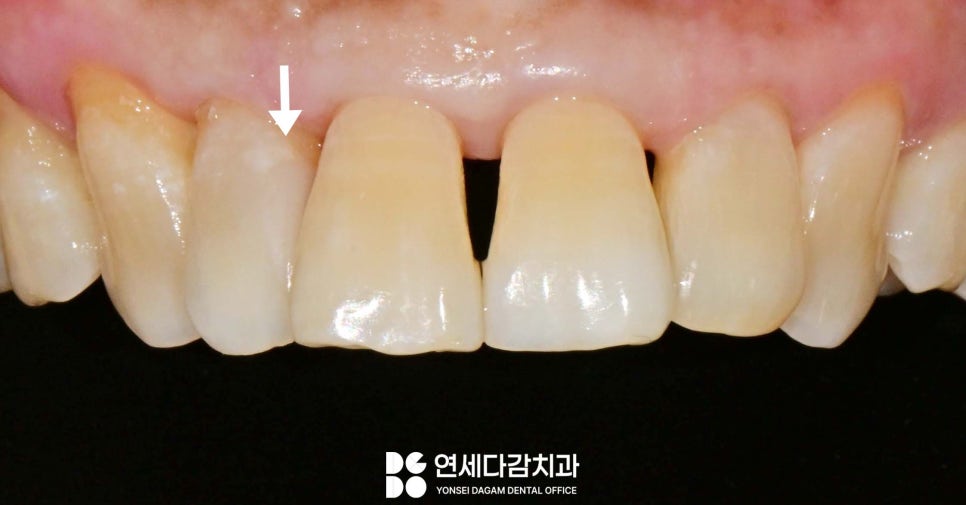
After removing the cavity or damaged area and cleaning up the tooth surface,
after etching and adhesion for filling,
the resin treatment has been completed.
2025.11.24
After resin treatment, it is better to avoid foods that stain easily,
such as coffee, wine, and curry,
and you should be careful with habits like biting hard foods with the front teeth
or biting your nails, as these can cause the resin to break.
Brush carefully with a soft toothbrush,
and keep the spaces between teeth clean using interdental brushes.
By visiting every 6 months,
checking the condition of the resin, and getting repolishing if needed,
it can last longer.
As in today’s Songpa Station dental clinic post,
when resin treatment is performed,
it is important to make a treatment plan that can lead to better results
by carefully examining the oral condition and considering the characteristics of the material.
The basic principle of treatment is to preserve natural teeth as much as possible.
Therefore, if possible, it is better to choose a conservative treatment method,
and since even a wide area of damage can be treated aesthetically
by using special materials such as opaque resin,
I hope you can consult sufficiently with a specialist
and receive the treatment that you need.
This has been Yonsei Dagam Dental Clinic at Songpa Station.
Thank you.
Treatment period 2025.11.24