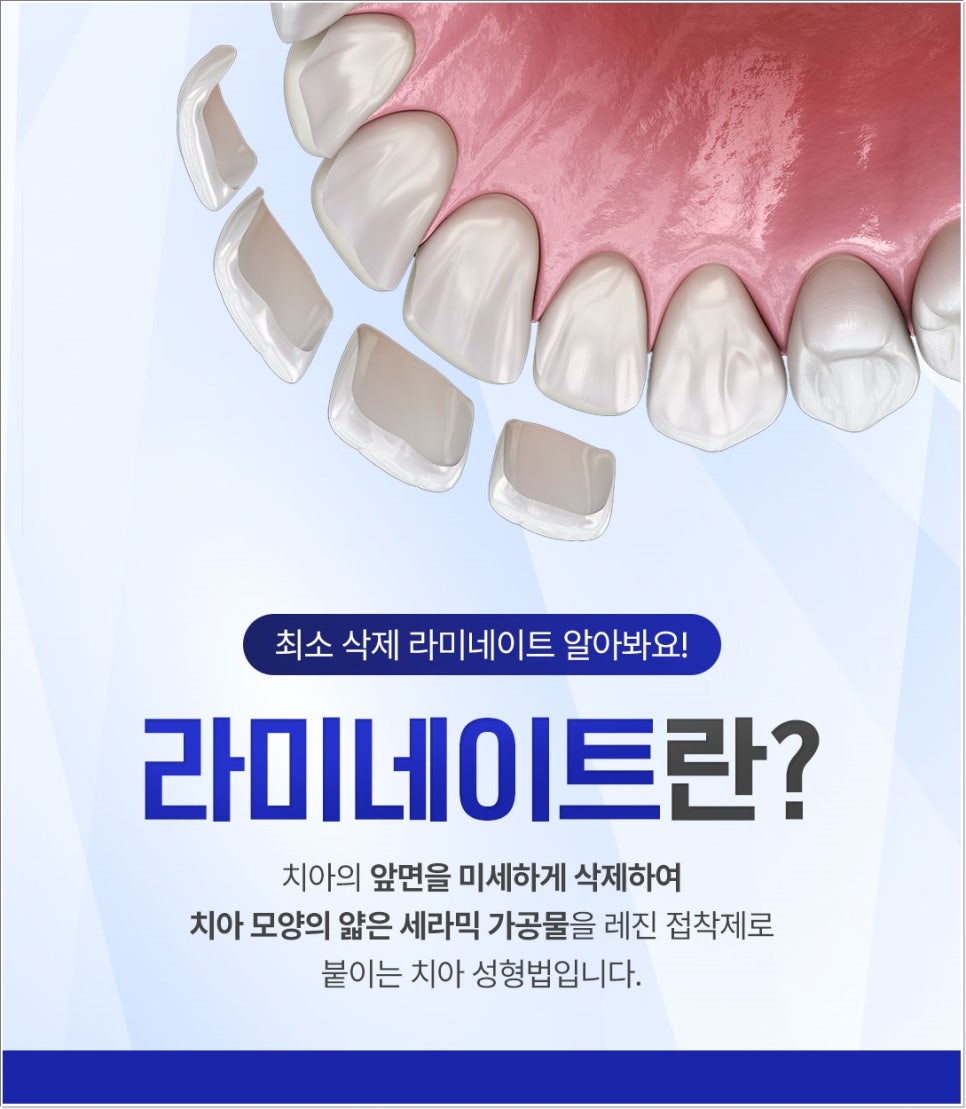
Gwanghwamun Dental Clinic laminate treatment is an aesthetic dental procedure that improves the color, shape, and alignment of teeth by attaching a thin prosthetic made of ceramic or composite resin to the outer surface of the teeth. It is mainly applied to the front teeth, and unlike crowns that cover the entire tooth, it is characterized by treating only the front surface of the tooth. Because the amount of tooth reduction is relatively small, it is classified as a treatment that considers preserving natural teeth, but the scope of application and results may vary depending on the condition of the teeth. The basic principle of laminate treatment is to improve the appearance by trimming the surface of teeth that are discolored or irregular in shape and then bonding a custom-made thin prosthetic.
7 Basic Facts You Must Know Before Laminate Treatment










Previous image
Next image
When considering laminate treatment at Gwanghwamun Dental Clinic, it is important to understand the overall characteristics of the procedure rather than expecting only an improvement in appearance. First, it is not a treatment that can be applied to every tooth. Second, you should be aware that it is not a treatment that involves no tooth reduction at all. Third, if you have cavities or gum disease, prior treatment is necessary. Fourth, if the teeth are severely misaligned, orthodontic treatment may be more appropriate. Fifth, if you have strong chewing habits or grind your teeth, the risk of fracture may increase. Sixth, laminate treatment causes permanent changes to the teeth, so careful judgment is required. Lastly, you should also consider that the maintenance period can vary greatly depending on post-treatment care.
Dental laminate is not always the best choice










Previous image
Next image
Gwanghwamun Dental Clinic laminate treatment is a procedure with clear aesthetic improvement effects, but it is not the best choice in every case. For example, it is often not suitable for teeth with significant structural damage or for molars that are subjected to strong chewing forces. Also, if you choose it only because it can improve appearance in a short period of time, you may end up with disappointing results in terms of long-term dental health. In particular, since tooth reduction is involved, both tooth preservation and functional aspects should be considered before treatment. Recently, minimally reduced laminate methods that are nearly equivalent to no-prep have been carried out, but even so, it is not a procedure that completely avoids tooth reduction, so it is important to decide whether to proceed only after 충분한 consultation with the Gwanghwamun Dental Clinic medical staff before treatment.
Cases where laminate treatment is suitable and cases where it is not










Previous image
Next image
Gwanghwamun Dental Clinic laminate treatment is considered relatively suitable for cases such as discoloration that is not easily improved by tooth whitening, small gaps between front teeth, minor shape irregularities, and slight fractures or wear. On the other hand, there are limitations when the extent of cavities is large, gum conditions are unstable, or tooth alignment issues are structural. Also, if laminate treatment is carried out forcefully when there is a bite problem, the risk of damage or detachment may increase. Therefore, whether the procedure is possible should be determined by comprehensively considering not just the appearance but also the function of the teeth, gum health, and bite condition. If there is a part that needs treatment first rather than simply changing the outer appearance of the teeth, the Gwanghwamun Dental Clinic medical staff will naturally recommend that treatment be performed first.
A summary of tooth problems that can be improved with laminate










Previous image
Next image
Representative problems that can be improved through Gwanghwamun Dental Clinic laminate treatment include tooth discoloration, surface imbalance, small gaps, and imbalance in tooth length and width. In particular, laminate may be an option for stains that do not respond well to whitening treatment or front teeth that are naturally uneven in shape. However, since it is not a treatment that solves internal structural or functional problems of the teeth, it is necessary to understand the scope of aesthetic improvement accurately. In other words, laminate is a treatment focused on improving the “visible” part.
Care after laminate treatment and long-term considerations
After Gwanghwamun Dental Clinic laminate treatment, care similar to that for regular teeth is needed, but there are a few precautions. It is best to avoid the habit of biting hard foods with the front teeth, and if you grind or clench your teeth, a protective appliance may help. Also, while laminate is relatively resistant to discoloration, regular oral checkups are necessary because management of the bonded area is important. Above all, since laminate is a treatment that is difficult to reverse once chosen, it is important to make a decision that considers not only short-term changes in appearance but also long-term dental health.